Tungsten Grinder vs Bench Grinder: Which One Should You Buy?
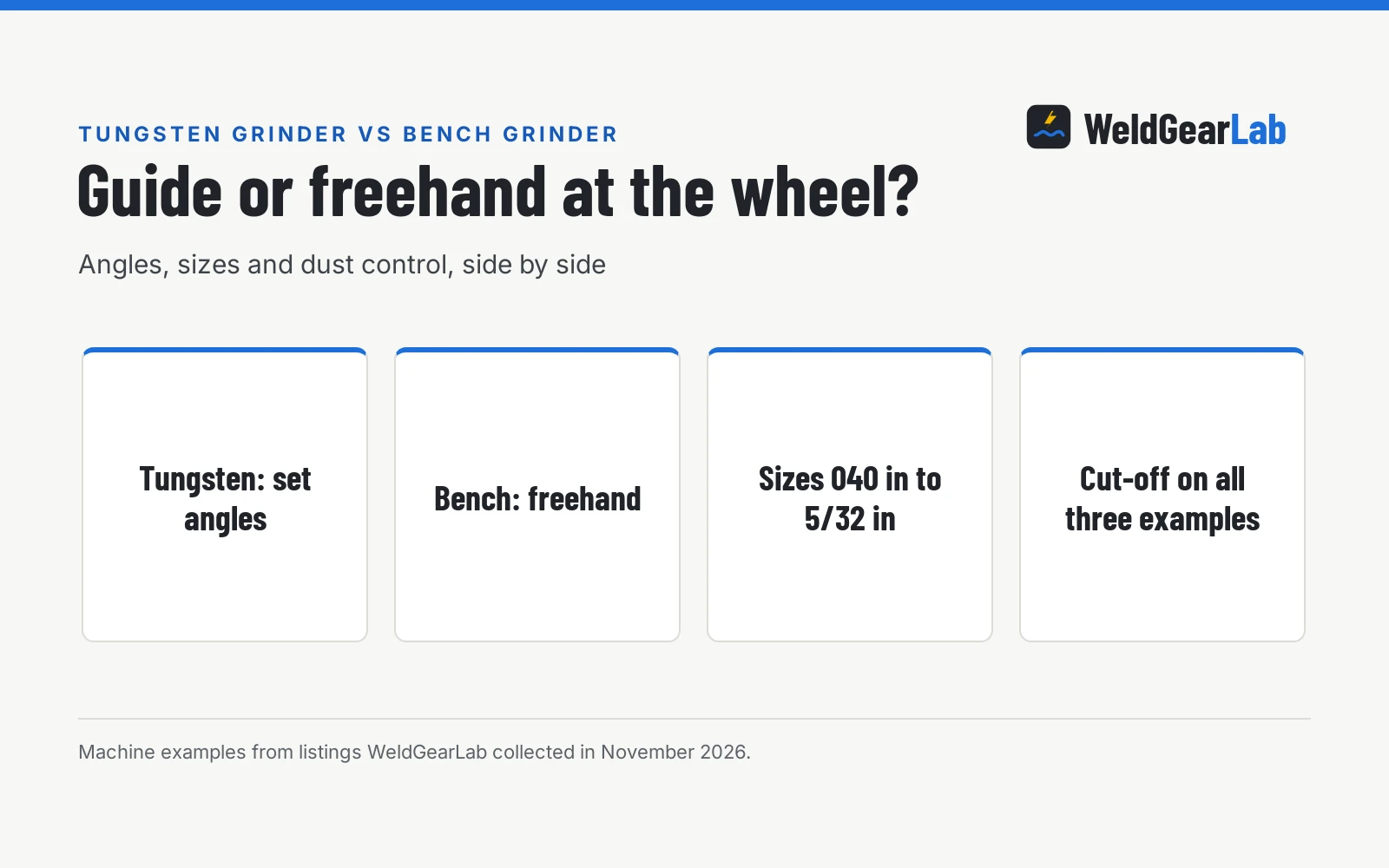
A tungsten grinder sets the taper with a guide and a bench grinder shapes it freehand, and this guide compares angles, sizes, dust control and three tungsten sharpening examples.

On this page
Top picks at a glance
As an Amazon Associate I earn from qualifying purchases.
- 1
 HTC Adjustable Bench Grinder Stand Pedestal9.8/10View on Amazon
- 2
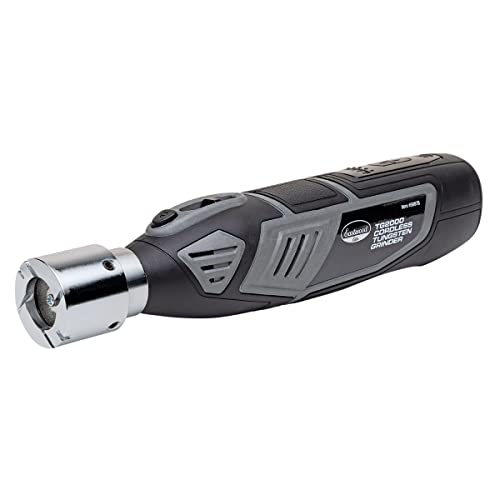 Eastwood Elite TG2000 Cordless TIG Welder Tungsten GrinderView on Amazon
- 3
 DEWALT DW758 8-Inch Bench GrinderView on Amazon
- 4
 WEN BG4276 2.1-Amp 6-Inch Single Speed Bench Grinder withView on Amazon
- 5
 WEN BG4260 2.1-Amp 6-Inch Single Speed Bench GrinderView on Amazon
- 6
 WEN BG4282 4.8-Amp 8-Inch Single Speed Bench Grinder with LEDView on Amazon
- 7
 WEN BG4286 3-Amp 8-Inch Slow Speed Bench GrinderView on Amazon
A TIG tungsten with a blunt or contaminated tip starts poorly and wanders, so the tip needs a clean, even taper before welding. That is the choice behind tungsten grinder vs bench grinder: a tungsten grinder shapes the electrode to a set angle with holes or an adjustable taper, while a bench grinder shapes it freehand at a wheel. A tungsten grinder fits repeatable set angles; a bench grinder fits a shop that already owns one and grinds many tools.
Other welders and gear to compare
 Eastwood Elite TG2000 Cordless TIG Welder Tungsten GrinderCheck price on Amazon
 DEWALT DW758 8-Inch Bench GrinderCheck price on Amazon
 WEN BG4276 2.1-Amp 6-Inch Single Speed Bench Grinder withCheck price on Amazon
 WEN BG4260 2.1-Amp 6-Inch Single Speed Bench GrinderCheck price on Amazon
 WEN BG4282 4.8-Amp 8-Inch Single Speed Bench Grinder with LEDCheck price on Amazon
 WEN BG4286 3-Amp 8-Inch Slow Speed Bench GrinderCheck price on Amazon
This guide links to our product roundups, where WeldGearLab gets a commission on purchases made through links on this page, and your price stays the same. Read our affiliate disclosure.
The difference in one paragraph
A tungsten grinder sets the electrode angle with holes or an adjustable taper against a diamond wheel, so tips repeat the set taper more consistently. A bench grinder leaves the angle to the hand holding the electrode, so the taper depends on the hand, not the tool. That difference decides repeatability: a guide repeats the set angle more consistently, while freehand grinding gives a close angle that varies from tip to tip.
Tungsten grinder vs bench grinder side by side
| Tungsten grinder | Bench grinder | Takeaway | |
|---|---|---|---|
| What it grinds | Tungsten electrodes | Many shop tools, including tungsten | Dedicated or general |
| Angle control | Holes or an adjustable taper guide | Hand and eye at the wheel | Guide or hand |
| Power | Cordless handheld, rotary tool head, or cordless motor on the examples | Bench machine | Portable or fixed |
| Wheel | Diamond wheel on the examples | General grinding wheel | Diamond or general |
| Dust control | Dust cover or enclosed wheel on the examples | Guarded wheel | Covered or guarded |
| Portability | Handheld, for shop or field | Bench-mounted | Carry or bench-mounted |
| Tungsten sizes | 040 in to 5/32 in across the examples | Not limited to guide holes | Set sizes or any size |
| Cut-off | Cut-off slot or option on all three examples | By hand at the wheel | Slot or by hand |
Bench grinder figures are general practice, since no bench grinder listing is among the examples reviewed here; tungsten figures come from the three listings below.
When a tungsten grinder is the better choice
- Repeatable angles. Fixed holes or an adjustable taper repeat the set angle more consistently.
- Several electrode sizes. The examples cover 040 in to 5/32 in across sizes, with holes or an adjustable taper for common diameters.
- Work away from the bench. Cordless handheld models grind in the shop or in the field.
- Cut-off and tip flats. Cut-off slots or options and a tip flat option shape and trim the electrode.
When a bench grinder is the better choice
- One machine for many tools. A bench grinder also grinds chisels, drill bits and other shop tools.
- No new purchase. A shop that already owns a bench grinder needs no dedicated tungsten tool.
- No hole sizes to match. Freehand grinding is not limited to the hole sizes of a guide.
- No guide to fit. Nothing to fit to a rotary tool and no holes to match to a diameter.
The gear: three tungsten sharpening examples
Ranked by what each listing gives for angle control, sizes and completeness, the three examples run from a complete cordless handheld to a head that needs a rotary tool. The YESWELDER handheld covers 4 sizes and 6 angles with a cordless design, an LED display, speed control across 0-32 settings from 8000 to 35000 RPM, and a battery for up to 4.5 hours of continuous use. Its double-sided diamond wheel and dust cover round out a complete kit, and the box holds the grinder, a storage box, a hexagon screwdriver, an acrylic dust cover and a USB-C cable.
The Sharpie DXCL is a handheld cordless sharpener with an adjustable 15 degree to 45 degree diamond ground taper, an M12 cordless motor, and electrode sizes from .040 in to 1/8 in. Its enclosed grinding wheel avoids the grab risk the listing names for open side grinders, and a tip flat option removes sharp points while a cut-off and scoring option trims the electrode. Machined parts are made in the USA, per the listing.
The SONNLER head is the odd one out: it is only a grinding head, with no electric grinder, and it fits most rotary tools, per the listing. It supports 6 sizes and 8 angled holes, with tip angles from 15 degrees to 60 degrees, and the box holds 10 double-sided grind wheels and 3 CNC mandrels. Its holes are fixed with an offset compensation for each size, so the tip centers stay on the grinding center point, and the listing recommends a mask and other protective gear unless grinding in a full-sealed space.
Choosing angles and sizes
Match the holes or the taper range to the electrodes you weld with. The YESWELDER covers 1/16 in, 5/64 in, 3/32 in and 1/8 in at 6 angles from 15 degrees to 50 degrees. The Sharpie DXCL covers .040 in, 1/16 in, 3/32 in and 1/8 in with an adjustable taper from 15 degrees to 45 degrees. The SONNLER head covers 6 sizes with 8 angled holes and tip angles from 15 degrees to 60 degrees, so check its size list against your electrodes before buying, since the head alone does no grinding without a rotary tool.
Tungsten dust and enclosed wheels. Grinding tungsten makes dust, so use the dust cover where the listing gives one, and follow the SONNLER listing’s mask recommendation unless grinding in a full-sealed space. Per the Sharpie listing, an enclosed wheel eliminates the safety issues common with side or wheel grinders, which can grab the electrode and shoot it back at the operator.
FAQ for welders
Can I sharpen tungsten on a bench grinder?
Yes, freehand at the wheel, but the angle depends on the hand, not a guide. A tungsten grinder with fixed holes or an adjustable taper repeats the set angle more consistently.
What angles do the examples cover?
The YESWELDER covers 6 angles from 15 degrees to 50 degrees, the Sharpie DXCL adjusts from 15 degrees to 45 degrees, and the SONNLER head gives tip angles from 15 degrees to 60 degrees.
Does the SONNLER head work on its own?
No. The listing states it is only a grinding head with no electric grinder, so it needs a rotary tool. The box holds the head, 10 double-sided grind wheels and 3 CNC mandrels.
Can a tungsten grinder cut off an electrode?
The examples give cut-off options: the YESWELDER has a cut-off slot, the SONNLER head has a cut-off slot, and the Sharpie DXCL has a cut-off and scoring option.
How long does the YESWELDER battery last?
Up to 4.5 hours of continuous use on a full charge, per the listing. The box includes a USB-C cable.
Related: how to sharpen tungsten for TIG welding, best tungsten electrode for beginners, best tungsten electrode for steel, best tungsten electrode for aluminum, and the TIG welders hub.