Dead Blow Hammer vs Rubber Mallet: Which One Should You Buy?
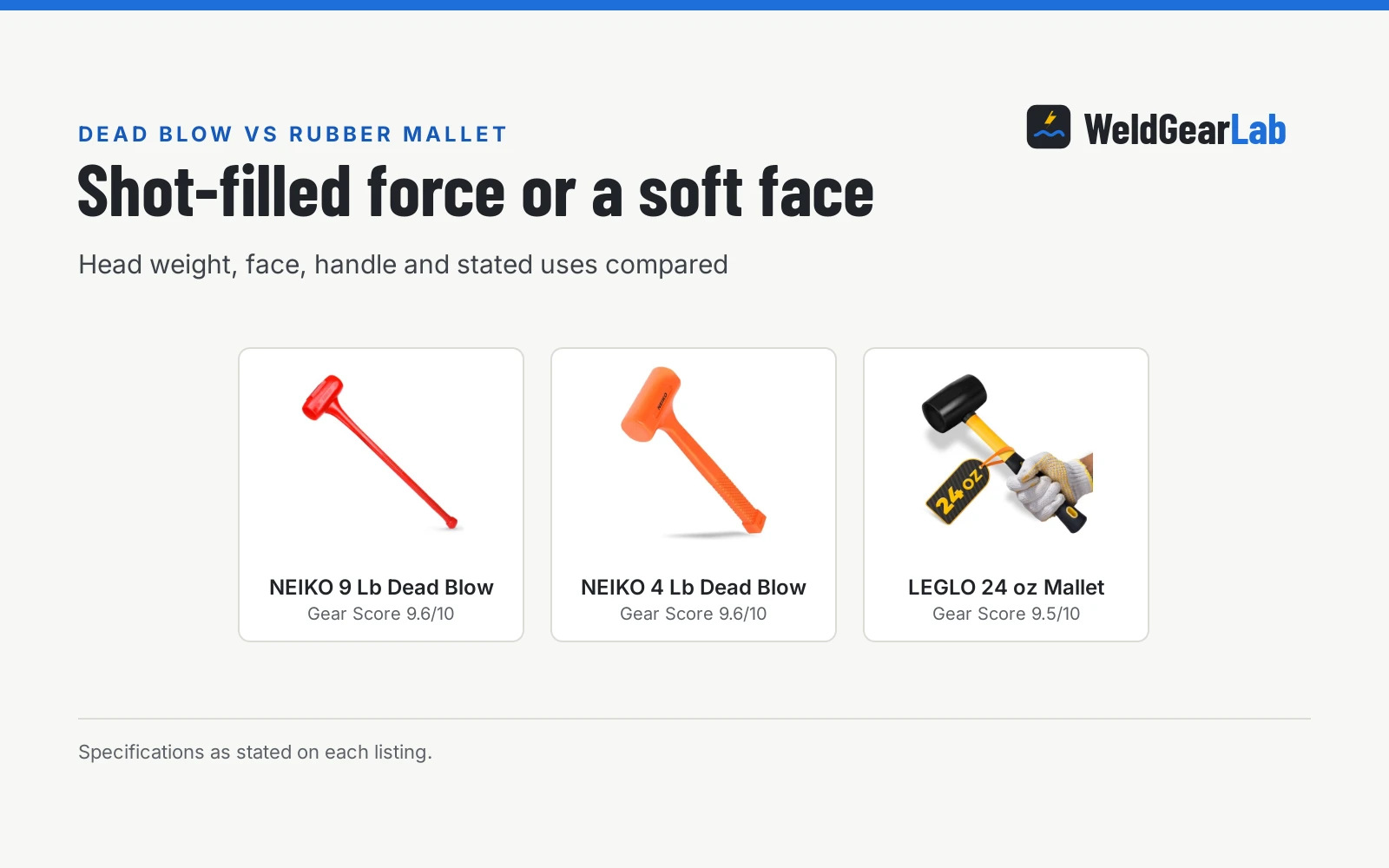
Dead blow hammers and rubber mallets compared on head weight, face, handle and stated uses, using the NEIKO and LEGLO listings as examples.

On this page
Top picks at a glance
As an Amazon Associate I earn from qualifying purchases.
- 1
 NEIKO 02884B 9 Lb Dead Blow Hammer, 30” Long, Red9.6/10View on Amazon
- 2
 NEIKO 02849A 4 Lb Dead Blow Hammer, Neon Orange9.6/10View on Amazon
- 3
 24 oz (1.5 lb) Rubber Mallet Hammer9.5/10View on Amazon
Verdict. Pick a dead blow hammer for the auto body work, automotive work, woodworking and sheet metal forming the NEIKO listings name, and pick a rubber mallet for pavers, tiles and planks where the face must not damage the work. The LEGLO listing names pavers, flooring, tile, tent stakes and woodworking uses.
A panel that needs persuading back into shape and a row of pavers that need seating can land in the same weekend, and each job wants a different hammer face. The dead blow hammer vs rubber mallet choice is between a shot-filled head that lands without rebound and a soft rubber face that lands without damage.
WeldGearLab gets a commission on purchases made through links on this page, and your price stays the same. Read our affiliate disclosure.
The machines
NEIKO 02884B 9 Lb Dead Blow Hammer, 30” Long, Red
A 9 pound dead blow hammer, 30 inches long, with a 3 inch head, a one piece steel core and a textured non-slip handle.
Pros
- Steel shot filled head adds extra force to hammer blows and eliminates rebound and spark
- Unicast poly molded body prevents wear between the head and handle
- One piece steel core for a solid striking build
- Solid red color makes it easy to locate among other hammers
Cons
- No warranty term is stated
- 9 pound head is heavy for light tapping work
- 30 inch length needs more swing room than a shorter hammer
- No hanging hole is stated for pegboard or hook storage
NEIKO 02849A 4 Lb Dead Blow Hammer, Neon Orange
A 4 pound dead blow hammer, 14-1/2 inches long, with a checkered grip, a neon orange poly molded body and a steel shot filled head.
Pros
- Steel shot filled head adds extra force to hammer blows and eliminates rebound and spark
- Unicast poly molded body prevents wear between the head and handle
- Diamond textured non-slip handle grip keeps the hammer in hand after impact
- Neon orange color makes it easy to locate among other hammers
Cons
- No warranty term is stated
- No steel core is stated, where the 9 pound example lists a one piece steel core
24 oz (1.5 lb) Rubber Mallet Hammer
A 24 oz (1.5 lb) rubber mallet, 13 inches long, with a 4.5 x 2.5 inch solid black rubber head and a steel core handle with a non-slip grip.
Pros
- Solid black rubber head drives pavers, tiles and planks without dents or chips
- Steel core inside the textured non-slip rubber grip gives a balanced swing and damps vibration
- Hanging hole lets the mallet store on a pegboard or a hook
- Weight stated as 24 oz (1.5 lb, 680 g)
Cons
- No warranty term is stated
- Not for splitting wood, striking steel wedges or prying, which can loosen the head
- Pale or glossy finishes may pick up light rubber scuffs unless tapped through a scrap block or cloth
Other welders and gear to compare
 TEKTON 21 oz. Dead Blow HammerCheck price on Amazon
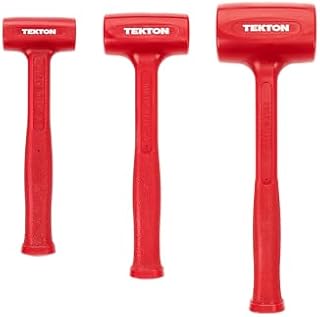 TEKTON Dead Blow Hammer SetCheck price on Amazon
 SK 28oz Dead Blow HammerCheck price on Amazon
 ABN 10 lb Rubber MalletCheck price on Amazon
 CRAFTSMAN 28 Oz Dead Blow HammerCheck price on Amazon
 BLACK CANYON 2 LB Dead Blow HammerCheck price on Amazon
Side by side
| NEIKO 9 Lb Dead Blow | NEIKO 4 Lb Dead Blow | LEGLO 24 oz Mallet | |
|---|---|---|---|
| Side | Dead blow hammer | Dead blow hammer | Rubber mallet |
| Head weight | 9 pounds | 4 pounds | 24 oz (1.5 lb) |
| Overall length | 30 inches | 14-1/2 inches | 13 inches |
| Head | 3 x 3 inches | 2-3/2 x 5-1/8 inches | 4.5 x 2.5 inches |
| Handle | Edged textured grip, one piece steel core | Diamond textured grip | Steel core, non-slip rubber grip |
| Face | Poly molded, steel shot filled | Poly molded, steel shot filled | Solid black rubber |
Ratings in this table are the makers’ own claims taken from each product page (29 October 2026). Where a listing contradicts itself, both figures are shown. No listing here states a warranty term.
Dead blow hammer vs rubber mallet: head weight and force
Head weight is the clearest split between the sides: the dead blow examples list 9 pound and 4 pound heads, while the rubber mallet example lists a 24 oz (1.5 lb) head. The NEIKO listings credit a steel shot filled head with extra force, while the LEGLO listing credits a soft face with driving work without dents or chips.
Faces and rebound
The dead blow face is a poly molded body over a steel shot filled head, and both NEIKO listings state that the shot filling eliminates rebound and spark. The rubber mallet face is solid rubber: the LEGLO listing states its solid black rubber head drives pavers, tiles and planks without dents or chips. Only the dead blow side claims rebound control; only the rubber mallet side claims a soft face.
Handles and control
Handle build differs across the listings. The NEIKO examples use textured non-slip grips, diamond textured on the 4 pound example and edged textured on the 9 pound example, and the 9 pound example adds a one piece steel core. The LEGLO example uses a steel core inside a textured non-slip rubber grip, with a hanging hole.
Choose a dead blow hammer if
- The work is auto body work, woodworking or sheet metal forming.
- Rebound wastes force, since the shot filled head is stated to eliminate rebound and spark.
- A heavier head is wanted: the examples here list 9 pound and 4 pound heads.
- A bright color helps in a shared kit.
Choose a rubber mallet if
- The work is flooring, pavers, tile, tent stakes or woodworking joints.
- The face must not damage the work, since the rubber mallet listings name soft blows without damage.
- A lighter head is wanted: the rubber mallet example lists a 24 oz (1.5 lb) head.
- Storage on a pegboard or hook matters, with a hanging hole listed on the LEGLO example.
Before You Strike an Arc
- Check the head weight marking before the first job.
- Check handle fit, grip and face material on arrival.
- On pale or glossy finishes, tap through a scrap block or cloth, as the LEGLO listing advises, to avoid light rubber scuffs.
- Keep the LEGLO example away from splitting wood, striking steel wedges and prying, which its listing states can loosen the head.
FAQ for welders
Can a rubber mallet replace a dead blow hammer for auto body work?
No. The dead blow listings name auto body work and credit a steel shot filled head with eliminating rebound and spark. The LEGLO listing names flooring, pavers, tile, tent stakes and woodworking, with no auto body claim.
Why does a dead blow hammer not bounce back?
Both NEIKO listings state that a steel shot filled head adds extra force to hammer blows and eliminates rebound and spark.
Will a rubber mallet damage tile or pavers?
The LEGLO listing states its solid black rubber head drives pavers, tiles and planks without dents or chips. On pale or glossy finishes, tap through a scrap block or cloth to avoid light rubber scuffs.
Which head weight should I pick?
Pick by the job the listing names. The examples here run from a 24 oz rubber mallet to a 9 pound dead blow hammer. Match the head weight to the work the listing states.
Can I strike steel wedges with a rubber mallet?
For the LEGLO example, no. Its listing states its mallet is not for splitting wood, striking steel wedges or prying, which can loosen the head. Check the listing for the mallet in hand before striking steel.
Related: the metal fab tools section, the dead blow hammer vs ball peen hammer comparison, the best heavy dead blow hammer roundup and the best long handle dead blow hammer roundup.
Scoring, line by line
Each hammer is scored on performance, build, value, safety and warranty. Performance, build and value carry the main weight, safety counts where a listing states a safety feature, and warranty counts only where a listing states a warranty term. No listing here states a warranty term, so warranty adds nothing to any score.
| Product | Gear Score | Perf. /35 | Build /25 | Value /25 | Safety /10 | Warranty /5 |
|---|---|---|---|---|---|---|
| NEIKO 9 Lb Dead Blow | 9.6 | 30 | 21 | 20 | 5 | 0 |
| NEIKO 4 Lb Dead Blow | 9.6 | 29 | 21 | 20 | 5 | 0 |
| LEGLO 24 oz Mallet | 9.5 | 28 | 20 | 20 | 3 | 0 |
The lowest score we show is 9.2 and the highest is 9.8; every point total is spread proportionally across that span, so extra points mean a higher figure.