Bristle Disc vs Wire Wheel: Which One Should You Buy?
Bristle discs and wire wheels compared by grit, speed, tool fit and finish, for deburring, coating removal, rust and weld cleanup.

On this page
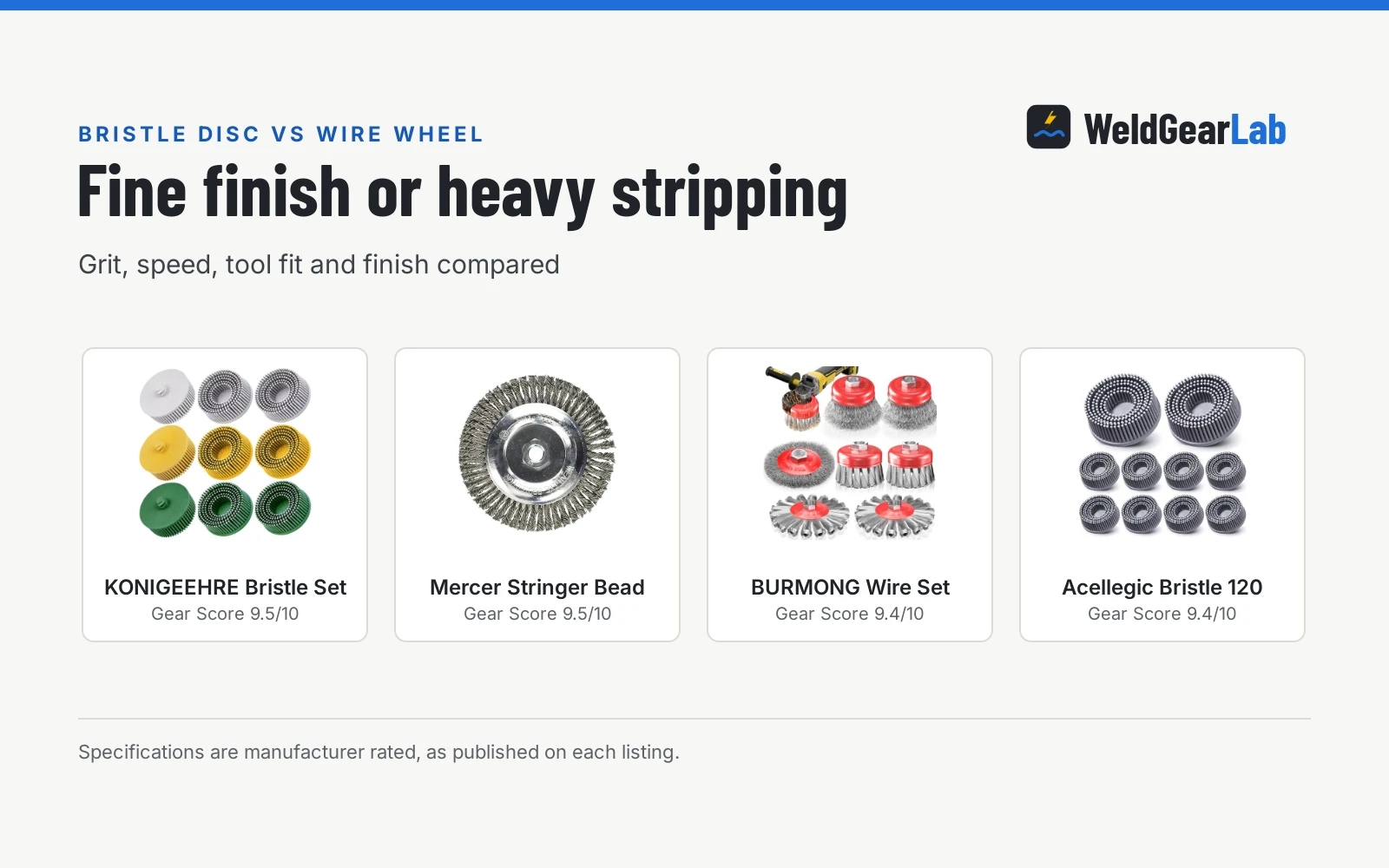
Top picks at a glance
As an Amazon Associate I earn from qualifying purchases.
- 1
 9 Pack 2 Inch Bristle Disc Grit 50# 80# 120#9.5/10View on Amazon
- 2
 Mercer Industries 186030-6" x 3/16" x 5/8"-119.5/10View on Amazon
- 3
 BURMONG 7 PCS Wire Wheel Brush for 4-1/2" Angle9.4/10View on Amazon
- 4
 Acellegic 10 Pcs 2 Inch Bristle Disc Grit 120#9.4/10View on Amazon
Verdict. Pick a bristle disc for fine deburring, blending, polishing and coating removal. Pick a wire wheel for heavy rust, paint, corrosion and weld cleanup on an angle grinder. Keep both if the bench sees fine finish work and heavy stripping.
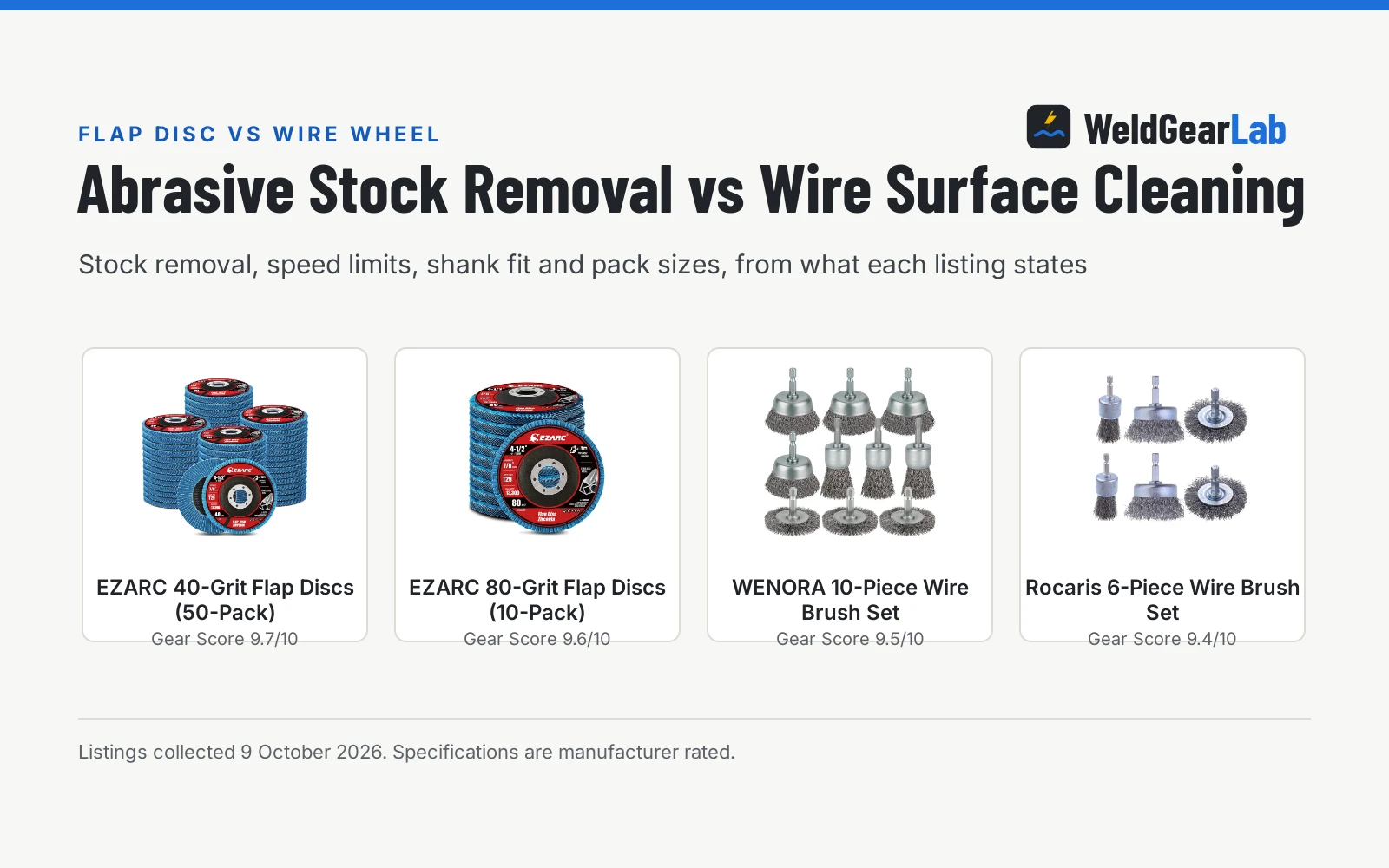
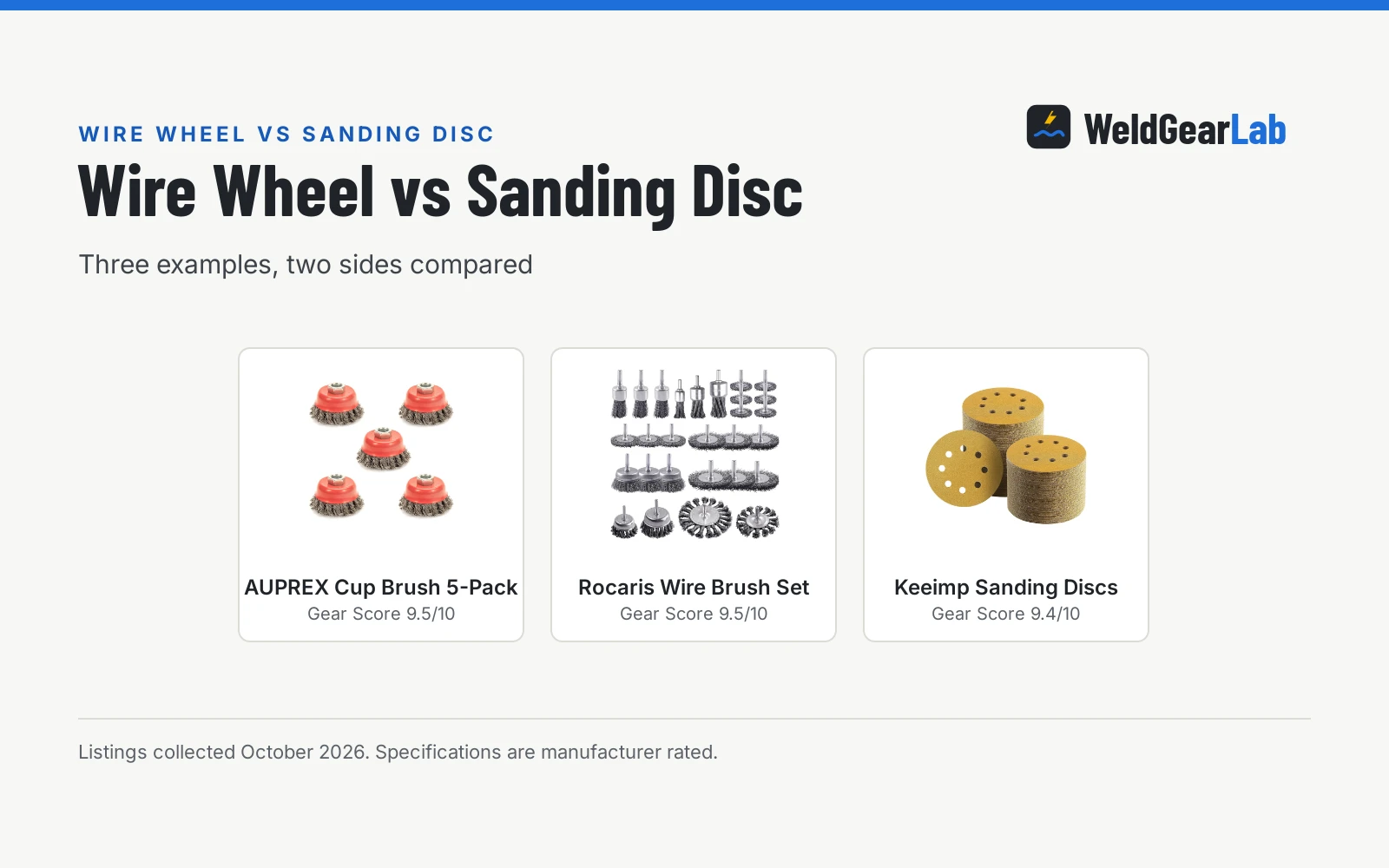
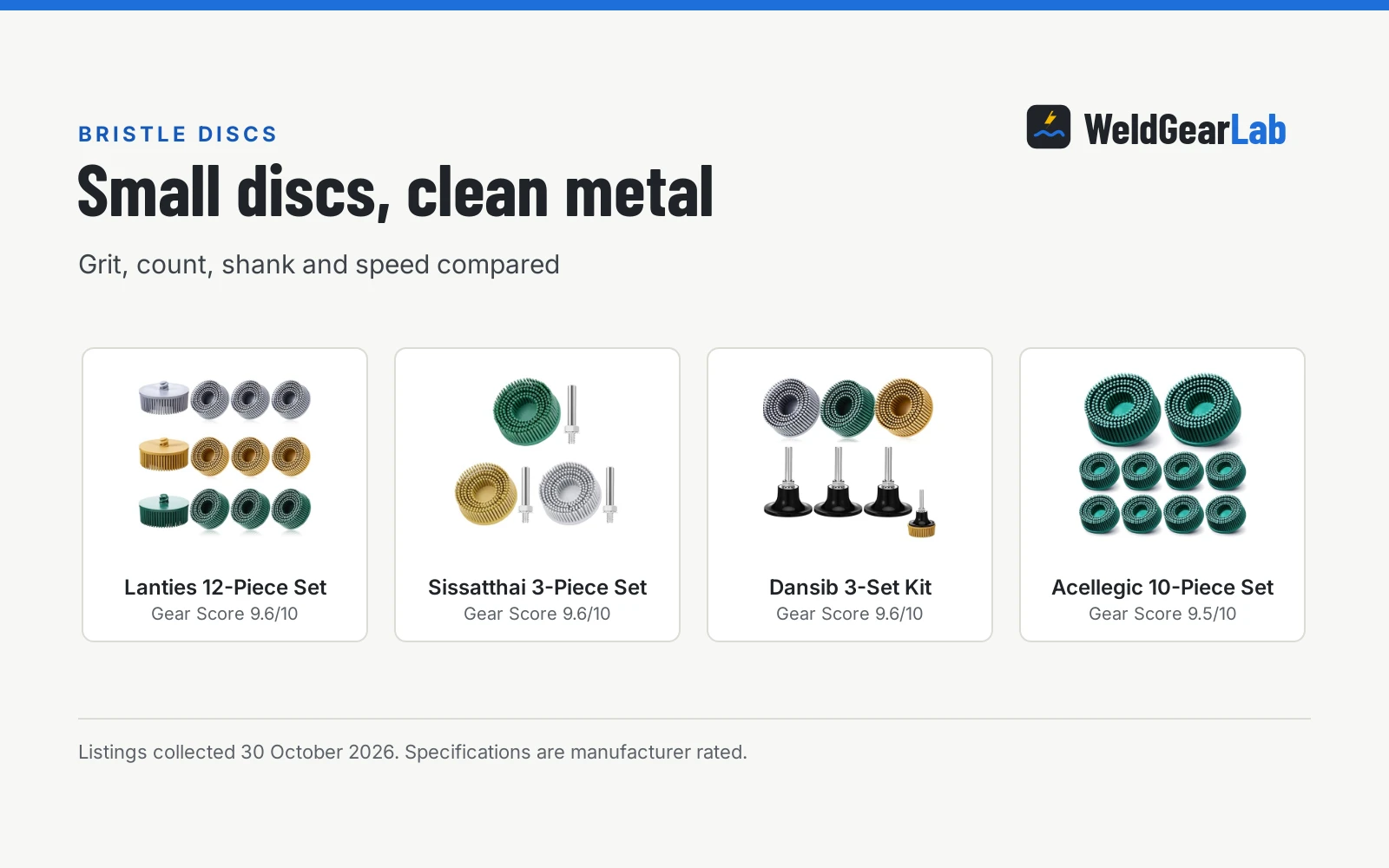
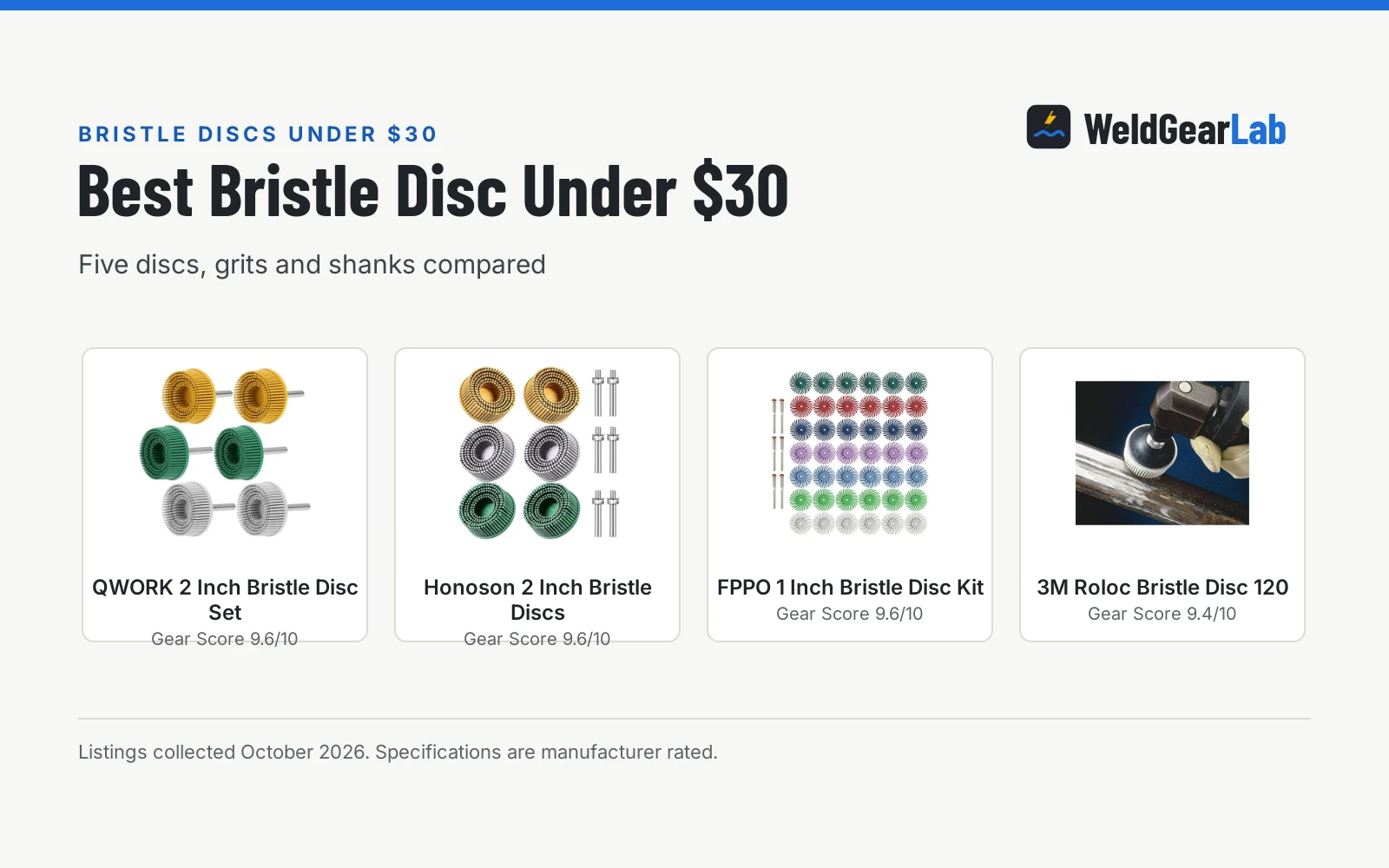
A weld bead needs cleaning, a rusted bracket needs stripping, and a gasket surface needs a careful touch before it goes back together. That bench work is where bristle disc vs wire wheel matters: one side finishes with flexible bristles, the other strips with steel wire, and each suits different jobs. This comparison uses four listed abrasives as concrete examples, with bristle and wire examples on both sides of the choice.
WeldGearLab gets a commission on purchases made through links on this page, and your price stays the same. Read our affiliate disclosure.
The examples
9 Pack 2 Inch Bristle Disc Grit 50# 80# 120#
A 9 pack of 2-inch bristle discs in grits 50, 80 and 120, for deburring, blending, finishing, polishing, cleaning and coating removal on metal, with flexible bristles that need less pressure than wire brushes. Who it is for: shop users who want several grits in one pack for steel and aluminum work. Who should skip it: anyone who wants a backing pad included or a single grit only.
Pros
- Three grits in one pack: 50 and 80 for hard metal such as steel, 120 for soft metal such as aluminum, per the listing
- Flexible bristles need less pressure than wire brushes and give more surface contact, per the listing
- Recommended speed range of 15,000-25,000 rpm is stated
- Works with drills, mini grinders and rotary tools, per the listing
Cons
- Backing pad is not included
- No warranty term is stated
- No weight is stated
- Disc material beyond grit and color is not stated
Mercer Industries 186030-6" x 3/16" x 5/8"-11
A 6-inch stringer bead wire wheel in .020 carbon steel wire, 3/16-inch wide with a 5/8-11 arbor, for cleaning welds on an angle grinder, including tight spots. Who it is for: welders who clean welds and need a narrow wheel for tight spots. Who should skip it: anyone who works stainless steel or wants a multi-piece set.
Pros
- 6-inch stringer bead wheel for cleaning welds, per the listing
- Narrow 3/16-inch width fits into tight spots, per the listing
- Carbon steel wire at .020, for tough weld cleaning jobs, per the listing
- 90 day warranty against manufacturer defects, stated in the spec table
Cons
- Not recommended for stainless steel, per the listing
- Single wheel only, with no cups or second wheel included
- One size only: 6-inch diameter with no smaller wheel stated
- Arbor size is fixed at 5/8-11, so grinders with other arbors do not fit
BURMONG 7 PCS Wire Wheel Brush for 4-1/2" Angle
A 7 piece set of carbon steel wire cup and wheel brushes in 3-inch and 4-inch sizes, knotted and crimped, for 4-1/2-inch angle grinders with a 5/8-11 arbor, for rust, paint, corrosion and weld spatter removal. Who it is for: shop users who want cups and wheels in one set for varied stripping jobs. Who should skip it: anyone who wants a single warranty term stated clearly or a bristle finish.
Pros
- Knotted and crimped wheels and cups in 3-inch and 4-inch sizes, per the listing
- Fits 4-1/2-inch angle grinders with 5/8-11 threaded arbors, per the listing
- Knotted wires at 0.02-inch and crimped wires at 0.012-inch for varied stripping work
- Maximum speed of 12,500 RPM stated
Cons
- No per-piece weight is stated; only the set weight of 2.0 pounds is listed
- No statement on stainless steel use is given
- Cups and wheels share one arbor size, so grinders outside 4-1/2-inch with 5/8-11 arbors are not covered
Acellegic 10 Pcs 2 Inch Bristle Disc Grit 120#
A 10 pack of white 2-inch bristle discs in 120 grit, in rubber and diamond, for deburring, fine processing and polishing, including gasket material cleaning from engine surfaces. Who it is for: shop users who want a single fine grit for contour work and gasket cleaning. Who should skip it: anyone who wants several grits, a stated backing pad, or a clear speed rating.
Pros
- 10 discs in 120 grit for fine work, deburring and polishing
- Rubber and diamond material with softness and elasticity, per the listing
- Flexible bristles conform to contours for intricate parts, per the listing
- Bristle length of approximately 5/8-inch with a thread diameter of approximately 0.35-inch stated
Cons
- Maximum speed figure of 212000 RPM stands far outside the other bristle listing's recommended range, so speed is unclear
- Single grit only, with no coarser option in this pack
- No warranty term is stated
- No backing pad is mentioned
Other welders and gear to compare
 WENORA 8 Pack 4 Inch Wire Wheels for Angle GrinderCheck price on Amazon
 WENORA 12 Pack 4 Inch Wire Wheels for Angle GrinderCheck price on Amazon
 6-PieceCheck price on Amazon
 9 Pack 4 Inch Wire Wheel for 4 1/2 Angle GrinderCheck price on Amazon
 Tandefio 24 Pcs Wire Wheels for Angle GrinderCheck price on Amazon
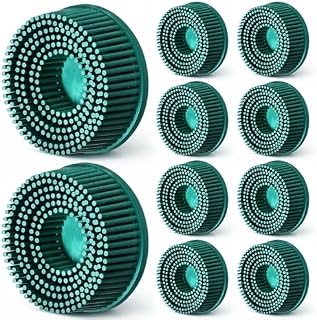 Hicarer 10 Pcs 2 Inch Bristle Discs Abrasive Bristle DiskCheck price on Amazon
Bristle Disc vs Wire Wheel Side by Side
| KONIGEEHRE Bristle Set | Mercer Stringer Bead | BURMONG Wire Set | Acellegic Bristle 120 | |
|---|---|---|---|---|
| Side | Bristle disc | Wire wheel | Wire wheel | Bristle disc |
| Size | 2-inch, 9 discs, grits 50, 80, 120 | 6-inch wheel, 3/16-inch wide | 3-inch and 4-inch cups and wheels, 7 pieces | 2-inch, 10 discs, 120 grit |
| Tool fit | Roloc TR backing pads, drill, rotary tool, mini grinder | Angle grinder, 5/8-11 arbor | 4-1/2-inch angle grinder, 5/8-11 arbor | Drill, rotary tool, small grinder |
| Speed | 15,000-25,000 rpm recommended | 12,500 RPM max | 12,500 RPM max | 212000 RPM stated |
| Best for | Deburring, blend, finish, polish, coating removal | Cleaning welds, tight spots | Rust, paint, corrosion, weld spatter | Deburring, polishing, gasket cleaning, contours |
| Warranty | Not stated | 90 day warranty against manufacturer defects | Lifetime Warranty | Not stated |
Ratings in this table are the makers’ own claims taken from each product page (30 October 2026). No listing states a safety listing.
How each side cuts
Bristle discs cut with flexible bristles. The KONIGEEHRE listing states its bristles need less pressure than wire brushes and give more surface contact, while maintaining abrasive property through the life of the disc. The Acellegic listing states its rubber and diamond discs absorb and remove dirt with softness and elasticity. Wire wheels cut with steel wires that strip hard. The Mercer listing states its wheel is designed for tough jobs like cleaning welds, and the BURMONG listing states its set removes rust, paint, weld scale, corrosion and spatter.
Grit and finish
Grit belongs to the bristle side in this guide. The KONIGEEHRE set covers three grits, with 50 and 80 grit for hard metal such as steel and 120 grit for soft metal such as aluminum, per its listing. The Acellegic set is 120 grit only, for fine processing and polishing. Wire wheels carry no grit rating in these listings; the listings state wire diameter and type instead, with the Mercer wheel in .020 carbon steel wire and the BURMONG set in knotted 0.02-inch and crimped 0.012-inch wires. Do not compare a grit number against a wire diameter; they describe different cutting actions.
Speed and tool fit
Tool fit splits the sides clearly. Bristle discs fit drills, rotary tools and small or mini grinders, per both bristle listings, and the KONIGEEHRE discs work with standard Roloc TR quick-change backing pads, with the pad not included. Wire wheels fit angle grinders, with both wire examples stating a 5/8-11 arbor and a maximum of 12,500 RPM. Speed needs care on the bristle side: the KONIGEEHRE listing recommends 15,000-25,000 rpm, while the Acellegic listing states a maximum speed of 212000 RPM, so speed for the Acellegic example is unclear from these listings alone.
Choose a bristle disc if
- You want fine deburring, blending, polishing or coating removal.
- You work contours or intricate parts where flexible bristles keep contact.
- You want grit choice in one pack, as in the KONIGEEHRE set, or a single fine grit, as in the Acellegic set.
Choose a wire wheel if
- You strip rust, paint, corrosion or weld spatter from metal.
- You clean welds, including tight spots, as in the Mercer example.
- You want cups and wheels in one set for varied stripping jobs, as in the BURMONG set.
Before You Strike an Arc
- Tool fit: bristle discs fit drills, rotary tools and small or mini grinders, while wire wheels fit angle grinders with a 5/8-11 arbor.
- Backing pad: the KONIGEEHRE discs need a Roloc TR backing pad, which is not included, so source the pad before ordering.
- Material check: the Mercer wheel is not recommended for stainless steel, and the KONIGEEHRE grit mapping puts 50 and 80 grit on hard metal such as steel and 120 grit on soft metal such as aluminum.
- Protective gear: the BURMONG listing advises wearing protective gear before use, and describes its holding plate as preventing wire breakage or fly-off, so check gear before starting.
FAQ for welders
Can a bristle disc replace a wire wheel?
Not for heavy stripping, per the listings. Bristle discs are stated for fine deburring, blending, polishing and coating removal, while wire wheels are stated for rust, paint, corrosion and weld spatter removal. Pick by the job, not by swapping one side for the other.
Which grit suits steel and which suits aluminum?
Per the KONIGEEHRE listing, 50 and 80 grit suit hard metal such as steel, and 120 grit suits soft metal such as aluminum. The Acellegic set is 120 grit only, so it does not cover the coarser steel grits in this guide.
Do bristle discs need a backing pad?
The KONIGEEHRE discs work with standard Roloc TR quick-change backing pads, and the pad is not included. The Acellegic listing mentions no backing pad, so check its mounting detail before ordering that set.
Can the Mercer wheel be used on stainless steel?
No, per its listing, which states the wheel is not recommended for stainless steel. Stainless work needs a different wheel from the ones compared here.
What speed do the wire wheels run at?
Both wire examples state a maximum of 12,500 RPM. Bristle speed differs by listing: the KONIGEEHRE listing recommends 15,000-25,000 rpm, while the Acellegic speed figure is unclear, as noted above.
Related: wire wheel vs sanding disc, knotted vs crimped wire wheel, best bristle disc for grinder and the metal fab tools hub.
Scoring, line by line
Each abrasive is scored on performance, build, value, safety and warranty, with performance carrying the largest share, followed by build and value. No listing states a safety listing, so safety scores nothing for every example, and warranty follows the stated terms: the Mercer example with its stated 90 day term and the BURMONG example with its stated Lifetime Warranty headline.
| Product | Gear Score | Perf. /35 | Build /25 | Value /25 | Safety /10 | Warranty /5 |
|---|---|---|---|---|---|---|
| KONIGEEHRE Bristle Set | 9.5 | 32 | 21 | 21 | 0 | 0 |
| Mercer Stringer Bead | 9.5 | 29 | 21 | 19 | 0 | 1 |
| BURMONG Wire Set | 9.4 | 28 | 20 | 20 | 0 | 1 |
| Acellegic Bristle 120 | 9.4 | 27 | 20 | 19 | 0 | 0 |
The lowest score we show is 9.2 and the highest is 9.8; every point total is spread proportionally across that span, so extra points mean a higher figure.