Best Die Grinder Under $50: 4 Air Picks Scored for the Shop (2026)
Four pneumatic straight die grinders under $50 compared on free speed, collet sizes, operating pressure, air consumption, weight and included accessories.

On this page
Top picks at a glance
As an Amazon Associate I earn from qualifying purchases.
- 1
 Best OverallWORKPRO 1/4-Inch Straight Air Die Grinder9.5/10View on Amazon
- 2
 Runner-UpCILEONBE 1/4-Inch Air Die Grinder9.4/10View on Amazon
- 3
 Best SetAEROPRO AP17315 Air Die Grinder9.4/10View on Amazon
- 4
 Most CompactNEIKO 30062A Mini Air Die Grinder9.3/10View on Amazon
When you need to clean up slag inside a pipe coping, port a manifold, or deburr a rough flame-cut bracket on the welding bench, an angle grinder is often too bulky to reach the seam. Finding the best die grinder under 50 comes down to checking air supply demands, collet sizes, free speed, and exhaust direction against what each listing actually publishes. We compared four pneumatic straight models to see which tools give honest specifications for shop fabrication.
WeldGearLab gets a commission on purchases made through links on this page, and your price stays the same. Read our affiliate disclosure.
Quick picks
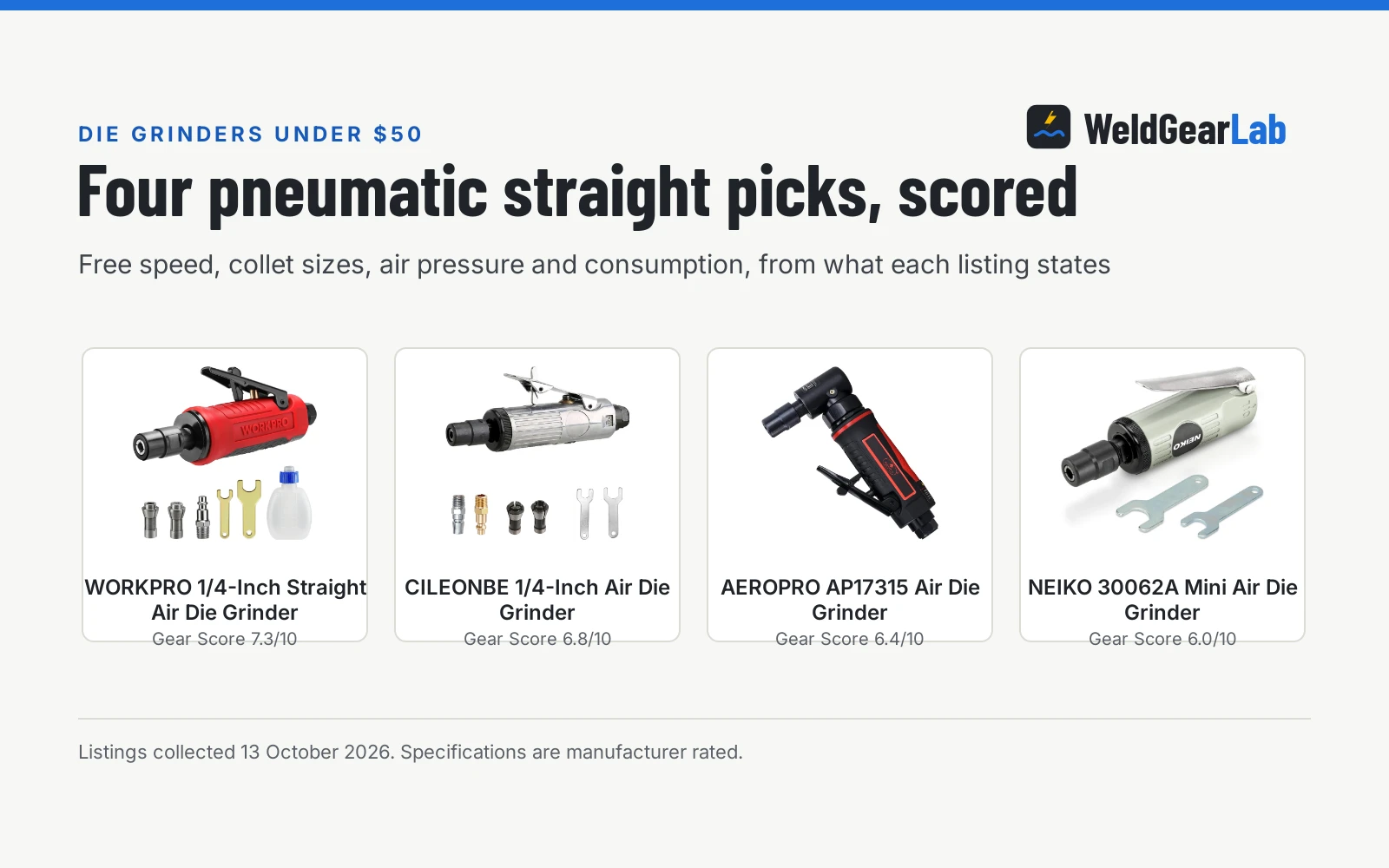
- Best Overall WORKPRO 1/4-Inch Straight Air Die Grinder: 25,000 RPM free speed, both 1/4 inch and 1/8 inch collets, 90 psi at 3 CFM, rear exhaust and 0.72 lb weight. Check price on Amazon
- Runner-Up CILEONBE 1/4-Inch Air Die Grinder: 25,000 RPM free speed, 1/4 inch and 1/8 inch collets, aluminum body, 90 psi operating pressure and rear exhaust. Check price on Amazon
- Best Set AEROPRO AP17315 Air Die Grinder: Rear exhaust, safety throttle lever, 3 CFM air consumption at 1/4 inch inlet, two wrenches and oil bottle included. Check price on Amazon
- Most Compact NEIKO 30062A Mini Air Die Grinder: Only 5 inches long with 24,000 RPM free speed and front exhaust vent slots for tight spaces. Check price on Amazon
The machines

WORKPRO Pneumatic Straight Die Grinder, 25000 RPM
A 25,000 RPM pneumatic straight die grinder with both 1/4-inch and 1/8-inch collets, a 90 psi operating rating, and a 0.72 lb slim body.
Pros
- States both 90 psi operating pressure and 3 CFM (85.5 L/min) air consumption
- Includes both a 1/4-inch collet and a 1/8-inch collet for different bit shanks
- Lightest stated weight in our sample at 0.72 lb for one-handed work
- Rear exhaust directs airflow away from the face and includes an air inlet filter
Cons
- No warranty term is stated in the listing
- No electrical or tool safety certification is listed
- Requires adding pneumatic tool oil regularly to maintain operation
- Air compressor and air connector must be supplied separately

1/4 Inch Air Die Grinder, 25,000 RPM Free Speed
A 25,000 RPM straight air grinder with an aluminum body, 15 cm length, 90 psi rating, and both 1/4-inch and 1/8-inch collets.
Pros
- Rated at 25,000 RPM free speed in the title and bullet points
- Supplied with both 1/4-inch (6 mm) and 1/8-inch (3 mm) collets
- Aluminum body construction weighing 12.32 oz with a 15 cm overall length
- Rear exhaust directs air discharge away from the work surface
Cons
- Listing does not state CFM air consumption figures
- No warranty term is stated in the listing
- No safety certification is listed

AEROPRO TOOLS 1/4-Inch Angle Pistol Grip Air Angle
A 20,000 RPM straight air die grinder kit with a 3 CFM air rating, rear exhaust, safety throttle lever, two wrenches, and an oil bottle.
Pros
- States average air consumption of 3 CFM (85.5 L/min) and suggests a 1.5 HP compressor
- Ships with two wrenches, an oil bottle, and a 1/4-inch collet
- Rear exhaust system directs exhaust airflow away from the work surface
- Integral safety-lock throttle lever prevents accidental startup
Cons
- Bullets include only a 1/4-inch collet while the table claims 1/8-inch as well
- No warranty term is stated in the listing
NEIKO 30062A 1/4" Mini Die Grinder
A 5-inch compact air die grinder with 24,000 RPM free speed, a 1/4-inch collet, and front exhaust vent slots for tight spaces.
Pros
- Compact 5-inch body length fits into tight fabrication spaces
- Free speed rated at 24,000 RPM for fast deburring and weld cleanup
- Touch lever flipper allows variable control of motor speed
- Lightweight design weighing less than a pound (0.39 kg in spec table)
Cons
- Front exhaust directs air and grinding dust forward toward the work area
- Listing omits operating air pressure and CFM consumption figures
- Ships as a bare tool without wrenches, oil, or a 1/8-inch collet
Other welders and gear to compare
 WORKPRO Air Angle Die GrinderCheck price on Amazon
 Angle air die grinder 1/4" with 4 pcs 2" roll lock sandingCheck price on Amazon
 PROSHI 1/4-Inch Air Die Grinder With Rubber SleeveCheck price on Amazon
 Gunpla 1/4 inch Angle Air Die GrinderCheck price on Amazon
 1/4-Inch Angle Air Die GrinderCheck price on Amazon
Spec sheet comparison
| Model | Gear Score | Free speed | Collet size | Air consumption | Operating pressure | Exhaust | Weight |
|---|---|---|---|---|---|---|---|
| WORKPRO 1/4-Inch Straight Air Die Grinder | 9.5/10 | 25,000 RPM | 1/4 in and 1/8 in | 3 CFM (85.5 L/min) | 90 psi (6.3 bar) | Rear | 0.72 lb |
| CILEONBE 1/4-Inch Air Die Grinder | 9.4/10 | 25,000 RPM (bullets), 20,000 RPM (table) | 1/4 in (6 mm) and 1/8 in (3 mm) | Not stated | 90 psi | Rear | 12.32 oz |
| AEROPRO AP17315 Air Die Grinder | 9.4/10 | 20,000 RPM | 1/4 in (bullets), 1/4 in and 1/8 in (table) | 3 CFM (85.5 L/min) | Not stated | Rear | 453.59 g (1 lb) |
| NEIKO 30062A Mini Air Die Grinder | 9.3/10 | 24,000 RPM | 1/4 in | Not stated | Not stated | Front | 0.39 kg (table), under 1 lb (bullets) |
These numbers are the manufacturer’s ratings exactly as each listing gives them, recorded on 13 October 2026. Where a listing states a figure two ways, the table shows both.
Buying guide: best die grinder under 50
Free speed and motor control
Pneumatic straight die grinders spin significantly faster than electric angle grinders. The listings in this category advertise free speeds from 20,000 RPM on the AEROPRO up to 25,000 RPM on the WORKPRO and CILEONBE models, with the NEIKO listed at 24,000 RPM. High rotational speed is essential when running rotary files and mounted stones to prevent the tool from chattering or grabbing against the edge of a weld seam. CILEONBE lists both 20,000 RPM in its specification table and 25,000 RPM in its bullets. Throttle levers vary between standard lockout paddles with safety latches and touch flippers. A spring-loaded safety latch prevents the grinder from kicking on if dropped on the welding table or bumped on a tool cart.
Collet sizes: 1/4-inch versus 1/8-inch
The shank size of your grinding burrs determines what collets you need. In fabrication shops, 1/4-inch shanks are the standard for tungsten carbide rotary burrs, mounted flap wheels, and heavy deburring stones. A 1/8-inch (3 mm) collet is useful for smaller engraving points, micro stones, and fine porting tools. WORKPRO and CILEONBE ship with both 1/4-inch and 1/8-inch collets in the package. AEROPRO lists chuck sizes of 1/4-inch and 1/8-inch in its table, but states only one 1/4-inch collet in its included components list. NEIKO supplies only a 1/4-inch collet as a bare tool. If you plan to switch between shank sizes without buying aftermarket adapters, verify what collets the package actually includes.
Air compressor requirements and CFM
Air tools require sustained airflow to maintain working torque under load. WORKPRO and AEROPRO both publish an air consumption rating of 3 CFM (85.5 L/min). WORKPRO and CILEONBE rate their tools for 90 psi (6.3 bar) operating pressure, and AEROPRO suggests a 1.5 HP compressor. Neither NEIKO nor CILEONBE publishes CFM consumption figures. Running a continuous bead cleanup or grinding down heavy weld reinforcement will drain a small portable compressor quickly. If your compressor cannot maintain the required CFM at 90 psi, the tool will lose speed and stall when pressed firmly against the steel.
Rear exhaust versus front exhaust
Exhaust design plays a significant role in comfort and clean visibility at the welding bench. WORKPRO, AEROPRO, and CILEONBE feature rear exhaust designs that route discharging air backward along the supply line, keeping oil mist and high-velocity air away from the workpiece. NEIKO uses a front exhaust layout with directional vent slots. While front venting can clear chips ahead of the tool, it also risks blowing fine grinding dust and loose metal shavings directly back toward the operator. For weld prep where maintaining a clear sightline on the joint is critical, rear exhaust is generally preferred.
Weight and compact body design
Grinding out defects inside square tubing or awkward weldments requires a nimble, lightweight tool. All four models in this roundup weigh less than one pound. WORKPRO lists the lightest specific weight at 0.72 lb, CILEONBE lists 12.32 oz, AEROPRO weighs 453.59 g (1 lb), and NEIKO lists 0.39 kg in its table. NEIKO emphasizes its short 5-inch length, while CILEONBE lists a 15 cm overall length. Slim, compact straight barrels fit into tight spaces where even a compact angle grinder cannot reach.
Warranty terms and listing accuracy
None of the four listings reviewed in this price group states a written warranty term. In addition, three of the four listings contain internal contradictions. NEIKO lists an operating voltage of 120 volts for a pneumatic tool. AEROPRO names both an angle pistol grip and a straight grinder in its title while listing electric power in its spec table. CILEONBE lists conflicting RPM figures between its bullet points and table. Only WORKPRO provides a clean listing without internal discrepancies. When buying in this entry category, check the product closely upon arrival to confirm all parts match your order.
Grinding safety. Die grinders operate at extreme speeds, turning mounted carbide burrs and stones at up to 25,000 RPM. Always wear ANSI-rated eye protection with side shields or a full face shield, sturdy leather welding gloves, and hearing protection to guard against high-pitched exhaust noise. Disconnect the air line before loosening the collet nut or swapping grinding accessories. Inspect burrs and stones for bent shanks or cracks prior to chucking them in the tool, and never exceed the maximum rated speed marked on any abrasive consumable.
Before You Strike an Arc
- Check the air supply connection on arrival: remove the dust plug from the air inlet as noted on the WORKPRO listing, apply thread sealant tape to your air connector fitting, and verify that your compressor delivers clean, regulated air at 90 psi.
- Add pneumatic tool oil regularly through the air inlet before running the motor, using the lubricant included with the WORKPRO or AEROPRO sets to protect the internal vanes from wear.
- Check collet fitment and bit seating: insert your 1/4-inch or 1/8-inch shank burr fully into the collet and tighten firmly with the two wrenches before connecting shop air.
- Inspect the throttle safety latch or lever flipper to confirm the lock engages smoothly and prevents accidental startup when set down on the bench.
FAQ for welders
Can I use a die grinder to clean up welds?
Yes, a straight pneumatic die grinder is widely used in fabrication shops to clean up welds in tight areas. Equipped with a 1/4-inch carbide burr, it removes slag pockets, flattens spatter, and grinds out porosity before you lay down another pass. It reaches into tight inside corners and pipe joints where an angle grinder wheel cannot fit.
What size air compressor do I need to run a pneumatic die grinder?
Check the air consumption and pressure ratings listed by the manufacturer. These models operate at 90 psi and demand around 3 CFM (85.5 L/min), with AEROPRO suggesting a 1.5 HP compressor. If your air compressor tank is too small or cannot keep up with the continuous CFM draw, the grinder will bog down and lose speed during extended weld cleanup.
What is the difference between a 1/4-inch collet and a 1/8-inch collet?
The collet size determines the shank diameter of the grinding accessories the tool can accept. A 1/4-inch collet fits standard industrial carbide rotary burrs, flap wheels, and mounted stones used for heavy metal removal. A 1/8-inch collet accepts smaller detail bits for fine engraving, tight radius deburring, and light polishing.
Why is rear exhaust preferred on a metalworking die grinder?
Rear exhaust channels discharging air backward toward the air supply hose and away from the operator. Front exhaust can blow high-speed air across your weld joint, kicking up loose grinding swarf, metal filings, and abrasive dust into the air. A rear exhaust keeps your line of sight clear and reduces airborne debris around the fabrication bench.
Can an air die grinder cut metal?
A straight die grinder can cut metal when fitted with a compatible cutoff wheel arbor and rated wheel. However, straight grinders are primarily built for deburring, grinding, porting, and surface polishing. For straight cuts through sheet or heavy plate, an angle grinder or metal chop saw is generally faster and easier to control.
Related: best die grinder, best angle grinder under 50, and the metal fab tools hub. Also see our best angle grinder. Also see our best angle grinder for welding prep. Also see our best angle grinder for cutting metal. Also see our best 3 inch cut off wheels. Also see our best flap disc for weld grinding.
More related guides (9)
Scoring, line by line
Each grinder is scored out of 10 on performance, build, value, safety listing and warranty, with the weights published on our How We Pick page. A spec the listing does not publish scores nothing.
| Product | Gear Score | Perf. /35 | Build /25 | Value /25 | Safety /10 | Warranty /5 |
|---|---|---|---|---|---|---|
| WORKPRO 1/4-Inch Straight Air Die Grinder | 9.5 | 30 | 21 | 21 | 0 | 0 |
| CILEONBE 1/4-Inch Air Die Grinder | 9.4 | 28 | 20 | 20 | 0 | 0 |
| AEROPRO AP17315 Air Die Grinder | 9.4 | 26 | 19 | 20 | 0 | 0 |
| NEIKO 30062A Mini Air Die Grinder | 9.3 | 24 | 18 | 18 | 0 | 0 |
Displayed scores fall between 9.2 and 9.8: the weighted point total is mapped onto that band in a straight line, so earning more points always lifts the score.