Argon vs C25 Gas for MIG Welding: Which Gas Fits Your Work
Argon and C25 shielding gases serve different welding tasks, with C25 providing balanced penetration for MIG steel while pure argon handles aluminum and TIG.
 By WeldGearLab Editorial
Updated October 10, 2026
By WeldGearLab Editorial
Updated October 10, 2026
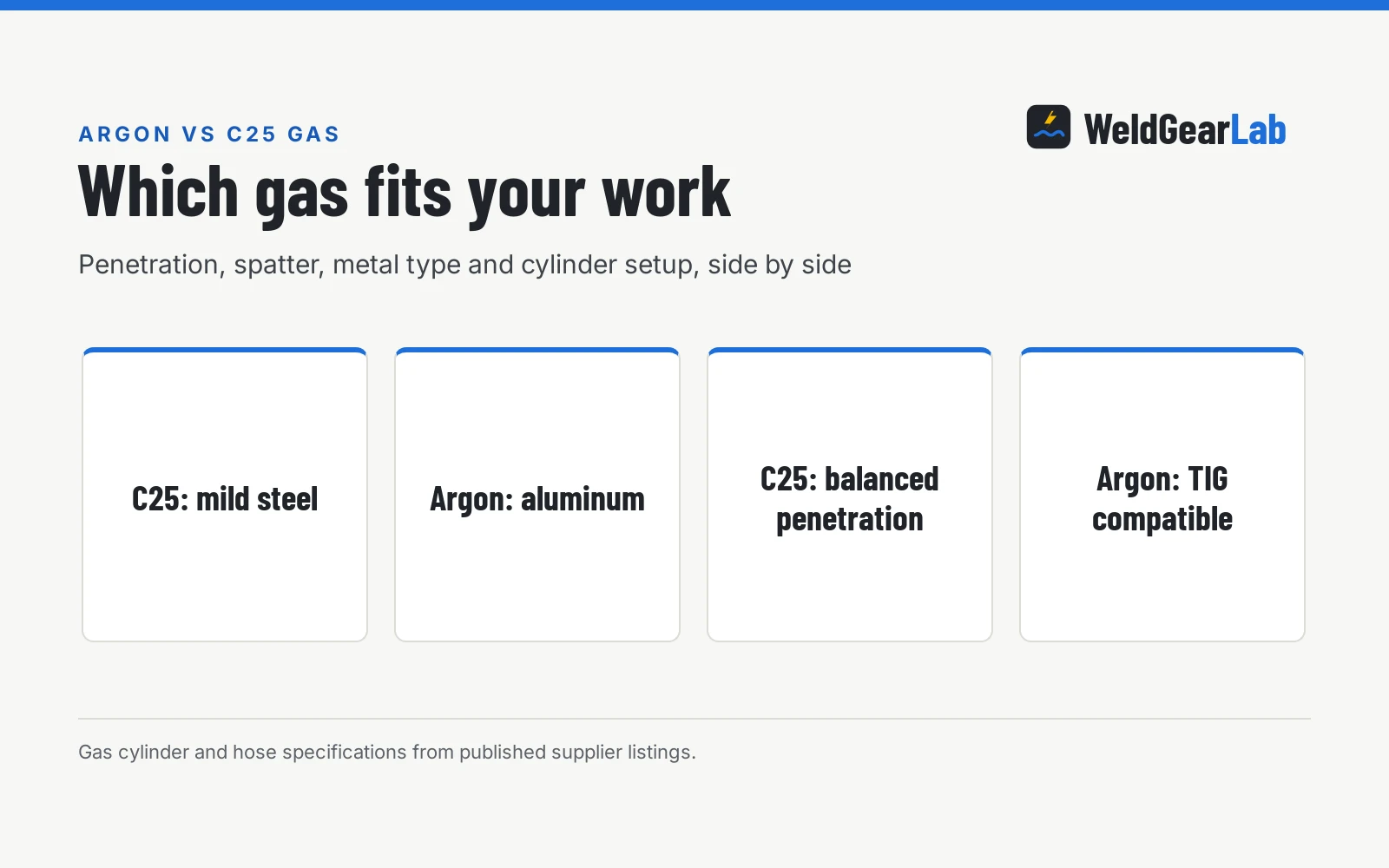
When comparing argon vs C25 gas for MIG welding, the correct shielding gas depends primarily on the metal you join. For mild steel, C25 (75% argon and 25% carbon dioxide) is the shop choice, giving a stable arc, low spatter, and balanced penetration. Pure 100% argon is standard when MIG welding aluminum with a spool gun, but pure argon on mild steel leads to an erratic arc and lack of sidewall fusion.
As an Amazon Associate I earn from qualifying purchases. This guide links to our product roundups, where WeldGearLab earns a commission when you buy through links, at no extra cost to you. Read our affiliate disclosure.
The difference in one paragraph
Shielding gas protects molten metal from atmospheric contamination. Pure argon is inert and does not react with the puddle, making it suitable for aluminum, yet on steel it produces an unstable arc and lack of sidewall fusion. Carbon dioxide breaks down in arc heat to provide broader heat distribution and root penetration on steel. Blending 75% argon with 25% carbon dioxide gives C25 the smooth arc of argon with the penetration of carbon dioxide, making C25 standard for steel MIG while pure argon serves aluminum MIG and TIG.
Side by side
| 100% Pure Argon | C25 (75% Argon / 25% CO2) | 100% Straight CO2 | |
|---|---|---|---|
| Gas composition | 100% argon | 75% argon and 25% CO2 | 100% carbon dioxide |
| Primary metals | Aluminum MIG and TIG welding | Carbon steel and mild steel MIG | Thick carbon steel MIG |
| MIG arc action on steel | Erratic arc with sluggish puddle | Smooth, stable arc with clean wetting | Harsh, turbulent arc action |
| Penetration on steel | Narrow bead with lack of sidewall fusion | Balanced, rounded root penetration | Deep, wide joint penetration |
| Spatter and cleanup | Erratic spatter on steel | Low spatter with fast cleanup | Heavy spatter requiring grinding |
| TIG welding use | Standard for DC and AC TIG | Unusable (oxidizes tungsten) | Unusable (erodes tungsten) |
| Cylinder valve standard | CGA 580 valve | CGA 580 valve | Standard CO2 valve fitting |
Both gases connect through standard CGA 580 cylinder valves, running DCEP polarity for solid wire MIG. Check the shielding gas recommendations on your wire spool and welder door chart before striking an arc.
When C25 is the better choice
C25 (often called 75/25) is the primary shielding gas for steel fabrication. Choose C25 for these tasks:
- Steel fabrication. C25 produces a stable arc with minimal spatter on sheet metal, tubing, and plate joints.
- Auto body and thin sheet metal. Clean puddle wetting prevents burn-through while preserving root fusion.
- Clean bead appearance. Compared to straight carbon dioxide, C25 cuts spatter and reduces post-weld grinding.
- Short circuit transfer. Crisp arc starts make out-of-position joints easier to control.
Our best MIG wire for mild steel guide covers solid and flux-core spools, and see our guide on why a MIG welder spatters if your setup sheds excess droplets.
When pure argon is the better choice
Pure 100% argon contains no reactive carbon dioxide. Choose pure argon for these situations:
- MIG welding aluminum. Carbon dioxide oxidizes molten aluminum into soot and porosity; aluminum requires an inert argon shield.
- Spool gun feeding. Feeding soft aluminum wire through a spool gun with pure argon produces clean beads with good toe cleaning.
- TIG welding compatibility. A cylinder of pure argon can serve both MIG and TIG machines. TIG welding on steel, stainless, and aluminum uses 100% argon.
- Non-ferrous metals. Silicon bronze and titanium require pure inert shielding without reactive gas components.
Our best MIG welder with spool gun included guide covers machine packages, while our best aluminum MIG wire guide helps pick wire alloys.
Argon vs C25 Gas for MIG Welding
Welders cannot use argon vs C25 gas for MIG welding interchangeably on steel because of arc physics and thermal transfer. Shielding gas molecules ionize to conduct current and transfer heat from the wire tip into the joint.
Pure argon conducts heat poorly across the outer edges of the arc cone, concentrating thermal energy in a narrow central column. On mild steel, this causes poor puddle wetting, sluggish toes, cold lap, and lack of sidewall fusion.
Adding 25% carbon dioxide to make C25 changes arc dynamics. Carbon dioxide molecules disassociate in arc heat and recombine near the steel surface, dispersing heat across the arc cone. This produces a bowl-shaped penetration profile that ties smoothly into the base metal, flattening liquid steel into a uniform bead.
Dial in flow settings carefully; see how to set gas flow rate for MIG welding and our guide on what causes porosity in MIG welds.
Cylinder sizes, pressure ratings, and hose hardware
Connecting a wire feed welder to gas requires a cylinder, regulator, and hose. Reference listings show specific capacities and ratings that define common shop equipment.
For portable jobs, Varies lists a steel cylinder with a 20 cu ft capacity, 13.67 lb tare weight, 5.25 inches diameter, 18 inches height, 2015 PSI service pressure, and 3/4″ NGT threads. For stationary fabrication, Generic lists an 80 cu ft cylinder for 75% Argon 25% CO2 weighing 50 pounds full with a 7 inches diameter and CGA 580 valve. Generic also lists a 125 cu ft cylinder for 75% Argon 25% CO2 weighing 69 pounds full with a 7 inches diameter. Kaplan Industries lists a 125 cu ft cylinder for 100% Argon with 3360 psi maximum pressure, 69 pounds shipping weight, 6 x 1 x 46 inches dimensions, 3/8 inch NPT threads, 1 inches inlet, 0.5 inches outlet, and a CGA 580 valve.
For gas delivery, STARTECHWELD lists a 25 feet hose with 5/8″ UNF-18RH male fittings, crimped 1/4″ ends, 200 PSI working rating, and 2.83 pounds weight. Weldcote Metals lists an ARG14X25 rubber hose at 25 feet weighing 2 pounds. Pidnsrozo lists a 5 feet hose with 5/8″ UNF-18RH fittings, 3-layer build, 0.63 inches outside diameter, 16 ounces weight, 200 PSI rating, and a -40°F to 150°F range. ZGTools lists 6.56 feet and 10 feet hoses with 3-layer build, 5/8″ UNF-18RH threads, 0.63 inches outside diameter, 200 PSI working rating, 900 psi maximum rating, and -40°F to 150°F tolerance. ANDELI lists a 205A multi-process welder running 110/220V dual voltage with a 4.1 inches LED screen, 10 ft MIG gun, and 33 pounds weight. See our gas regulator for welder guide for regulator options.
Compressed gas safety and cylinder handling
Compressed cylinders require careful handling. High pressure makes a damaged valve dangerous; fasten cylinders upright to a cart or wall with chains or straps at all times.
Argon and carbon dioxide are heavier than air, settling in pits and low spots to displace breathable oxygen. Keep your shop ventilated, check connections with soapy water, and close tank valves when finished. See our can you MIG weld without gas guide for shop options.
Frequently Asked Questions
Can I use pure argon to MIG weld mild steel?
You can strike an arc on mild steel with pure argon, but weld quality is poor. Pure argon on steel creates an erratic arc, excessive spatter, and a narrow bead prone to cold lap and lack of sidewall fusion. For sound steel welds, use C25 or straight carbon dioxide.
Can I use C25 gas for TIG welding?
No, C25 cannot be used for TIG welding. Carbon dioxide oxidizes and erodes tungsten electrodes rapidly, causing arc wander and contamination. TIG welding requires 100% pure argon or argon-helium blends.
Do argon and C25 tanks use the same regulator?
Yes, cylinders for pure argon and C25 both use standard CGA 580 valve connections in North America. You can use the same flowmeter regulator on both tanks without swapping stem fittings or buying adapters.
What is the difference between C25 and straight CO2 for MIG welding?
Straight 100% carbon dioxide penetrates deep into heavy steel plate at lower refill costs, but generates heavy spatter requiring grinding cleanup. C25 blends 75% argon with 25% carbon dioxide, producing a calmer arc, flatter bead profile, and lower spatter.
Which gas cylinder size is best for a home shop?
An 80 cu ft cylinder is a practical balance for small shops. It provides ample welding time across multiple projects without frequent refill trips, while remaining manageable to mount on a rolling shop cart.
Related: how to choose a MIG welder, flux core vs MIG with gas, MIG welder wire speed and voltage chart, and the welding consumables hub.
About the author
WeldGearLab Editorial is the editorial team behind WeldGearLab. We research product listings, specifications, safety listings and warranty terms, score every pick with the published Gear Score method, and correct errors when readers report them. We do not run our own shop trials; see How We Pick for exactly how picks are made.