What Size TIG Filler Rod for 1/8 Steel?
Choose the right TIG filler rod size for 1/8 steel by comparing 3/32 and 1/16 inch ER70S-6 wire for puddle control, joint fit-up, and clean beads.
 By WeldGearLab Editorial
Updated October 10, 2026
By WeldGearLab Editorial
Updated October 10, 2026
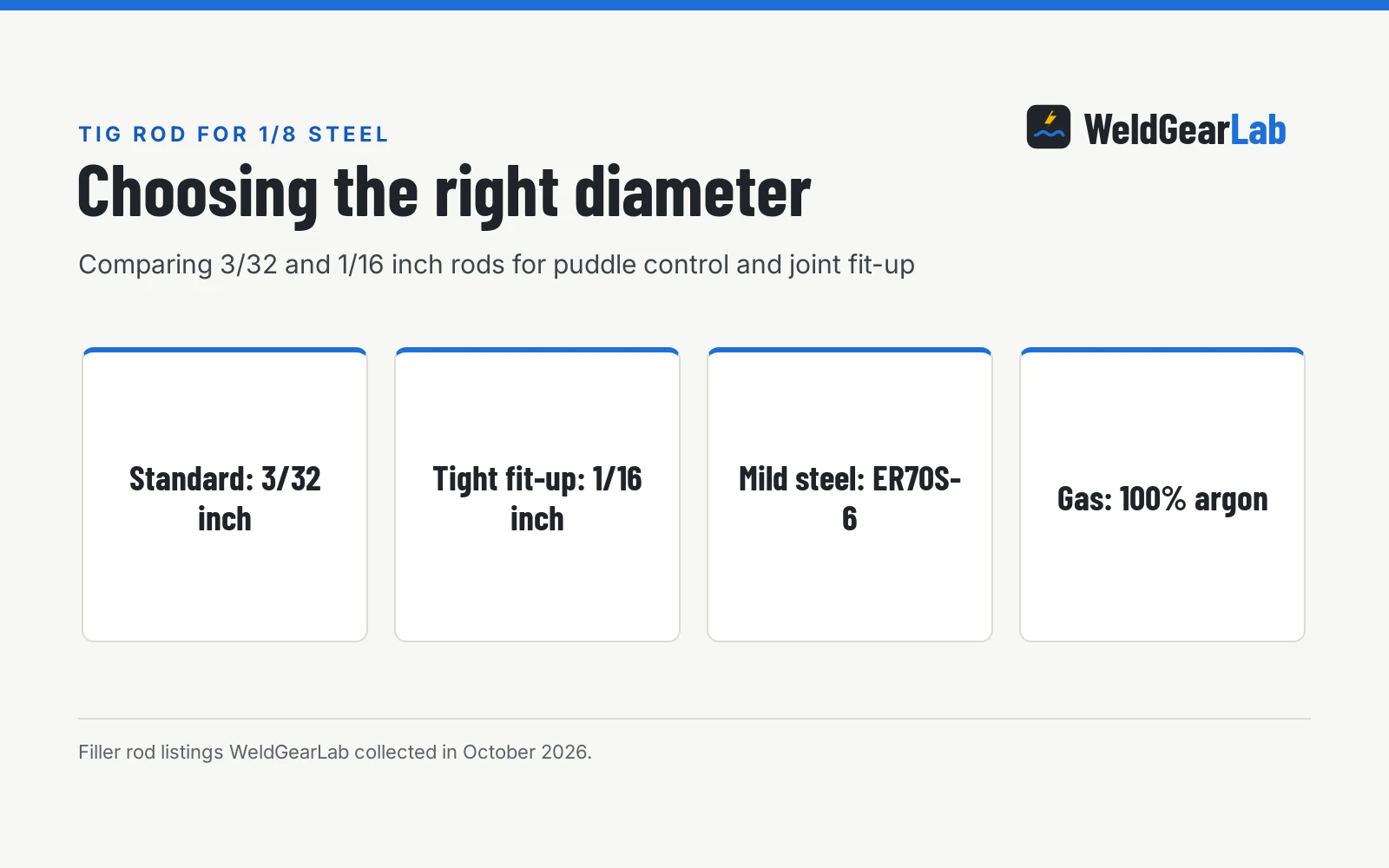
When deciding what size tig filler rod for 1/8 steel, the standard all-around choice is 3/32 inch (2.4 mm), while 1/16 inch (1.6 mm) is the practical alternative for tight butt joints and thin edges. A 3/32 inch rod deposits enough filler to build proper reinforcement on fillet and lap joints without excessive dipping. On flat butt joints with tight fit-up, a 1/16 inch rod gives finer puddle control and prevents overfilling the seam. This guide explains how to choose between 3/32 and 1/16 inch mild steel filler wire for your joint design, travel speed, and puddle control.
As an Amazon Associate I earn from qualifying purchases. This guide links to our product roundups, where WeldGearLab earns a commission when you buy through links, at no extra cost to you. Read our affiliate disclosure.
What size TIG filler rod for 1/8 steel
In TIG welding, selecting filler rod diameter balances molten puddle volume against wire melt rate. For 1/8 steel, a 1/8 inch (3.2 mm) rod is often too thick because adding that much mass chills the puddle and demands excessive heat. Stepping down to 3/32 inch (2.4 mm) provides an effective balance: it adds filler metal quickly enough to fill fillet throats and lap seams while melting smoothly into the puddle. For closed butt joints or outside corner welds where minimal reinforcement is needed, stepping down to 1/16 inch (1.6 mm) keeps the puddle manageable and prevents high, crowned beads.
Side by side
| 3/32 inch (2.4 mm) | 1/16 inch (1.6 mm) | 1/8 inch (3.2 mm) | |
|---|---|---|---|
| Role on 1/8 steel | Standard all-around choice | Precision and tight fit-up | Too large for most passes |
| Typical joint types | T-joints, lap joints, fillet welds | Butt joints, outside corners, edge welds | Heavy beveled joints only |
| Deposition rate | Higher volume per dab | Lower volume, smaller additions | Excessive volume per dab |
| Thermal effect on puddle | Balances puddle heat and deposition | Melts quickly with small wire mass | Chills puddle due to large wire mass |
| Burn-through control | Steady travel maintains uniform heat | Helps prevent overheating on edges | Lingering to melt wire overheats joint |
| Bead profile | Wider convex bead with full reinforcement | Flat, narrow bead with minimal buildup | Excessively heavy crowned bead |
| Common mild steel wire | ER70S-6 | ER70S-6 | ER70S-6 |
| Typical listed length | 16 inches (406.4 mm) | 16 inches (406.4 mm) | 16 inches (406.4 mm) |
| Shielding gas | 100% argon | 100% argon | 100% argon |
A tig filler rod size chart helps compare wire diameters against joint requirements. Retail listings from brands like ARCCAPTAIN and SONNLER show ER70S-6 wire commonly supplied in 1/16 inch, 3/32 inch, and 1/8 inch diameters at 16 inches in length. Choosing between them depends on whether your joint needs rapid metal deposition or precise thermal control.
When 3/32 inch is the better choice
- T-joints and fillet welds. Fillet welds require filling a triangular throat across both pieces of 1/8 steel. A 3/32 inch (2.4 mm) rod deposits enough volume with each dab to build a proper throat without stalling forward travel.
- Lap joints. The top edge of a lap joint melts rapidly under the arc. Adding a 3/32 inch rod provides sufficient material to catch that melting edge and form a flat, reinforced bead.
- Beveled butt joints with root gaps. When edges are beveled or have an open gap, 3/32 inch filler bridges the space securely and fills the groove in fewer passes.
- Faster deposition and steady travel speed. Because 3/32 inch wire delivers more metal per dab than 1/16 inch wire, you can advance along the seam with a steady pace and complete 1/8 steel joints without pausing.
For dedicated shop equipment capable of clean DC TIG output on mild steel, see our best TIG welder for aluminum roundup, which covers AC/DC machines that handle both steel fabrication and aluminum repairs.
When 1/16 inch is the better choice
- Square butt joints with tight fit-up. When mating pieces of 1/8 steel butt together with zero gap, adding too much filler creates an excessively tall bead that requires heavy grinding. A 1/16 inch (1.6 mm) rod deposits a low-profile reinforcement.
- Outside corner joints. Outside corners already contain ample base metal at the mating apex. A 1/16 inch rod supplies just enough deoxidizers to stabilize the puddle without overbuilding the corner.
- Tack welding and fit-up alignment. Small tack welds made with 1/16 inch wire melt flat and blend seamlessly into the final weld pass without leaving large, bulky lumps.
- Better visibility and puddle control. The thinner wire provides a clearer view of the tungsten tip, arc length, and joint seam, giving beginners and precision fabricators tighter control over each dab.
How to choose rod diameter in retail listings
When purchasing filler rods for 1/8 steel fabrication, product listings publish specific wire grades, diameters, lengths, and packaging weights. Look for these details in product descriptions:
- Stated rod diameter and metric equivalent. Listings often specify diameter in fractional inches alongside metric conversions. For example, SONNLER lists 1/16 inch (1.6 mm), 3/32 inch (2.4 mm), and 1/8 inch (3.2 mm) sizes, while ARCCAPTAIN specifies 3/32 inch (2.4 mm) and 1/8 inch (3.2 mm). Convivium lists stainless options in 1/16 inch (1.6 mm) and 3/32 inch (2.5 mm).
- Rod length. Retail packaging specifies rod lengths tailored for hand feeding. SONNLER, ARCCAPTAIN, Blulu, and Indulward list 16 inch (406.4 mm) rods in their product details. Other listings state different lengths, such as WISUNO at 17 inches and MorningRo at 39 inches.
- Package weight and quantity. Pack sizes vary widely by brand. Indulward lists a 5.5LB pack containing approximately 400 rods in 1/16 inch size. Blulu offers a 2 lb pack, WISUNO supplies a 1LB package, and ARCCAPTAIN and SONNLER provide 5LB boxes.
Check that packaging keeps rods dry during storage. SONNLER lists reusable waterproof plastic packaging to protect welding wire from moisture.
Which alloy and shielding gas for mild steel
For carbon steel and mild steel fabrication, ER70S-6 is the standard filler metal classification. The listing for ARCCAPTAIN explains that ER70S-6 contains manganese and silicon deoxidizers to improve mechanical properties, puddle fluidity, and crack resistance. Indulward similarly notes that higher silicon and manganese content helps eliminate porosity when welding steel with surface rust or mill scale. For stainless steel projects, brands like SONNLER and Convivium list ER308L filler wire, which is compatible with 304, 308L, 321, and 347 stainless grades.
TIG welding steel requires pure inert gas shielding to keep atmospheric oxygen and nitrogen out of the molten puddle. ARCCAPTAIN specifies 100% argon shielding gas for ER70S-6 wire, and SONNLER lists 100% argon or argon/helium. Although retail descriptions from brands like Blulu and Indulward mention CO2 or argon/CO2 blends, those bullets copy MIG wire specifications. TIG arcs require pure inert argon; reactive gases like CO2 erode the tungsten electrode rapidly. Always follow your machine manual and run 100% argon for manual TIG welding on mild steel.
Can you keep both rod sizes in the shop?
For most home fabricators and repair shops working with 1/8 steel, keeping both 3/32 inch and 1/16 inch rods in stock is a practical strategy. Use 3/32 inch for general fabrication, structural frames, and fillet joints where deposit speed matters. Keep 1/16 inch on hand for tack welding, closed butt seams, outside corners, and thin-gauge brackets. For a detailed comparison of filler metal formulations, read our guide to the best TIG rod for mild steel.
Welding safety and ventilation. TIG welding produces intense arc flash, ultraviolet radiation, and welding fumes. Wear a shade-appropriate welding helmet, safety glasses, and dry leather welding gloves. Clean mill scale and surface grease with a dedicated grinder before striking an arc, and avoid welding galvanized metal without proper mechanical fume extraction. Secure all compressed shielding gas cylinders upright to a wall or welding cart with a safety chain.
Frequently Asked Questions
Can I use 1/16 inch filler rod on 1/8 steel?
Yes, 1/16 inch filler wire works well on 1/8 steel for square butt joints, outside corners, and root passes. Because it deposits less metal per dab, it gives you tighter control over puddle size and bead height. On heavy fillet joints, however, you will need to add filler more rapidly to achieve proper throat thickness.
Why is a 1/8 inch filler rod usually too large for 1/8 steel?
A 1/8 inch rod has the same thickness as the base metal, which means feeding it into the puddle introduces a large mass of cold wire. Melting that thick rod cools the puddle rapidly and requires excessive arc heat, increasing the risk of overheating or blowing through the workpiece. Stepping down to 3/32 inch keeps the puddle fluid while maintaining steady deposition.
What is the difference between 3/32 and 1/16 inch TIG rods?
The difference lies in wire diameter and deposition rate. A 3/32 inch (2.4 mm) rod delivers significantly more filler metal per dip, making it ideal for filling gaps, T-joints, and lap welds on 1/8 steel. A 1/16 inch (1.6 mm) rod melts faster with less wire volume, making it preferable for tight butt joints and minimal bead crowns.
What shielding gas should I use for TIG welding mild steel?
Use 100% argon shielding gas for manual TIG welding on mild steel. Listings from makers like ARCCAPTAIN and SONNLER specify 100% argon to protect the tungsten electrode and weld pool from atmospheric contamination. Pure argon provides smooth arc stability, minimal spatter, and clean weld appearance.
What length do TIG filler rods come in?
Retail pack lengths vary across brands. Listings from ARCCAPTAIN, SONNLER, Blulu, and Indulward publish a 16 inch (406.4 mm) length for compact packaging. Other listings specify different dimensions, such as WISUNO at 17 inches and MorningRo at 39 inches.
Related: what color tungsten for steel, TIG welding argon flow rate, and the TIG welders hub.
About the author
WeldGearLab Editorial is the editorial team behind WeldGearLab. We research product listings, specifications, safety listings and warranty terms, score every pick with the published Gear Score method, and correct errors when readers report them. We do not run our own shop trials; see How We Pick for exactly how picks are made.