Why Are My TIG Welds Black?
TIG welds turn black when shielding gas is lost, gas flow is turbulent, base metal is contaminated, or post-flow shuts off before the puddle cools.
 By WeldGearLab Editorial
Updated October 10, 2026
By WeldGearLab Editorial
Updated October 10, 2026
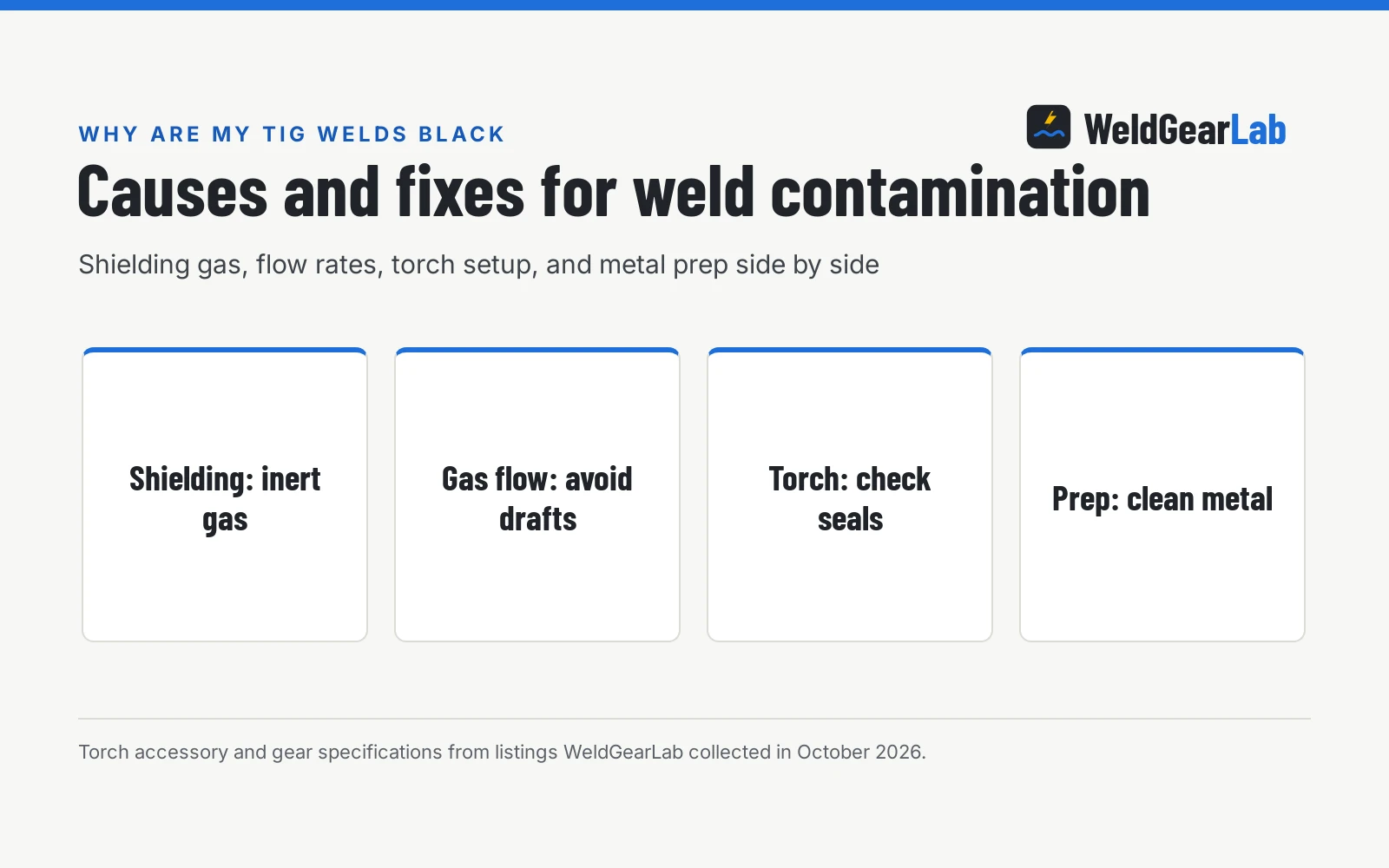
TIG welds turn black because of severe oxidation caused by atmospheric contamination when ambient air reaches the molten puddle without proper shielding gas. If you are asking why are my tig welds black, the underlying fault is almost always a loss of shielding gas coverage, gas line turbulence, a leaky torch seal, inadequate post-flow, or dirty base material. When shielding gas is displaced by oxygen and nitrogen from ambient air, the molten puddle reacts immediately, leaving a dull, dark, crusty deposit instead of a clean, bright bead. This guide breaks down each potential cause step by step and shows how to inspect your gear to restore clean welds.
As an Amazon Associate I earn from qualifying purchases. This guide links to our product roundups, where WeldGearLab earns a commission when you buy through links, at no extra cost to you. Read our affiliate disclosure.
Why Are My TIG Welds Black?
Molten weld pools are highly reactive and require complete isolation from atmospheric gases until the metal cools and solidifies. In gas tungsten arc welding, shielding gas flows through the torch cup to push oxygen and nitrogen away from the arc. When that protective envelope breaks down, oxygen combines with hot metal to form thick surface oxides that appear charcoal black, rough, or soot-covered. Atmospheric nitrogen also dissolves into the molten puddle, causing porosity and embrittlement. Fixing the discoloration requires tracking down where ambient atmosphere is entering the weld zone.
Side by side
| Factor | Oxidized black weld | Clean protected weld | Corrective action |
|---|---|---|---|
| Surface appearance | Black, crusty, or heavily discolored oxide layer | Bright, shiny, silver or light straw color | Grind down to bright bare metal |
| Shielding gas coverage | Disturbed, deficient, or contaminated gas | Undisturbed inert gas envelope over puddle | Inspect cylinder contents and flowmeter setting |
| Post-flow protection | Gas shuts off while puddle or tungsten is hot | Gas flows until metal cools below oxidation temperature | Increase post-flow time or hold torch in place |
| Electrode condition | Black, split, or contaminated tungsten tip | Clean, properly ground electrode free from contamination | Regrind tip and remove contaminated end |
| Gas line and torch seals | Air pulled into stream via loose fittings or bad O-rings | Airtight torch head, tight back cap, and intact O-rings | Replace cracked O-rings and tighten connections |
| Base metal preparation | Oil, mill scale, rust, or cutting residue on joint | Bright metal ground clean and degreased with solvent | Remove mill scale and wipe with solvent |
| Gas nozzle and flow | Turbulent flow, excessive draft, or undersized cup | Smooth laminar shielding from proper cup size or gas lens | Install gas lens and shield from drafts |
| Filler rod handling | Hot rod tip pulled outside shielding gas envelope | Rod tip kept continuously inside shielding gas shield | Keep filler wire within gas stream while dipping |
Shielding gas performance and torch tightness dictate whether a puddle stays clean or oxidizes into a dark crust. Most contamination problems come down to gas delivery, torch assembly, or base metal cleanliness rather than welder power settings.
When shielding gas issues cause black welds
- Shielding gas loss or empty cylinder. If the cylinder runs dry or the solenoid valve fails to open, welding without gas creates an immediate black, boiling crust full of pinholes.
- Wrong gas selection. TIG requires pure argon or specialty argon blends. Using active shielding gases intended for wire feed welding, such as carbon dioxide or mixed gases, instantly burns the tungsten and turns the puddle black.
- Turbulent gas flow from excessive flow rates. Setting the flowmeter too high causes gas turbulence at the nozzle, which pulls outside air into the stream through venturi action and destroys the shield. Conversely, setting flow too low fails to displace atmosphere. Consult our guide on TIG welding argon flow rate for proper flowmeter adjustment.
- Drafts and shop breezes. Moving air from open overhead doors, cooling fans, or HVAC vents sweeps the argon envelope away from the puddle before it can protect the weld.
Upgrading to a gas lens helps produce smooth, laminar gas flow that resists mild drafts better than standard collet bodies.
When base metal and torch prep cause black welds
- Surface mill scale and heavy rust. Unlike stick welding, TIG cannot burn through scale, rust, or paint. Any residual oxide on the joint melts into the puddle and floats to the top as black slag.
- Oil, grease, and cutting fluids. Hydrocarbons vaporize under the arc, releasing hydrogen and carbon that discolor the bead and create internal porosity. Wipe joints with dedicated degreasers before striking an arc.
- Contaminated filler rod. Filler wire stored on open shop racks collects oily dust and surface oxidation that transfers directly into the puddle during dipping. Wipe filler wire clean with a fresh rag.
- Tungsten electrode dipped in the puddle. Touching the tungsten tip into the molten pool or contacting the filler wire contaminates the electrode, destabilizes the arc, and sprays tungsten oxides across the joint. Read our guide on how to sharpen tungsten for TIG welding to restore a contaminated tip.
How to inspect your torch setup and gas delivery
Air leaks inside the torch handle or hose pull outside air into the gas stream before it reaches the nozzle. Inspect these hardware points on your setup:
- Torch back cap O-rings. A cracked, missing, or pinched O-ring on the back cap allows room air to siphon into the torch head under low pressure.
- Cup size and gas lens style. Nozzle selection must match joint geometry and gas flow. For instance, accessory kits from RX WELD include large #10 and #12 cups for WP-17, WP-18, and WP-26 torches to deliver wide shielding coverage on specialty joints, though consumable listings from WelderElite note that alumina nozzles remain standard for conventional welding on WP-17, WP-18, and WP-26 torches. A gas lens uses fine mesh screens to straighten the shielding stream into a uniform column.
- Tungsten grind and diameter. Grinding electrodes longitudinally prevents arc wander that can push the arc outside the shielding gas envelope. For mechanical grinding, DIDUEMEN lists preset angles of 10, 15, 20, and 22.5 degrees for 0.04, 1/16, 3/32, and 1/8 inch electrodes. Keeping the tip clean and properly sized for your amperage stabilizes the puddle; see our guide on what color tungsten for steel.
- Gas hose fittings and connections. Loose hose clamps, cracked vinyl lines, or poorly seated quick-connect fittings introduce atmosphere into the gas line. Brush soapy solution over all gas connections to inspect for bubbles while the line is pressurized.
If your torch body has an internal crack or degraded threads, replacing worn hardware with a dedicated model from our best TIG torch guide eliminates elusive leaks.
Which shielding gas to use for clean TIG welds
Clean TIG welding on carbon steel, stainless steel, and aluminum relies on inert shielding gas, most commonly pure argon. Unlike wire feed welding with active gas mixtures, TIG cannot tolerate oxidizing gases like carbon dioxide or oxygen because the superheated tungsten electrode degrades rapidly in their presence. Even small percentages of oxidizing gas erode the tungsten, destabilize the arc, and coat the weld in dark soot.
While specialized applications sometimes employ inert mixtures such as argon-helium for heavy aluminum or argon-hydrogen for stainless steel, general shop fabrication uses pure argon. When purchasing or refilling a gas cylinder at a local welding distributor, verify that the cylinder shoulder label clearly indicates welding-grade argon. If you suspect cylinder contamination from an impure fill, verify your torch setup on clean scrap metal using a known good cylinder.
Can aluminum and stainless turn black for the same reasons?
Both stainless steel and aluminum suffer dark discoloration when atmospheric protection fails, though each material has distinct sensitivities. On stainless steel, atmospheric exposure on the molten face produces a crusty black oxide, while unpurged joint backsides develop severe granular oxidation commonly known as sugaring. On aluminum, an insulating oxide film forms immediately in the presence of air; welders operating AC equipment, such as machines covered in our guide to the best TIG welder for aluminum, encounter dark soot or peppered deposits if AC cleaning balance is set with insufficient electrode positive action or if drafts disrupt the argon blanket.
Safety precautions with shielding gas and electrical equipment. Compressed argon cylinders store gas under high pressure and must remain secured upright with safety chains at all times. Always cap cylinders when moving them and close the main cylinder valve when the welder is turned off. High-frequency electrical arc starting and intense ultraviolet radiation require full personal protective gear, including fire-resistant jackets, leather gloves, and a properly shaded welding helmet to prevent arc flash burns. Maintain adequate shop ventilation to avoid gas displacement in confined spaces, keep a charged fire extinguisher accessible, and consult the operating manual for your specific machine before adjusting settings.
Frequently Asked Questions
Can I just grind off a black TIG weld and keep going?
Surface discoloration from mild oxidation can sometimes be removed with a stainless steel wire brush or abrasive disc. However, if the bead is crusty, pitted, or filled with black porosity, the contamination extends throughout the weld deposit. You must grind out the entire defective area down to clean, bright base metal before running another bead.
Why does my tungsten electrode turn black alongside the weld?
A blackened tungsten tip indicates that oxygen reached the electrode while it was hot. This happens when post-flow gas shuts off too soon, when an internal torch leak introduces air, or when the torch is pulled away immediately after breaking the arc. Increase post-flow duration so argon protects the tungsten until the tip cools.
Does excessive shielding gas flow cause welds to turn black?
Yes, excessive gas velocity creates turbulence at the cup nozzle instead of a smooth column. The swirling gas pulls surrounding air into the stream through venturi suction, delivering oxygen directly to the molten puddle. Lowering gas flow to a moderate rate recommended for your nozzle size restores an effective shield.
Why do my stainless steel TIG welds look gray or black instead of colorful?
Stainless steel turns dull gray or black when it overheats and stays exposed to air while above its oxidation temperature. Using excessive amperage, traveling too slowly, or failing to maintain post-flow coverage causes chromium in the alloy to burn out into thick surface oxide. Lower heat input and a larger gas lens help maintain bright colors.
How does a gas lens prevent black welds?
A gas lens replaces the standard collet body with stacked screens that straighten turbulent argon into a uniform, laminar stream. This wider, stable gas column prevents ambient air from swirling into the puddle and allows longer tungsten stick-out for joint visibility. It provides significantly better coverage when welding in drafty environments or awkward corners.
Related: TIG welding argon flow rate, how to sharpen tungsten for TIG welding, what color tungsten for steel, best TIG torch, and the TIG welders hub. Also see our guide to the best TIG rod for mild steel.
About the author
WeldGearLab Editorial is the editorial team behind WeldGearLab. We research product listings, specifications, safety listings and warranty terms, score every pick with the published Gear Score method, and correct errors when readers report them. We do not run our own shop trials; see How We Pick for exactly how picks are made.