What Color Tungsten for Aluminum? Best Electrodes for AC TIG
Blue 2% lanthanated is the top tungsten choice for AC aluminum TIG welding, while purple rare earth, gray ceriated, and green pure tungsten suit specific setups.
 By WeldGearLab Editorial
Updated October 10, 2026
By WeldGearLab Editorial
Updated October 10, 2026
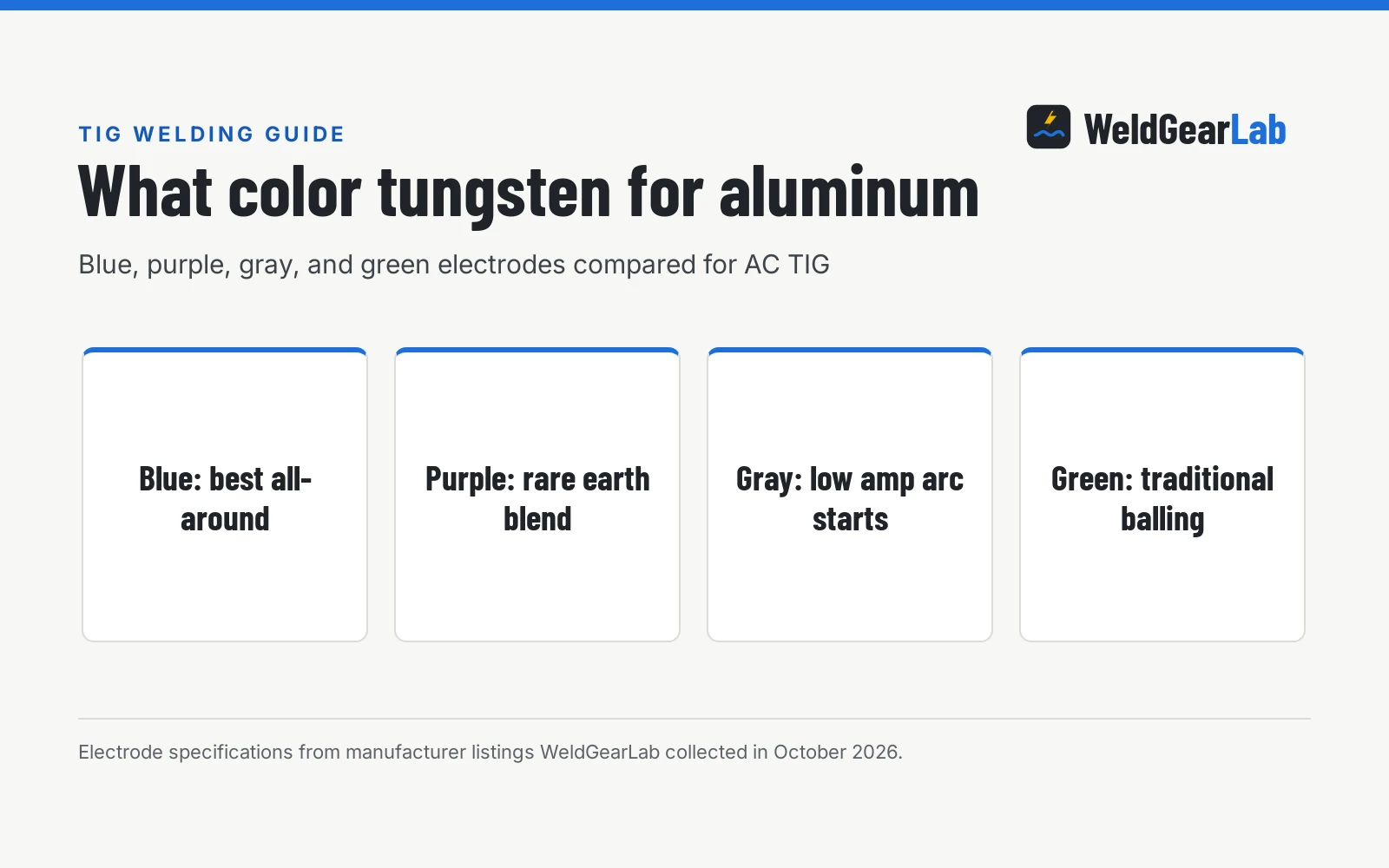
If you need to know what color tungsten for aluminum welding works best, the direct answer for modern AC TIG setups is blue (2% lanthanated). Purple (rare earth blend) and gray (2% ceriated) also deliver dependable results on alternating current, while green (pure tungsten) remains an option primarily for older transformer machines. For an inverter machine, blue 2% lanthanated provides stable arc starts, puddle control, and tip longevity without spitting tungsten into the weld pool.
As an Amazon Associate I earn from qualifying purchases. This guide links to our product roundups, where WeldGearLab earns a commission when you buy through links, at no extra cost to you. Read our affiliate disclosure.
What Color Tungsten for Aluminum Works Best
Selecting tungsten for aluminum differs from choosing electrodes for steel because aluminum welding requires alternating current (AC). During the AC cycle, the current switches between electrode negative for penetration and electrode positive for cleaning the oxide layer. That cleaning half of the cycle directs heat back into the tungsten, demanding an alloy that withstands thermal loads without melting away.
Traditional transformer welders generated a sine wave that required green pure tungsten to melt into a rounded ball at the tip. Modern inverter machines, including models in our guide to the best TIG welder for aluminum, generate square wave arcs with balance controls. These machines perform best with alloyed tungsten that holds a pointed or slightly blunted tip rather than a large ball.
Side by side
| Color | Composition | AWS Class | Current Type | Tip Shape on AC |
|---|---|---|---|---|
| Blue | 2% Lanthanated | EWLa-2 / WL20 | AC and DC | Pointed or slightly blunted |
| Purple | Rare Earth Blend | EWG / WG20 | AC and DC | Pointed or modified taper |
| Gray | 2% Ceriated | EWCe-2 / WC20 | AC and DC | Pointed taper |
| Green | Pure Tungsten | EWP | Primarily AC | Balled rounded tip |
Electrode specifications follow standard AWS A5.12M classifications. While blue 2% lanthanated serves as the primary all-around electrode, purple rare earth blends and gray ceriated provide dependable alternatives for specific current ranges.
Blue 2% Lanthanated: The Modern Standard
Blue tungsten contains lanthanum oxide, designated as EWLa-2 or WL20. It is the primary recommendation for inverter AC TIG welding because it combines high electrical conductivity with resistance to thermal shock. The listing for CK Worldwide states its blue tungsten contains 1.8 to 2.2% lanthanum oxide in 3/32″ diameter by 7″ length. Similarly, ARCCAPTAIN packages blue 2% lanthanated electrodes in 1/16″ and 3/32″ diameters at 7″ length, noting the alloy resists thermal shock and avoids splitting under heavy amps even on thick aluminum plate.
Under an alternating current arc, blue tungsten resists melting into a sphere. The tip forms micro-balls across the ground point while preserving a pointed shape. This maintains a focused arc cone for precise puddle control. Patriot Tungsten also lists blue 2% lanthanated electrodes in 3/32″ diameter in a 10 pack conforming to standard AWS dimensions.
Purple and Gray: Versatile Alternatives
Purple tungsten represents a rare earth blend, classified under AWS as EWG or WG20. Manufacturers combine complementary rare earth oxides to enhance arc ignition and reduce burn-off. Midwest Tungsten Service packages purple rare earth blend electrodes in 1/16″ diameter in a 10-pack, noting consistent arc reliability on AC and DC applications for aluminum alloys. In larger sizes, MELTSTAR lists rare earth blend electrodes in 1/8″ by 7″ (3.2 mm by 175 mm) dimensions in a 10-pack, describing the material as an alternative to WT20.
Gray tungsten contains cerium oxide, designated as EWCe-2 or WC20. Ceriated tungsten initiates an arc easily at low current, making it useful for thin sheet aluminum bracketry. WelderElite lists 2% ceriated gray electrodes in 1/16″ by 7″ (1.6 mm by 175 mm) size in a 10 pack, stating that the alloy provides fast arc striking and low burn-off without splitting under high amperage. In general shop practice, gray ceriated is favored for low-current precision work, whereas blue lanthanated handles heavy current on thick sections more reliably.
Green Pure Tungsten: Traditional Transformer Choice
Green tungsten, classified as EWP, consists of unalloyed pure tungsten without oxide additives. Arc-Zone lists pure green EWP electrodes in 1/16″ by 7″ (175 mm) dimensions in a 10 pack, noting that pure tungsten is historically common for AC aluminum welding. Because pure tungsten has a high work-function and lacks oxide additions to ease electron emission, it requires higher operating temperatures at the tip, causing it to melt readily into a ball under the reverse polarity cycle.
On a transformer machine with a sine wave output, this melting forms a clean ball that distributes heat across a rounded surface. On a modern inverter welder, however, green pure tungsten often causes issues. The high switching speeds of square wave AC cause a balled pure tungsten tip to wobble, spit molten tungsten into the puddle, or split. Inverter machines from our TIG welders hub perform far better with blue 2% lanthanated.
How to Prepare Tungsten for AC Aluminum
Tip preparation dictates arc focus and puddle stability. How you prepare an electrode depends on your power source:
- Inverter machines: Grind the tungsten to a pointed taper, then grind a small flat land onto the point. This truncated point prevents the extreme tip from overheating and dropping into the puddle during cleaning cycles. Avoid forming a large ball on the tungsten when using an inverter welder, as square wave current performs best with a pointed or truncated tip. For balance adjustments, consult our guide to TIG welding aluminum settings.
- Transformer machines: Form a rounded ball on the tip using direct current electrode positive on scrap copper or aluminum. The ball diameter should not exceed the electrode shaft diameter.
- Grinding direction: Grind longitudinally along the length of the electrode rather than across the diameter. Radial grinding marks cause the arc to wander.
- Dedicated wheels: Use a grinding wheel dedicated exclusively to tungsten. Wheels contaminated with steel or shop grit transfer debris into the tungsten and spoil aluminum welds.
Storing prepared electrodes in protective cases keeps them clean. Blue Demon lists storage tubes sized to hold up to 10 electrodes in 1/8″ and smaller diameters, or 5 to 7 electrodes in 5/32″ and 1/4″ sizes.
Selecting Electrode Diameter for Aluminum
Electrode diameter determines current handling and arc stability. An undersized tungsten overheats and splits, while an oversized tungsten makes arc ignition difficult at low current. Reference listings show standard sizes tailored to different workloads: WelderElite lists 1/16″ diameter for low-amperage work, CK Worldwide provides 3/32″ diameter for mid-range fabrication, and MELTSTAR lists 1/8″ diameter for heavy sections. For thinner aluminum sheet, smaller diameters provide responsive arc starting. For general shop fabrication, 3/32″ diameter serves as the standard choice for sheet and tubing. For thick structural plate, stepping up to 1/8″ diameter provides the mass needed to handle high current without eroding the tip. Match your electrode with filler metal from our guide to the best TIG rod for aluminum.
Shop Safety and Tungsten Handling
TIG welding aluminum produces intense ultraviolet light and ozone. Always wear a shaded helmet and protective leather gear covering all skin to prevent arc flash burns. Because hot aluminum shows no color change, treat all metal on the bench as hot.
When grinding tungsten, use local exhaust ventilation or a respirator to avoid inhaling fine dust particles. Non-radioactive options like blue 2% lanthanated, purple rare earth, and gray 2% ceriated provide dependable AC arc performance without radioactive handling concerns. Secure shielding gas cylinders upright with safety chains and use proper regulators before opening cylinder valves.
Frequently Asked Questions
Why did blue lanthanated tungsten replace green pure tungsten for aluminum?
Blue 2% lanthanated tungsten contains lanthanum oxide, which lowers the electrical work function and improves thermal stability compared to unalloyed green tungsten. On modern inverter welders, blue electrodes maintain a pointed geometry across alternating current cycles rather than melting into an uncontrolled ball. This creates a much narrower, more stable arc cone that gives the operator superior puddle control.
Should tungsten for aluminum be balled or pointed?
On modern inverter TIG machines, grind the tungsten to a pointed taper with a small flat land on the tip to maintain a focused arc cone. A balled tip was standard practice for pure green tungsten on older transformer power sources to prevent the tip from melting away. Running a balled electrode on an inverter machine creates a wide, unstable arc puddle that is difficult to steer.
Why does my tungsten split or crack when welding aluminum?
Tungsten splitting usually occurs when the electrode diameter is too small for the welding current or when the AC balance directs excessive cleaning action, and therefore excessive heat, into the electrode and torch. Thermal shock from abrupt current changes or using pure tungsten on high AC frequencies can also cause splintering. Stepping up to 3/32″ or 1/8″ diameter blue lanthanated tungsten provides greater thermal capacity without cracking.
What shielding gas should be used with tungsten on aluminum?
TIG welding aluminum requires pure argon shielding gas to protect both the molten aluminum puddle and the hot tungsten electrode. Never use carbon dioxide or mixed MIG gases, which will instantly contaminate the tungsten and oxidize the weld puddle. Proper gas post-flow after extinguishing the arc keeps the tungsten shielded until it cools below oxidizing temperatures.
How do you clean a contaminated tungsten electrode?
If the tungsten touches the aluminum puddle or the filler rod, stop welding immediately and remove the electrode from the torch. Break or cut off the contaminated end before grinding a fresh point on a dedicated grinding wheel. Attempting to weld with an aluminum-capped tip will spit tungsten inclusions into the puddle and destabilize the arc.
Related: best TIG welder for aluminum, TIG welding aluminum settings, best TIG rod for aluminum, and the TIG welders hub. Also see our guide to welding aluminum with a TIG welder.
About the author
WeldGearLab Editorial is the editorial team behind WeldGearLab. We research product listings, specifications, safety listings and warranty terms, score every pick with the published Gear Score method, and correct errors when readers report them. We do not run our own shop trials; see How We Pick for exactly how picks are made.