TIG vs MIG Welding for Beginners: Which Should You Learn First
TIG and MIG welding suit different beginner projects, differing in learning curve, equipment setup, metal thickness, and whether you need speed or fine control.
 By WeldGearLab Editorial
Updated October 9, 2026
By WeldGearLab Editorial
Updated October 9, 2026
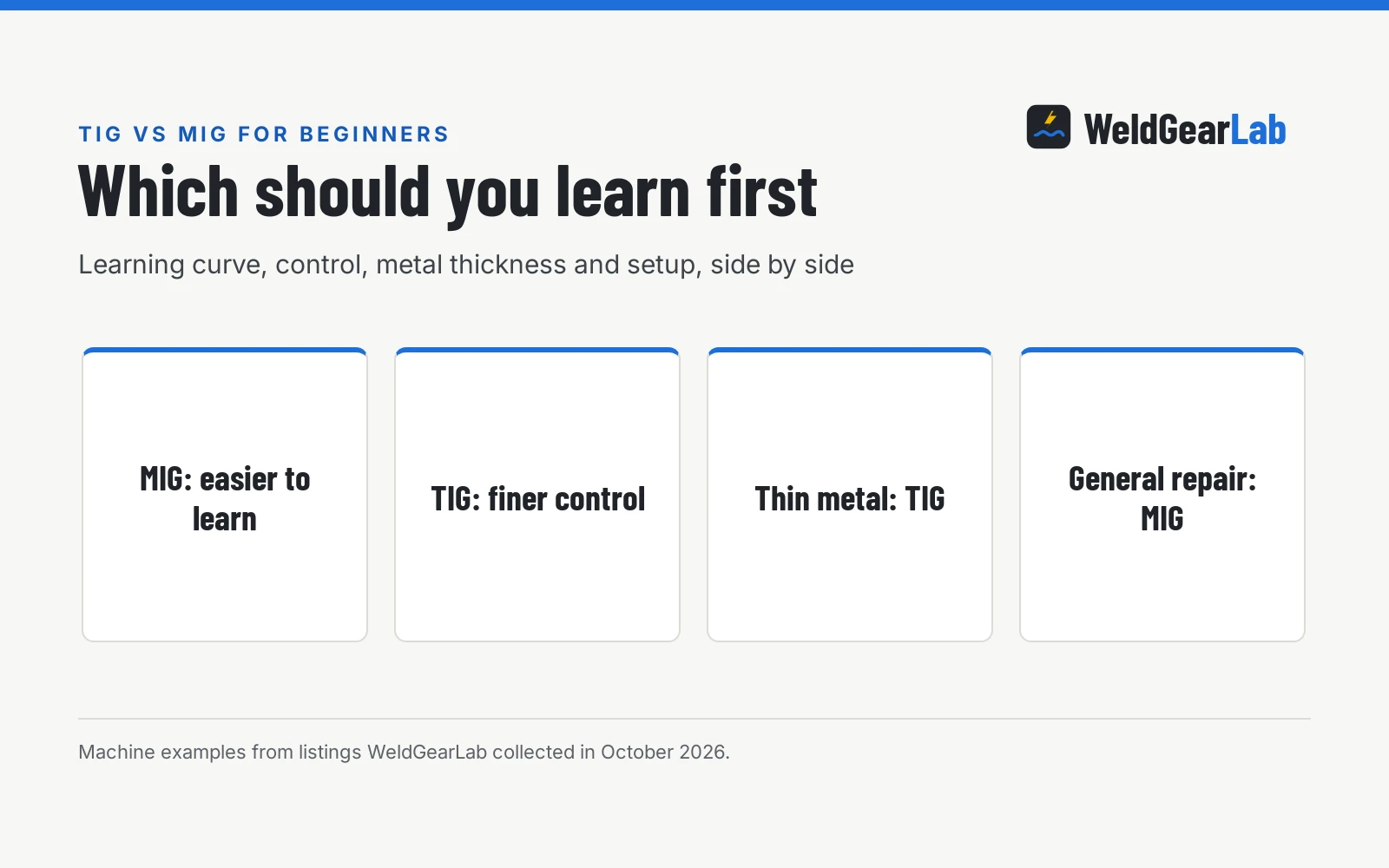
When deciding between TIG vs MIG welding for beginners, MIG welding is almost always the easier process to learn first, while TIG welding offers superior precision once you master torch and filler control. MIG uses a spool-fed wire gun that acts as both electrode and filler metal, letting you strike an arc and lay a sound bead with a steady hand. TIG uses a non-consumable tungsten electrode and requires guiding the torch with a steady hand while manually adding filler rod with the other hand. For home hobbyists, automotive sheet work, and quick structural repairs, MIG gets you welding solid joints within an afternoon, whereas TIG requires patience and deliberate practice to produce clean, spatter-free beads. This guide explains how both processes operate, where each excels in a home workshop, and how to pick the right path for your fabrication goals.
As an Amazon Associate I earn from qualifying purchases. This guide links to our product roundups, where WeldGearLab earns a commission when you buy through links, at no extra cost to you. Read our affiliate disclosure.
TIG vs MIG welding for beginners: the core difference
Both methods create strong metal bonds by melting base metal with an electric arc, but they handle filler material and arc shielding differently. In MIG welding (gas metal arc welding), a motorized drive roll pushes wire through a flexible cable to the gun tip. Pulling the trigger simultaneously energizes the wire, starts wire feeding, and opens a gas valve to blanket the puddle in shielding gas. Because wire feed speed and arc voltage remain constant once dialed on the machine, you only need to focus on torch angle, travel speed, and stickout distance.
In TIG welding (gas tungsten arc welding), the electric arc jumps from a pointed tungsten electrode that does not melt into the puddle. You hold the torch like a pencil, establish the arc without touching tungsten to base metal, and introduce a separate bare rod into the leading edge of the molten pool. On machines equipped with a foot pedal or torch control, heat input can be adjusted dynamically, giving you precise control over puddle width and penetration. That level of finesse makes TIG rewarding on delicate projects, but coordinating torch height, arc length, and filler feeding takes steady practice.
Side by side
| Gas MIG | Flux-Core | TIG | |
|---|---|---|---|
| Electrode type | Continuously fed solid wire | Continuously fed fluxed hollow wire | Non-consumable tungsten electrode |
| Shielding method | Argon and carbon dioxide gas from cylinder | Internal flux core produces gas and slag | Pure argon gas from cylinder |
| Filler metal feeding | Automated feeding through gun trigger | Automated feeding through gun trigger | Manual hand feeding with separate rod |
| Learning curve | Easiest to learn, trigger controls wire and gas | Easy to learn, no gas setup required | Steeper, requires coordinated torch and rod work |
| Travel speed | Fast on long joints and seams | Fast on long joints and seams | Slower, deliberate pacing for precision |
| Outdoor wind tolerance | Poor, breeze blows shielding gas away | Good, flux protects arc in moderate breeze | Poor, breeze blows shielding gas away |
| Thin metal control | Good on sheet, moderate burn-through risk | Difficult on thin sheet, high heat and burn-through | Superior heat control, excellent on thin material |
| Spatter and cleanup | Low spatter, no slag to chip | Heavier spatter, requires slag chipping | No spatter, no slag |
| Aluminum welding | Possible with spool gun and pure argon | Not capable of welding aluminum | Capable with alternating current machine |
| Typical polarity | DCEP (electrode positive) | DCEN (electrode negative) | DCEN (electrode negative on steel) |
| Best beginner uses | Auto sheet, shop carts, indoor fabrication | Outdoor fences, farm gates, rusty equipment | Tubing, precision brackets, decorative fabrication |
Shielding gas and electrical polarity follow distinct requirements for each process. MIG on mild steel typically runs direct current electrode positive with an argon and carbon dioxide gas blend. TIG on steel and stainless steel runs direct current electrode negative with pure argon gas to preserve the pointed tungsten shape and shield the puddle without oxidation.
When MIG welding is the better choice
- Faster learning curve. Beginners can produce functional, strong joints quickly because the gun feeds filler automatically. You do not have to split your attention between separate hands to keep the arc alive and the joint filled.
- Higher travel speed on long joints. When assembling shop benches, garden gates, or utility trailers, MIG lays continuous beads without interruption. You can complete long seams in a fraction of the time required by manual rod feeding.
- Practical thickness range on common steel. Wire feed welding deposits filler metal quickly, making it efficient on everyday garage stock and repair material. For example, the PONEY listing rates its 110V machine to weld mild steel up to 1/8 in (3mm), and joints up to 3/16 in (4.8 mm). Similarly, the GNI listing specifies welding on metals from 0.03 to 0.18 inches thick using .030, .035, and .039 inch wire. While heavy structural steel requires higher amperage, these capacities comfortably cover common home shop brackets, frames, and sheet repair.
- Forgiving joint fit-up. MIG easily bridges slight gaps between poorly aligned metal pieces. The constant stream of wire deposits enough metal to fill gaps without blowing away the edges.
If you want to start with a versatile shop setup, our best welder for beginners and how to choose a MIG welder guides break down entry-level machines. We also explore affordable options in our best MIG welder for hobbyist roundup.
When TIG welding is the better choice
- Pinpoint heat control on thin material. Fine heat control lets you weld thin metal without blowing through. For practicing joints on thin sheet without burn-through, the METAVION practice kit uses 1.4mm (17 Gauge) 304 stainless steel. That control helps prevent warping and heat distortion across decorative panels and vehicle bodywork.
- Exceptional bead cleanliness and appearance. TIG creates no spatter, no airborne sparks, and no slag. The resulting bead features smooth, uniform ripples that look attractive without grinding, making it preferred for exposed architectural furniture, bicycle tubing, and decorative fabrication.
- Exotic and varied metals. TIG handles copper, bronze, chromoly tubing, and stainless alloys with precise metallurgy. Because no flux or spatter is present, the weld zone stays clean and ductile.
- Precise aluminum welding. When paired with alternating current output, TIG breaks up the durable surface oxide layer on aluminum while creating clean puddles; explore our guide to the best TIG welder for aluminum.
Browse our TIG welders guide for equipment details and setup configurations across dedicated machines.
Equipment, gas, and running costs
Setting up a welding station involves more than the power supply. A complete MIG station requires the welder, a spool of wire, spare contact tips, drive rolls, a gas regulator, and a cylinder of blended argon and carbon dioxide. Wire spool capacity varies between machines, with the FEMEROL listing supporting 2LB and 10LB wire spools. Because solid wire feeds smoothly from an internal spool, consumable costs remain low per foot of weld deposited.
A TIG station requires a torch with collets, collet bodies, alumina cups, sharpened tungsten electrodes, filler rods matching your base material, and a cylinder of pure argon. You also need a dedicated bench grinder or sharpening wheel to point your tungsten electrodes. Tungsten preparation becomes a recurring task because accidental contact with the weld puddle contaminates the tip, immediately dispersing the arc and requiring a fresh grind.
Many fabricators compromise by choosing a multiprocess machine capable of running both wire feed and lift TIG. Multiprocess units like the RUBIK offer 200A output on 110V and 220V dual voltage, providing flexible power options for varied workshop tasks. See our guide to the best multi-process welder for versatile machine options.
Safety and shop setup
Both welding methods produce intense heat, ultraviolet radiation, and toxic fumes that demand proper workshop precautions. The open electric arc generates strong ultraviolet rays that can burn unprotected skin within moments, making a flame-resistant jacket and proper shade helmet mandatory. Because TIG arcs emit concentrated ultraviolet light without smoke filtration, choose an auto-darkening helmet with sensitive sensors; see our scored selections in the best welding helmet for TIG welding.
Protect your hands with appropriate leather gloves. TIG demands thin goat or pigskin gloves that provide tactile feedback for feeding filler rod, whereas MIG requires heavier split cowhide to resist stray spatter and radiant heat. Always keep your head clear of the rising fume plume and weld in an area with fresh air circulation. Secure all compressed shielding gas cylinders upright to a sturdy wall or rolling cart using chains to prevent accidental tip-overs. For a comprehensive inventory of personal protective equipment, read our welding safety gear checklist for beginners.
Frequently Asked Questions
Should I learn TIG or MIG first?
Most beginners should start with MIG because the automated wire feed and simple gun trigger let you establish a stable puddle right away. Learning MIG teaches you how to observe the weld pool, control travel angle, and adjust travel speed without juggling separate filler wire. Once you understand puddle dynamics on steel, moving to TIG becomes much easier because you only need to add torch and rod manipulation.
Is TIG welding stronger than MIG welding?
Both processes produce strong, sound welds when joint preparation, shielding gas coverage, and heat settings match the material. TIG allows finer control over heat input, making it easier to avoid defects on thin tubing and critical joints. For typical hobby, farm, and automotive fabrication, a properly executed MIG weld provides all the structural holding strength you need.
Can a beginner weld aluminum with TIG or MIG?
Welding aluminum is possible with both processes, but it presents unique challenges for beginners due to rapid heat dissipation and surface oxide. TIG welding aluminum requires an alternating current machine with high frequency arc starting to clean oxide while melting the base metal. MIG welding aluminum requires pure argon shielding gas along with a spool gun to prevent soft aluminum wire from bunching inside the cable.
Can a single machine run both TIG and MIG?
Many multiprocess welders support MIG, stick, and lift TIG in a single compact chassis. However, most entry multiprocess machines only offer direct current lift TIG without high frequency arc start or foot pedal control. If your main goal is detailed aluminum work, you will need a dedicated alternating current TIG unit rather than a basic multiprocess MIG machine.
Why is TIG welding considered harder to learn?
TIG requires dividing your attention between maintaining a consistent arc gap with the torch and manually dabbing filler rod into the molten puddle. Touching the tungsten electrode to the puddle contaminates the tip immediately, requiring you to stop and grind a clean point before continuing. MIG simplifies the physical work by feeding wire continuously through the gun, allowing beginners to concentrate entirely on puddle direction and travel speed.
Related: MIG welders hub, how to learn welding at home, and welding projects for beginners.
About the author
WeldGearLab Editorial is the editorial team behind WeldGearLab. We research product listings, specifications, safety listings and warranty terms, score every pick with the published Gear Score method, and correct errors when readers report them. We do not run our own shop trials; see How We Pick for exactly how picks are made.