Hobart Handler 140 vs 140EZ: What Changed and Is It Worth It?
The Hobart Handler 140 and 140EZ compared on controls, wire feed setup, gas capability, and arc tuning to help you pick the right wire welder for your shop.
 By WeldGearLab Editorial
Updated October 9, 2026
By WeldGearLab Editorial
Updated October 9, 2026
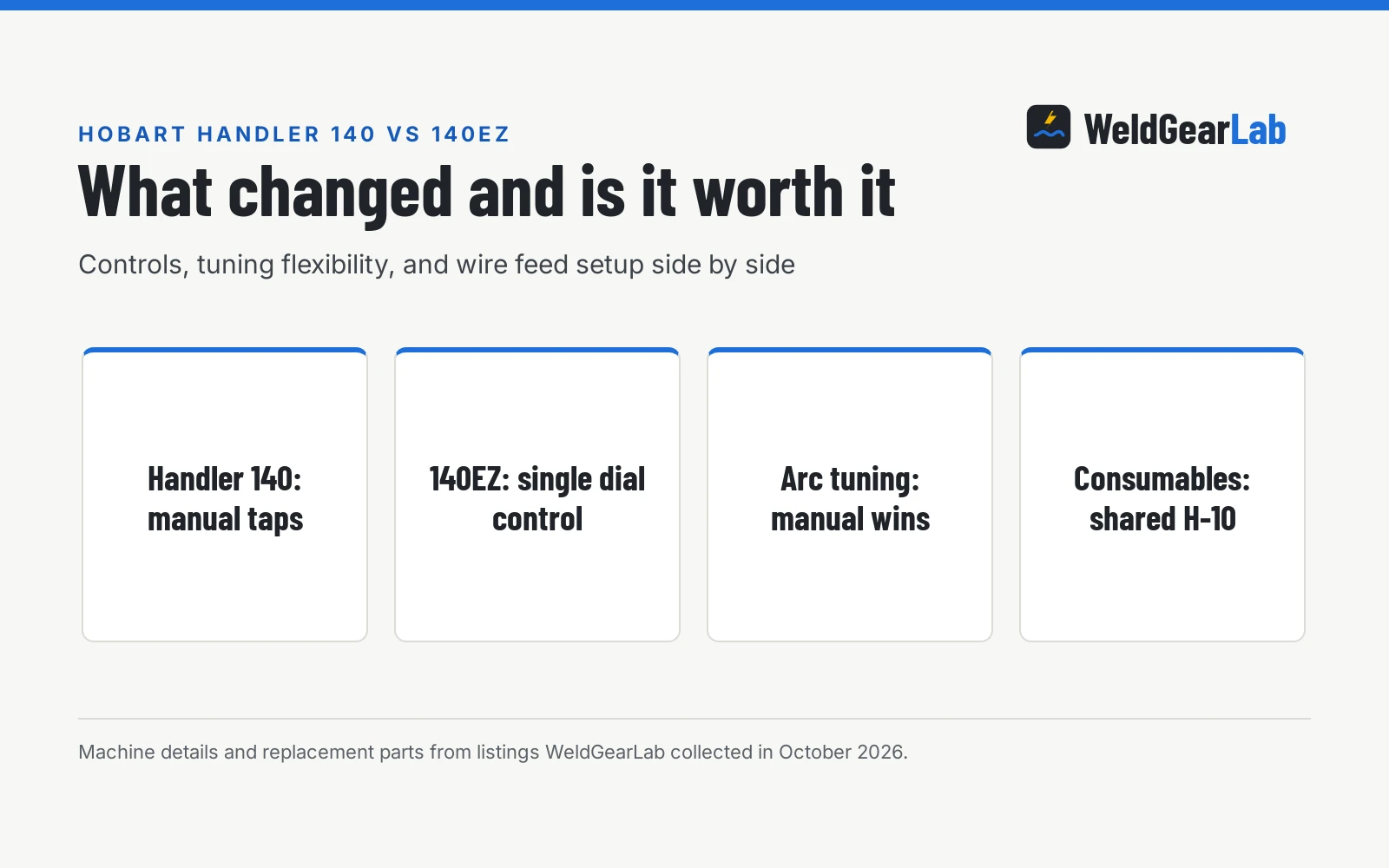
When comparing the Hobart Handler 140 vs 140EZ, the primary difference is the control system. The standard Hobart Handler 140 provides independent controls with tapped voltage settings and a separate wire feed speed dial, whereas the Handler 140EZ uses a single knob calibrated by material thickness that sets both parameters automatically. If you already own a Handler 140, upgrading to the 140EZ is not worth it because you lose independent arc tuning. The Handler 140 remains more versatile for shop fabrication, while the 140EZ offers dial-and-weld simplicity for quick maintenance.
As an Amazon Associate I earn from qualifying purchases. This guide links to our product roundups, where WeldGearLab earns a commission when you buy through links, at no extra cost to you. Read our affiliate disclosure.
The difference in one paragraph
Both welders share a durable transformer design, wire drive assembly, and heavy cabinet running on a standard household electrical circuit. Both machines feed solid wire with shielding gas or gasless flux-core wire using standard Hobart H-10 series guns. The difference sits on the front panel. The classic Handler 140 gives you discrete tapped voltage positions alongside a continuous wire feed speed dial for fine arc adjustment. The Handler 140EZ collapses those settings into a single thickness dial, trading manual trim for fast setup.
Hobart Handler 140 vs 140EZ side by side
| Hobart Handler 140 | Hobart Handler 140EZ | Takeaway | |
|---|---|---|---|
| Voltage adjustment | Discrete tapped voltage selector | Single dial linked to wire speed | Handler 140 provides manual voltage selection |
| Wire feed control | Independent wire feed dial | Automatic tracking based on thickness setting | Handler 140 allows independent wire speed tuning |
| Welding processes | Solid wire MIG and flux-core | Solid wire MIG and flux-core | Both run solid wire MIG and flux-core |
| Stated wire sizes | .023, .030, and .035 inch wire | .023, .030, and .035 inch wire | Both feed .023 to .035 with matching tips and liner |
| Torch connection | Direct connect H-10 series torch | Direct connect H-10 series torch | Both utilize H-10 series torch style |
| Consumables | Standard 000-067, 000-068 tips and 169-715 nozzle | Standard 000-067, 000-068 tips and 169-715 nozzle | Shared front end tips and gas nozzles |
| Arc fine tuning | Manual control for gaps and out of position welds | Preset tracking curve based on thickness dial | Handler 140 offers superior puddle control |
| Protective machine cover | Hobart part 195186 | Not stated in reference listings | Cover listing specifies Handler 140 compatibility |
| Best suited for | Fabricators who want independent heat and wire control | Users who want straightforward dial and weld operation | Handler 140 provides better long term versatility |
Both models use standard wire spools and Hobart front end parts. Consumable listings specify the Hobart H-10 torch style, taking 000-067 contact tips for .030 inch wire, 000-068 tips for .035 inch wire, the 169-715 gas nozzle, and the 169-716 gas diffuser. To protect the machine between jobs, listings specify Hobart cover part number 195186 for Handler 140 welders. For equipment selection advice, read our guide on how to choose a MIG welder.
When the standard Handler 140 is the better choice
The traditional Hobart Handler 140 is preferred when you want complete control over the puddle:
- Out of position welding. For vertical or overhead joints, independent controls let you lower voltage and trim wire feed speed to keep the puddle small and prevent sagging.
- Poor joint fit up. For uneven gaps, reducing wire speed and heat helps bridge openings without burning through edges.
- Thin sheet metal. The Handler 140 lets you choose a low voltage tap and dial in exact wire speed for small, clean tacks without warping.
- Skill building. Balancing voltage taps with wire speed teaches you to read the puddle and listen to the arc.
For more versatile machines, our best MIG welder for hobbyist roundup compares wire feed units that run on household circuits.
When the Handler 140EZ is the better choice
The Handler 140EZ is designed for operators who want simple setup without referencing a door chart:
- Novice welders. The single dial eliminates balancing dials. You set the knob to match metal thickness and weld.
- Occasional repairs. For fixing brackets, gates, or garden tools, single knob operation saves time and avoids parameter mistakes.
- Bench fabrication. On clean mild steel with tight fit up, the factory tracking delivers a smooth arc in the flat position.
- Fewer errors. Single dial control minimizes mismatched settings that cause wire stubbing or tip burnback.
For sheet repair alternatives, see our guide on the best welder for body panels.
How the controls and arc tuning differ
The standard Handler 140 features a tapped selector where each tap sets voltage, determining arc length and bead width. A continuous potentiometer regulates wire drive speed, controlling amperage and metal deposition. This separation lets the welder adjust heat and deposition independently for varied travel speeds and joint types.
The Handler 140EZ replaces both dials with one knob marked by steel thickness. Turning the knob changes voltage and wire speed together along a preset curve. While effective on clean steel in flat joints, you cannot adjust wire speed independently to stabilize the arc on rust or out of position joints.
To reduce popping while welding, review our guide on why a MIG welder spatters.
Wire sizes and shielding gas setup
Both welders handle flux-core wire without gas, or solid wire with shielding gas:
- Solid wire MIG. Both units support .030 inch and .035 inch solid steel wire using standard 000-067 and 000-068 contact tips, with .023 inch wire supported using matching tips. Replacement liners, such as Hobart part 196139, are listed to feed .023 to .035 inch diameter wire on Handler welders.
- Self shielded flux-core. Flux-core runs in .030 inch and .035 inch diameters without gas. Check spool labels and the door chart to set appropriate direct current electrode negative polarity.
- Torch parts. Replacement listings specify Hobart H-10 torches (parts 245924 and 195957) with 169-715 gas nozzles and 169-716 diffusers.
- Shielding gas. Both welders connect to gas regulators for mixed argon and carbon dioxide cylinders.
Read our complete breakdown on flux core vs MIG welding.
Is the Handler 140EZ worth upgrading to?
If you own a standard Hobart Handler 140, upgrading to the Handler 140EZ is not worth it. Switching reduces tuning control. Power output, transformer build, and wire drive components are comparable. The only shift is replacing the wire speed dial with a single thickness knob, which simplifies setup for novices but removes fine tuning.
The 140EZ fits shops where fast repairs take precedence over custom adjustment. If you understand voltage taps and wire speed, the standard Handler 140 remains more capable. For higher output, consider a larger unit rather than changing controls; see our comparison in Hobart vs Lincoln MIG welder or check spool gun for Hobart Handler 140 options.
Shop safety precautions. Wear a shaded helmet, welding gloves, and flame resistant clothing. Maintain ventilation to keep fumes away. Secure your ground clamp to bare metal and chain gas cylinders upright to a cart or wall.
Frequently Asked Questions
Can the Hobart Handler 140EZ weld with shielding gas?
Yes, the Handler 140EZ supports solid wire MIG welding with external shielding gas. It connects to a gas regulator for mixed argon and carbon dioxide cylinders, or runs flux-core without gas.
Do the Handler 140 and 140EZ use the same contact tips and nozzles?
Both models use standard Hobart H-10 series torch consumables. Listings specify 000-067 contact tips for .030 inch wire, 000-068 tips for .035 inch wire, the 169-715 gas nozzle, and the 169-716 diffuser.
Can you adjust wire feed speed independently on the Handler 140EZ?
No, the Handler 140EZ links wire feed speed directly to voltage through a single thickness dial. For independent wire speed control to fine tune your arc, choose the standard Handler 140.
Is the Handler 140EZ worth upgrading if I already own a Handler 140?
Upgrading is not recommended. The 140EZ provides comparable welding output while removing manual wire speed control, making the standard Handler 140 more versatile overall.
Which welder is better for auto body and thin sheet metal?
The standard Hobart Handler 140 is better suited for thin sheet metal. Its separate wire speed dial allows you to reduce wire delivery on low voltage taps to prevent burn-through on thin panels.
Related: explore the MIG welders category, our guide on can you MIG weld without gas, and our troubleshooting tips on how to fix MIG wire birdnesting. Also see our advice on how to choose flux core wire.
About the author
WeldGearLab Editorial is the editorial team behind WeldGearLab. We research product listings, specifications, safety listings and warranty terms, score every pick with the published Gear Score method, and correct errors when readers report them. We do not run our own shop trials; see How We Pick for exactly how picks are made.