Flap Disc Type 27 vs 29: Which One Should You Buy?
Type 27 flat flap discs and Type 29 conical flap discs compared on grinding angle, stock removal, surface blending, disc materials and listing clarity.
 By WeldGearLab Editorial
Updated October 9, 2026
By WeldGearLab Editorial
Updated October 9, 2026
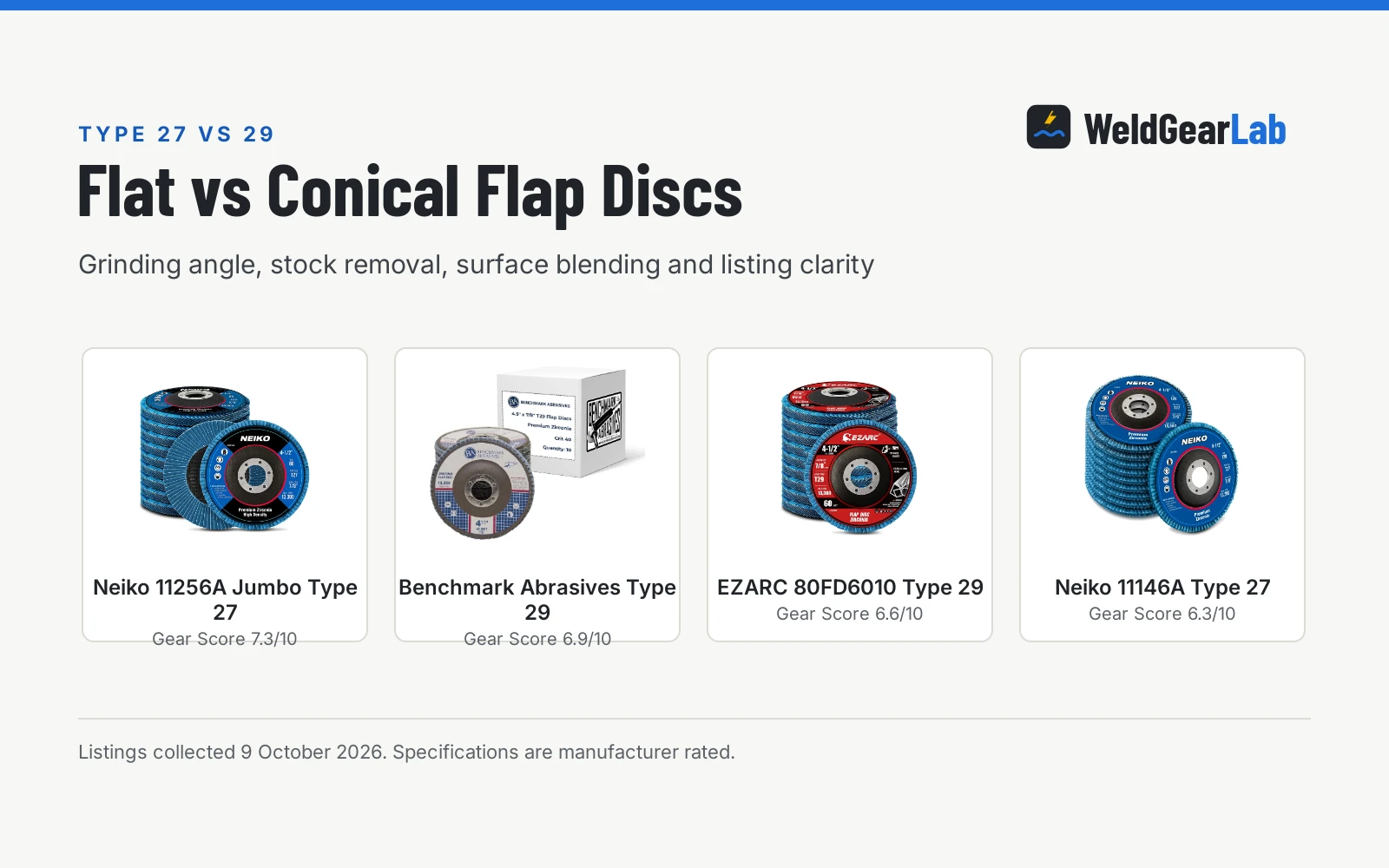
Verdict. Type 29 conical flap discs are the right pick for heavy weld blending, edge beveling and rapid stock removal, where the angled face provides full flap contact and tool clearance at a natural grinding angle. Type 27 flat flap discs are the right pick for smoothing flat plate, blending broad surfaces and fine finishing, where a flat profile distributes pressure evenly and prevents gouging.
When choosing between flap disc type 27 vs 29, the main difference comes down to the shape of the disc and the grinding angle you use against the steel. Type 27 discs have a flat profile designed for flat surface blending, smoothing, and finishing where you keep the disc nearly flat to the work. Type 29 discs feature a conical, angled face that angles the abrasive flaps, making them ideal for aggressive stock removal, edge chamfering, and weld seam leveling. This comparison puts flap disc type 27 against type 29 using four concrete Amazon listings from Neiko, Benchmark Abrasives, and EZARC to show how each style performs in the shop.
As an Amazon Associate I earn from qualifying purchases. WeldGearLab earns a commission when you buy through links on this page, at no extra cost to you. Read our affiliate disclosure.
Side by side
| Neiko 11256A Jumbo Type 27 | Benchmark Abrasives Type 29 | EZARC 80FD6010 Type 29 | Neiko 11146A Type 27 | |
|---|---|---|---|---|
| Gear Score | 60 | 57 | 54 | 52 |
| Side / Profile | Type 27 (Flat) | Type 29 (Conical) | Type 29 (Conical) | Type 27 (Flat) |
| Grit | 80 grit, Medium | 40 grit, Coarse | 60 grit, Coarse | 120 grit, Super Fine |
| Abrasive grain | Zirconia Alumina | European Zirconia Cloth | Zirconia Alumina (table notes ceramic) | Zirconia Alumina |
| Stated working angle | Flat surface (angle not stated) | Angled (angle not stated) | 15 to 20 degrees | Flat surface (angle not stated) |
| Maximum speed | 13,300 RPM | Not stated | 13,300 RPM | 13,300 RPM |
| Diameter & arbor | 4-1/2 in, 7/8 in arbor | 4.5 in, 7/8 in arbor | 4-1/2 in, 7/8 in arbor | 4-1/2 in, 7/8 in arbor |
| Backing plate | Fiberglass | Not stated | Fiberglass | Fiberglass |
| Flap density | High Density Jumbo | Standard (0.5 in thickness) | Standard | Standard |
| Pack quantity | 10 Count | 10 Count | 10 Count | 10 Count |
| Warranty | Not stated | Not stated | Not stated | Not stated |
Specifications are manufacturer rated, as published on each listing and collected 9 October 2026. None of the four listings states a written warranty, and none lists a formal third-party safety certification like UL or ETL.
Flap disc type 27 vs 29: shape and grinding angle
The primary distinction between flap disc type 27 vs 29 is the angle at which the abrasive flaps contact the metal. Type 27 flap discs feature a flat profile across their abrasive face. This flat construction is designed for working nearly flat against the metal, providing smooth blending across broad surfaces without digging into the base metal.
Type 29 flap discs are built with a conical, angled profile where the abrasive flaps flare upward toward the backing plate. For example, the EZARC listing explicitly states a working angle of 15 to 20 degrees for working along welded seams and plate edges. The angled build allows you to hold your angle grinder at that natural working angle while maintaining full flap contact with the steel, keeping the tool spindle and your knuckles clear of the work.
Stock removal and contact area
Stock removal rates depend heavily on how the disc profile matches the working angle. When an operator holds an angle grinder at an angle to grind down a weld seam or bevel an edge, a Type 29 conical disc aligns its flaps flush against the steel at that angle. This provides consistent abrasive contact under direct operator pressure, making Type 29 discs efficient for aggressive weld leveling, edge chamfering, and stock removal. The Benchmark Abrasives example uses a coarse 40 grit European zirconia cloth specifically for heavy stock removal and deburring, while the EZARC example uses 60 grit zirconia for cutting and weld blending.
When working across large flat surfaces, a Type 27 flat disc allows the operator to work nearly flat to the plate. Holding a flat disc at a low angle distributes grinding contact over the face of the flaps, smoothing surfaces and leveling welds without digging an edge into the plate. The Neiko 11256A example features an 80 grit abrasive with jumbo extra flaps for longer surface grinding life, while the Neiko 11146A example uses a super fine 120 grit abrasive suited for final surface finishing.
Abrasive grit and materials
All four products featured here use zirconia-based abrasive grain, which provides greater durability and heat tolerance than basic aluminum oxide on carbon steel and stainless steel. However, the stated grits and material descriptions vary considerably across listings.
On the Type 29 side, Benchmark Abrasives specifies a coarse 40 grit European zirconia cloth, while EZARC provides a 60 grit zirconia abrasive. The EZARC listing contains an internal contradiction: while its title and bullet points describe a zirconia abrasive, its specification table lists material type as aluminum oxide and ceramic. On the Type 27 side, Neiko provides an 80 grit zirconia alumina abrasive in its 11256A high-density jumbo disc, and a 120 grit zirconia alumina in its 11146A standard disc. The Neiko 11146A listing also features a contradiction, claiming cutting under recommended uses in its spec table despite the title and bullets describing a 120 grit flat finishing disc.
Backing plates and operating speeds
Abrasive flap discs rely on a sturdy backing plate to support the cloth flaps and absorb machine vibration. The Neiko 11146A, Neiko 11256A, and EZARC 80FD6010 listings all specify fiberglass backing plates combined with resin bonding to absorb vibration without smearing the metal. The Benchmark Abrasives listing specifies disc thickness at 0.5 inches but leaves the backing plate material unstated.
Operating speed ratings are vital for grinder safety. Both Neiko listings and the EZARC listing state a maximum rotational speed of 13,300 RPM, which matches common 4-1/2-inch angle grinders using a 7/8-inch arbor. The Benchmark Abrasives listing states compatibility with 4.5-inch and 5-inch angle grinders with a 7/8-inch arbor, but it omits the maximum RPM rating entirely from both its bullet points and specification table.
Pack size and listing clarity
Every featured option in this comparison comes packaged as a 10-pack of 4-1/2-inch discs with standard 7/8-inch arbors. None of the four manufacturers lists a written warranty term on their product listings, which is common for consumable grinding abrasives.
Listing quality differs among the brands. The Neiko listings provide complete mechanical specifications, though the 11256A bullets casually refer to the discs as cut off wheels 4 1/2 inch. The EZARC listing contains multiple specification conflicts, including listing dimensions as 1 x 1 x 0.04 inches and unit count as 1 in the spec table despite the 4-1/2-inch 10-pack title. The Benchmark listing provides clear application descriptions but omits the maximum RPM rating.
Choose flap disc type 27 if
- You are blending welds flush on flat plate or sheet metal without gouging surrounding metal.
- Your metalworking tasks center on broad surface blending, smoothing, and uniform finishing.
- You prefer operating the angle grinder at a low angle nearly flat against the steel.
- You want longer working life on flat stock from extra abrasive flaps, as seen on the Neiko 11256A jumbo example.
Choose flap disc type 29 if
- You need aggressive stock removal, rapid weld leveling, or heavy defect removal.
- You are beveling plate edges, chamfering corners, or grinding inside fillet welds.
- You want built-in wrist and tool clearance while grinding at an angle, such as the 15 to 20 degree angle specified by EZARC.
- You need full abrasive flap contact while holding the angle grinder at a comfortable working tilt.
The four flap discs
| Award | Product | Gear Score About the Gear ScoreThe Gear Score runs from 0 to 10 and weighs performance (35%), build (25%), value (25%), safety (10%, where it applies) and warranty (5%), using only what the manufacturer and the listing publish. How we pick › | |
|---|---|---|---|
 Neiko 11256A High Density Jumbo Premium Zirconia
|
7.3/10 | Check price on Amazon | |
 Benchmark Abrasives 4.5" Type 29 Zirconia Flap
|
6.9/10 | Check price on Amazon | |
 EZARC Zirconia Flap Discs 60 Grit
|
6.6/10 | Check price on Amazon | |
 NEIKO 11146A Premium Zirconia Flap Disc
|
6.3/10 | Check price on Amazon |
Neiko 11256A High Density Jumbo Premium Zirconia
A 4.5-inch Type 27 flat flap disc with high-density jumbo flaps, 80 grit zirconia alumina abrasive and a fiberglass backing plate rated for 13,300 RPM.
Pros
- Jumbo high-density build with extra flaps for longer wear life
- Flat Type 27 profile suited for smooth blending and flat surface finishing
- 80 grit zirconia alumina abrasive holds up to high temperatures and pressure
- Fiberglass backing plate absorbs vibrations and runs up to 13,300 RPM
Cons
- Bullets inconsistently refer to the product as cut off wheels
- Flat profile requires keeping the grinder nearly flat to avoid uneven edge wear
- Medium 80 grit removes stock slower than coarse 40 or 60 grit discs
- No warranty term is stated in the listing
Benchmark Abrasives 4.5" Type 29 Zirconia Flap
A 4.5-inch Type 29 angled flap disc made with European zirconia cloth in 40 grit for aggressive stock removal, beveling and deburring.
Pros
- Angled Type 29 conical profile provides full flap contact at working angles
- Coarse 40 grit abrasive provides aggressive metal removal and beveling
- European zirconia cloth abrasive with uniform particle size
- Standard 7/8-inch arbor fits 4.5-inch and 5-inch angle grinders
Cons
- Maximum rotational speed is not stated in the bullets or spec table
- Spec table lists aluminum oxide alongside zirconia alumina
- Coarse 40 grit leaves deep grind marks that require finer follow-up steps
- No warranty term is stated in the listing
EZARC Zirconia Flap Discs 60 Grit
A 4.5-inch Type 29 angled flap disc with 60 grit zirconia abrasive, rated for 13,300 RPM at a stated working angle of 15 to 20 degrees.
Pros
- Stated working angle of 15 to 20 degrees for edge and welded seam work
- 60 grit zirconia abrasive balances stock removal with controllable blending
- Fiberglass backing plate absorbs vibration up to a maximum 13,300 RPM
- Conical bevel shape provides convenient edge and corner access
Cons
- Spec table contradicts title by listing aluminum oxide and ceramic material
- Spec table dimensions list 1 x 1 x 0.04 inches instead of 4.5 inches
- Spec table lists number of items as 1 despite being a 10-pack
- No warranty term is stated in the listing
NEIKO 11146A Premium Zirconia Flap Disc
A 4.5-inch Type 27 flat flap disc with super fine 120 grit zirconia alumina abrasive and a fiberglass backing plate rated for 13,300 RPM.
Pros
- Flat Type 27 build provides a stable, wide contact patch on flat surfaces
- Super fine 120 grit abrasive delivers smooth surface finishing and blending
- Resin fiber with fiberglass backing plate absorbs vibration without smear
- Compatible with angle grinders operating at up to 13,300 RPM
Cons
- Spec table mistakenly lists recommended use as cutting
- Fine 120 grit abrasive is too slow for heavy stock removal or beveling
- Standard density flaps wear faster than high-density jumbo discs
- No warranty term is stated in the listing
How we scored them
All four flap disc packs are scored on performance, build, value, safety listing and warranty, following our standard evaluation framework. Because abrasive flap discs are consumables without written warranties or formal third-party electrical safety ratings on these listings, scores reflect stated abrasive quality, flap construction, RPM ratings, and listing consistency.
| Product | Gear Score | Perf. /35 | Build /25 | Value /25 | Safety /10 | Warranty /5 |
|---|---|---|---|---|---|---|
| Neiko 11256A Jumbo Type 27 | 7.3 | 29 | 22 | 21 | 0 | 0 |
| Benchmark Abrasives Type 29 | 6.9 | 28 | 21 | 20 | 0 | 0 |
| EZARC 80FD6010 Type 29 | 6.6 | 27 | 19 | 20 | 0 | 0 |
| Neiko 11146A Type 27 | 6.3 | 24 | 20 | 19 | 0 | 0 |
Safety reminder. Always wear safety glasses or a face shield, heavy leather work gloves, and hearing protection when operating an angle grinder with flap discs. Inspect each disc for tears or backing cracks before mounting, confirm your grinder does not exceed the disc’s maximum RPM rating, and always keep grinder wheel guards securely in place. See our metal fab tools section for more grinding equipment guides.
Frequently Asked Questions
What is the difference between flap disc type 27 vs 29?
The main difference is disc shape and working angle. Type 27 discs have a flat abrasive face designed for smooth surface blending and finishing on flat metal. Type 29 discs have an angled conical face designed for edge grinding, beveling, and aggressive stock removal at an angle.
What angle should you hold a type 29 flap disc?
Type 29 conical flap discs are designed to operate at an angle to the workpiece. For example, the EZARC Type 29 listing specifies an operating angle of 15 to 20 degrees, which keeps the abrasive edge engaged while providing wrist and tool clearance.
Can you use a type 27 flap disc on edges?
Type 27 flat discs can be used for deburring and edge smoothing, as noted in the Neiko 11256A listing. However, because the flaps sit flat across the backing plate, working on sharp edges wears the outer flap perimeter faster than an angled Type 29 disc designed specifically for edge contact.
How long do flap discs last?
Flap disc life depends on abrasive material, pressure, workpiece metal, and flap density. High-density jumbo discs like the Neiko 11256A pack extra abrasive flaps to extend working life compared to standard discs, while coarse grits like 40 grit remove metal faster before wearing down.
What grit flap disc is best for smoothing welds?
Grit selection depends on the stage of work rather than disc shape. For rough weld leveling and heavy stock removal, coarse grits like 40 or 60 grit remove excess filler metal quickly. For blending the weld flush with surrounding plate and final finishing, medium grits like 80 grit or fine grits like 120 grit produce a smooth, uniform surface.
Related: best flap disc for metal, flap disc for angle grinder, best angle grinder, and the metal fab tools hub. Also see our best cut off wheels for metal.
About the author
WeldGearLab Editorial is the editorial team behind WeldGearLab. We research product listings, specifications, safety listings and warranty terms, score every pick with the published Gear Score method, and correct errors when readers report them. We do not run our own shop trials; see How We Pick for exactly how picks are made.