What Is Cold Saw? How It Works and Cuts Metal
A cold saw uses a toothed circular blade running at low rotational speed to mill through metal, leaving cool, clean, burr-free cuts without heat or sparks.
 By WeldGearLab Editorial
Updated October 9, 2026
By WeldGearLab Editorial
Updated October 9, 2026
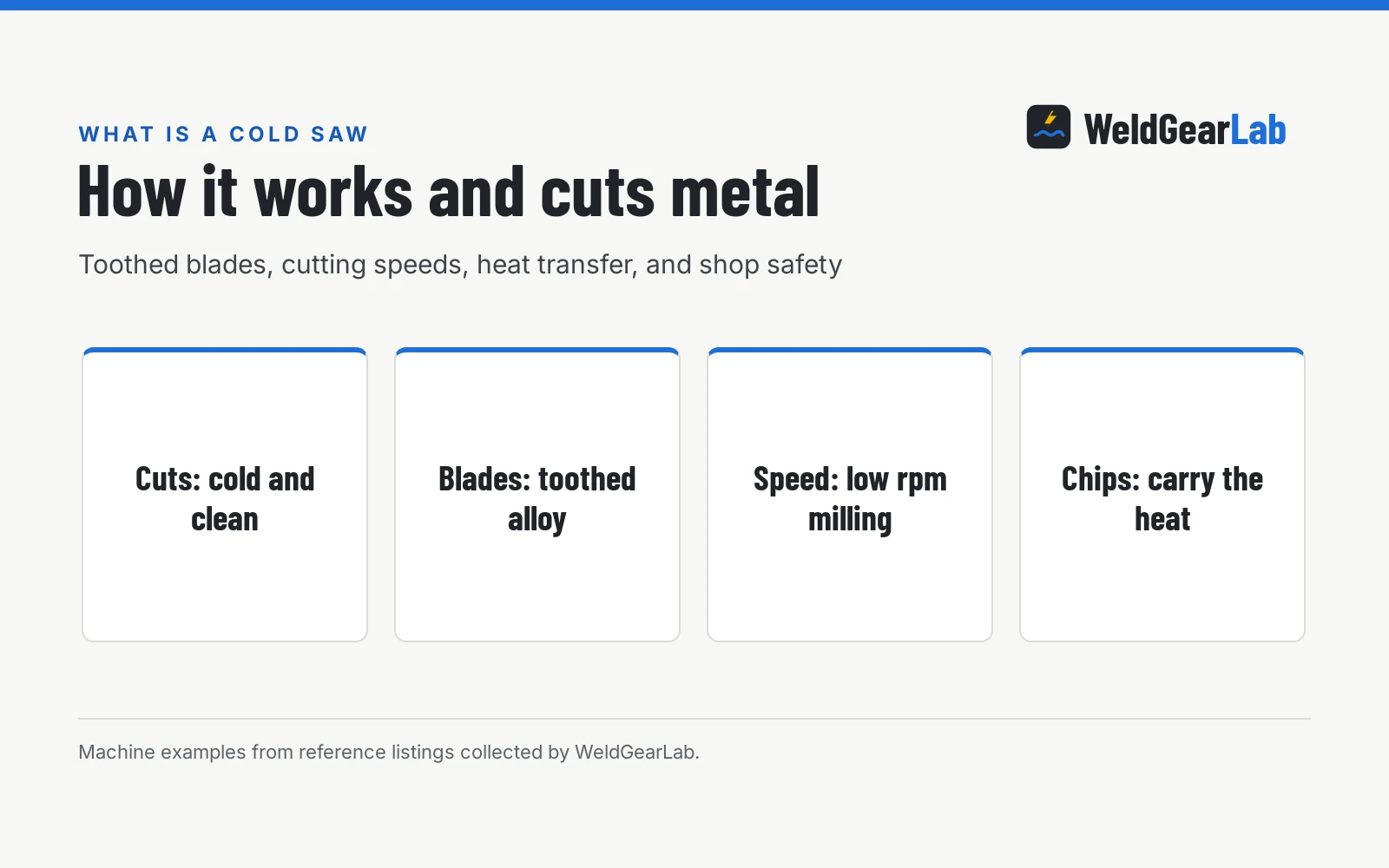
If you are asking what is cold saw cutting, it is a metal-cutting method that uses a circular, toothed blade running at low speed to shear metal without generating heat. Instead of grinding steel with friction like an abrasive chop saw, a cold saw mills chips away mechanically. Thermal energy transfers into the discarded metal chips, leaving the workpiece cool to the touch and burr-free. This guide explains how cold saws work, how they compare to abrasive chop saws, and what to look for when choosing a saw for your shop.
As an Amazon Associate I earn from qualifying purchases. This guide links to our product roundups, where WeldGearLab earns a commission when you buy through links, at no extra cost to you. Read our affiliate disclosure.
What is cold saw cutting: the process in one paragraph
A cold saw cuts metal through mechanical milling rather than friction grinding. Each tooth on the heavy circular blade acts like a milling cutter, shaving off a distinct metal chip with every rotation. Because the blade rotates at a low rotational speed, the teeth slice clean curls without generating high friction heat. The physics of chip formation concentrates shear heat into the expelled chips. When chips fly into the collection tray, they carry the heat away, leaving the cut edge cool and metallurgically unchanged.
Side by side
| Cold saw (dry cut) | Abrasive chop saw | Horizontal band saw | |
|---|---|---|---|
| Cutting action | Toothed blade mills individual chips | Abrasive wheel grinds metal with friction | Continuous flexible toothed blade slices metal |
| Workpiece temperature | Cool to the touch immediately after cutting | Hot workpiece with heat affected edge | Cool to the touch |
| Cut edge finish | Clean, square, burr-free, weld-ready | Rough edge with heavy burrs that need grinding | Square cut with minimal burr |
| Sparks and airborne debris | Virtually no sparks, metal chips drop into tray | Heavy shower of hot sparks and abrasive dust | No sparks, small chips drop below cut |
| Blade construction | Solid steel body with carbide or cermet teeth | Bonded abrasive composite disc that wears down | Continuous bimetal loop under tension |
| Cutting speed on tube | Fastest, cuts through profiles in seconds | Moderate speed, burns through wall | Slower, deliberate constant feed |
| Cut line accuracy | Rigid blade body resists deflection | Flexible disc can deflect on heavy stock | Blade guides maintain vertical tracking |
| Best suited for | Structural tubing, channel, and angle iron | Rough demolition, rebar, and scrap | Solid billets, heavy bar, and thick structural steel |
| Weld preparation | Ready to weld immediately without edge prep | Requires grinding away burrs and hardened crust | Ready to weld after light deburring |
Abrasive chop saws, cold cut saws, and horizontal band saws share space in fabrication shops, but their cutting mechanics, edge finishes, and operating workflows differ completely. The table above highlights the functional differences between toothed cold cutting, abrasive grinding, and band sawing.
When a cold saw is the better choice
- Weld-ready joint preparation. Cut edges emerge square, clean, and burr-free, eliminating the grinding step before welding.
- Clean indoor shop environments. Cold saws drop heavy metal chips into a collection tray rather than filling the shop with airborne abrasive dust and hot sparks.
- Accurate structural tube cuts. Rigid steel blade bodies resist deflection when entering tube walls, holding tight tolerances on square tubing, angle iron, and channel.
- Cutting speed on structural steel. By milling through stock rather than melting it, cold cutting operates efficiently. Maker listings state that cold cut saws cut metal 4x faster than abrasive saws on structural tubing and bar stock.
- Preserving metal temper. Without friction heat, cut edges have no heat-affected zone, keeping steel soft enough for easy drilling and tapping.
Our best cold cut saw guide covers dedicated shop models evaluated on motor power, clamping systems, and blade stability.
When an abrasive chop saw is the better choice
- Hardened or contaminated steels. Abrasive wheels grind through hardened steel rod, rebar, and heavy weld seams that would chip or break precision carbide teeth.
- Initial machine cost. Standard abrasive chop saws cost less up front than dedicated low-speed cold cut machines, and replacement abrasive discs are inexpensive.
- Demolition and scrap work. For cutting rusty pipe, salvaged metal, or dirty farm iron, abrasive wheels handle contaminants without ruining an expensive toothed blade.
- Outdoor jobsites. Where spark containment is not a concern, abrasive chop saws offer durable rough cutting in dusty conditions.
How to choose the right blade and machine
Cold cut blades feature tungsten carbide or cermet teeth brazed onto an alloy steel disc. Selecting the right blade requires matching tooth count and geometry to material thickness and type:
- Tooth count and wall thickness. Thicker structural shapes require fewer teeth with larger gullets to clear chips, while thin tubing requires higher tooth counts. For example, Evolution lists a 14-inch mild steel blade with 66 teeth, a .094-inch kerf, and a 1-inch arbor size rated for 1600 RPM. For general fabrication, Evolution includes an 80-tooth cermet carbide blade on its 14-inch S14MCS saw, rated for 3500+ cuts in 4” mild steel. For larger saws, VEVOR lists a 16-inch 96-tooth cermet-tipped blade on its 3000 W model, advertising up to 4,000 cuts through Q235 reinforcing bar.
- Material compatibility. Mild steel blades are designed strictly for low-carbon steel. Cutting stainless steel requires dedicated blades; VEVOR lists a 14-inch stainless steel cold cut blade with 66 teeth and a 5.12 inch cutting capacity on its 3500 W saw.
- Cordless portability. Handheld cold cutting saws also exist for plate. Evolution lists a 6-1/2 inch cordless saw running at 3,400 RPM on a 20V 5.0Ah battery, cutting steel plate up to 1/4 inch thick with a 40-tooth blade.
Cutting speed and motor power
Operating speed separates cold saws from abrasive chop saws. Abrasive saws require high rotational speeds to burn metal away, whereas cold cutting demands low rotational speed and high torque to shear chips cleanly.
- Abrasive speeds. VEVOR lists an abrasive chop saw running at 3600 rpm with a 2300W motor on 120 volts, weighing 30 pounds. DEWALT similarly lists a 2300W motor drawing 15 A at 120 volts on its 14-inch D28730 abrasive saw. At 3600 rpm, friction creates intense heat.
- Cold cutting speeds. Cold saws run far slower. Evolution lists an 1800 watts motor on its 14-inch S14MCS saw running at 1100 rpm with a 15A draw, weighing 72.4 pounds. VEVOR lists a 3500 W 15A brushless motor on its 14-inch saw providing 750–1200 RPM with 10-speed adjustment at 50 RPM per gear on 240 volts. For larger stock, VEVOR lists a 3000 W motor on a 16-inch saw running on 240 volts with a 1–2 second soft start, weighing 57.8 pounds.
- Braking and safety. Evolution lists an electronic brake on its 14-inch S14CPS and 15-inch S15CPS models that stops the blade within 2-3 seconds, with both units weighing 71 pounds.
- Mitering capacity. Secure clamping is vital to avoid stripping teeth. DEWALT lists a 45 degree pivoting fence, VEVOR lists 0–45 degrees or -45° to 45° miter adjustment, and Evolution lists miter cuts up to +/-46 degrees on its S14MCS saw.
Cold saw vs horizontal band saw
Fabricators choosing a primary metal cutting station often compare cold saws against horizontal band saws. Both methods avoid the abrasive dust and heat-affected zones of cut-off wheels, but suit different workflows.
A cold saw excels at speed, repeatability, and squareness on structural tube, angle iron, and extruded profiles, making cuts in seconds. A horizontal band saw cuts more slowly with a continuous flexible blade, but handles large solid billets and structural beams with lower consumable costs. For shops considering a band saw, our best horizontal band saw guide reviews shop models for capacity and blade tracking.
Shop safety with metal cutting saws. Although cold cutting eliminates the spark shower of abrasive wheels, flying metal chips present real hazards. Hot metal curls fly off the blade at high velocity, requiring ANSI-rated safety glasses or a face shield. Hearing protection is necessary when cutting hollow profiles. Workpieces must always be clamped securely in the vise before cutting; loose stock will catch and strip teeth from the blade. Never force the feed rate, and check the machine manual for recommended feed pressure. For related tools, visit our metal fab tools category.
Frequently Asked Questions
Can a cold saw cut stainless steel?
Cold saws can cut stainless steel if fitted with a blade formulated specifically for stainless alloys. Cutting stainless steel requires a dedicated tooth geometry and a steady feed pressure to prevent work hardening. Using a blade designed only for mild steel will cause rapid tooth dulling and premature blade failure.
Do cold saws require liquid coolant?
Industrial production cold saws typically circulate flood coolant over the cut zone, but modern dry-cut metal chop saws operate without liquid coolant. Dry-cut cold saws use cermet or carbide-tipped blades designed to shed heat into the expelled metal chips. This keeps the cut cool without requiring coolant pumps, reservoirs, or messy cleanup.
Can I put a cold saw blade on an abrasive chop saw?
Never put a toothed cold cut blade on an abrasive chop saw. Abrasive chop saws spin far too fast for toothed carbide or cermet blades, which will shatter the teeth, ruin the blade, and create a severe hazard. Toothed cold cutting requires a dedicated low-speed machine engineered for metal cutting.
Why are cold saw cuts cool to the touch?
Cold saws cut by milling individual chips rather than grinding metal away with friction. The shearing geometry of the teeth concentrates mechanical energy into chip formation, so nearly all thermal energy transfers directly into the discarded chips. Because the chips carry the heat away, the base material remains cool and free from heat-affected zones.
What is the difference between a cold saw and a band saw?
Both tools cut metal without excessive heat, but they serve different shop needs. A cold saw uses a rigid circular blade that delivers exceptionally fast, square cuts with minimal burrs on tubing and structural profiles. A horizontal band saw uses a continuous flexible blade that cuts more slowly but handles larger solid billets and thick sections with lower consumable costs.
Related: best cold cut saw, best horizontal band saw, best angle grinder, and the metal fab tools hub.
About the author
WeldGearLab Editorial is the editorial team behind WeldGearLab. We research product listings, specifications, safety listings and warranty terms, score every pick with the published Gear Score method, and correct errors when readers report them. We do not run our own shop trials; see How We Pick for exactly how picks are made.