AC vs DC TIG Welding: Which One Should You Buy
AC and DC TIG welding use different electrical currents for different metals, with AC cleaning aluminum oxide and DC penetrating steel and stainless.
 By WeldGearLab Editorial
Updated October 9, 2026
By WeldGearLab Editorial
Updated October 9, 2026
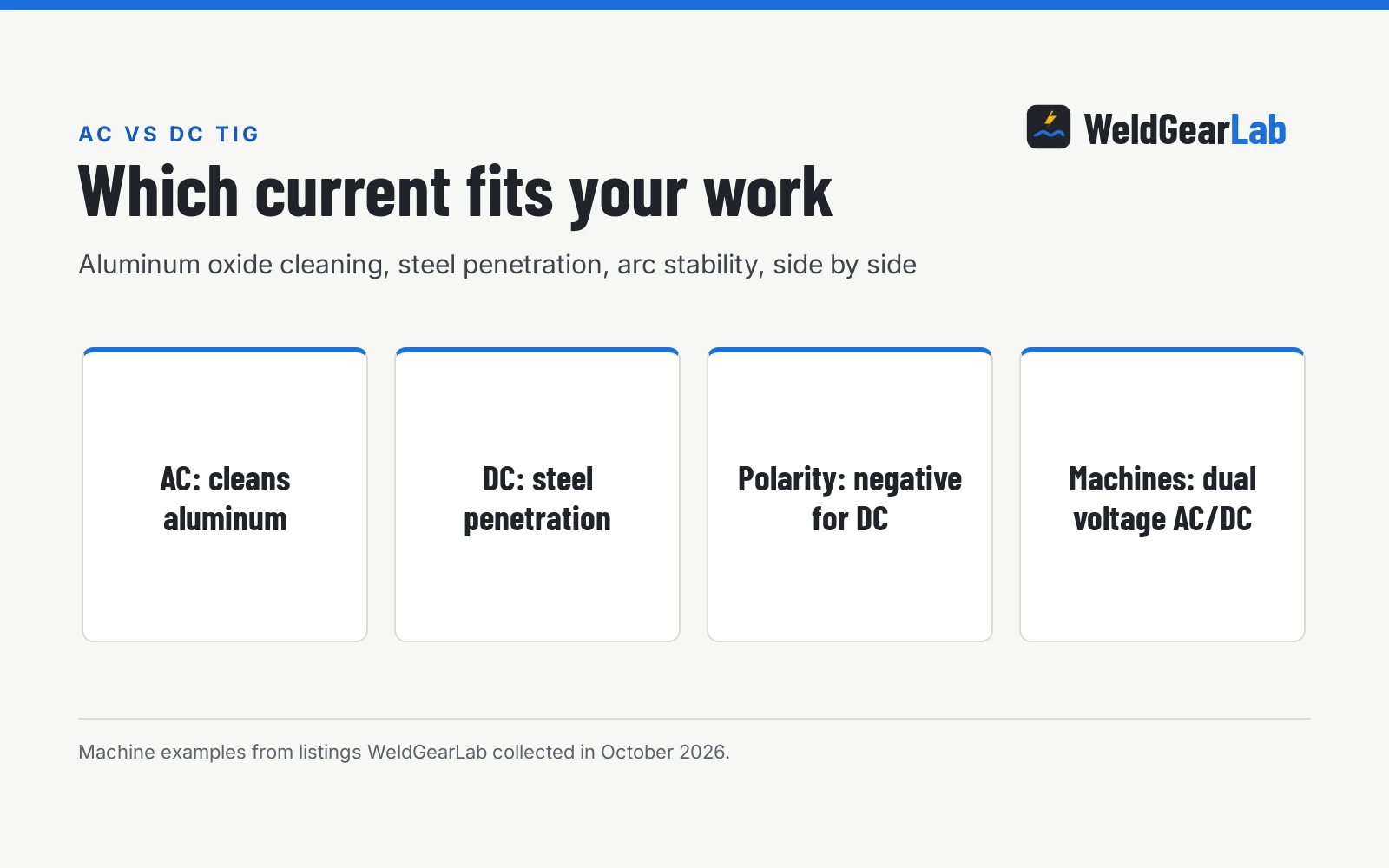
The choice between AC vs DC TIG welding comes down to the metal you need to join: alternating current (AC) is standard for aluminum and magnesium, while direct current (DC) is used for steel, stainless steel, chromoly, and titanium. Direct current electrode negative directs arc heat straight into the workpiece for clean penetration on dense ferrous metals. Alternating current rapidly reverses flow to blast away tough surface oxides on aluminum before melting the metal. This guide explains how AC and DC currents behave, when to use each process in a home or fab shop, and what machine features to look for.
As an Amazon Associate I earn from qualifying purchases. This guide links to our product roundups, where WeldGearLab earns a commission when you buy through links, at no extra cost to you. Read our affiliate disclosure.
AC vs DC TIG welding: the core difference
In electric arc welding, current can flow steadily in a single direction or cycle back and forth. In DC TIG welding set to direct current electrode negative (DCEN), electrons flow continuously from the negative tungsten torch into the positive workpiece. This directional bombardment puts the majority of the arc energy directly into the base metal. The result is deep, efficient joint penetration with a narrow heat-affected zone, while the tungsten electrode stays cool enough to hold a sharp ground point.
Aluminum and magnesium present a completely different metallurgical hurdle. Both alloys form a tenacious surface oxide skin almost immediately upon contact with atmosphere. This refractory oxide layer has a much higher melting point than the raw metal beneath it. If you attempt to weld aluminum on DCEN, the base metal melts beneath the oxide skin while the surface remains unbroken, preventing filler rod from wetting into the joint.
Alternating current solves this problem by reversing polarity many times each second. During the electrode positive portion of the AC waveform, electrons flow upward from the workpiece to the tungsten. This cathodic action literally blasts the refractory oxide skin off the surface of the aluminum. During the electrode negative portion of the waveform, the current drives heat down into the cleared base metal to create a clean, fluid weld pool. Balancing these alternating half-cycles gives the operator both oxide cleaning and puddle penetration in a single pass.
Side by side
| DC TIG (DCEN) | AC TIG | AC/DC Inverter | |
|---|---|---|---|
| Target metals | Carbon steel, stainless steel, titanium | Aluminum, magnesium alloys | All common metals |
| Current flow | Continuous straight polarity | Alternates negative and positive | Selectable AC or DC output |
| Oxide cleaning | No cleaning action | Cathodic cleaning strips surface oxide | Cathodic cleaning when set to AC |
| Heat balance | Heats workpiece for deep penetration | Splits heat between workpiece and torch | Adjustable balance and frequency |
| Tungsten prep | Ground to a sharp longitudinal point | Short taper with a small flat land | Point for DC, blunted land for AC |
| Shielding gas | Pure argon | Pure argon | Pure argon |
| Arc starting | Lift TIG or high frequency | High frequency air-gap ignition | High frequency or lift start |
| Arc control | Amperage control | AC balance and frequency control | Full pulse and balance adjustments |
| Shop application | Dedicated steel and exhaust fabrication | Dedicated aluminum welding | Full shop alloy versatility |
Polarity conventions reflect standard shop practice for TIG arcs; always verify torch setup and machine polarity recommendations in your equipment manual. Inverter power supplies allow fabricators to switch between current modes electronically without moving heavy cable lugs.
When DC TIG is the better choice
- Carbon and mild steel fabrication. DCEN delivers clean penetration and narrow heat-affected zones on tubing, plate, and brackets without overheating the tungsten.
- Stainless steel sanitary and exhaust tubing. DC produces smooth, discoloration-free beads with tight heat control, especially when paired with pulse cycling.
- Chromoly and titanium alloys. Aerospace tubing and bicycle frames demand focused heat input and precise puddle control that only continuous DC can deliver.
- Sharpened tungsten geometry. Because heat concentrates in the workpiece rather than the torch, the tungsten electrode retains a sharp ground point for pinpoint arc placement in tight joints.
Our best welding machine for stainless steel guide covers dedicated and multi-process machines for precise alloy work, while our best TIG rod for stainless steel review details filler alloy selection.
When AC TIG is the better choice
- Aluminum sheet, plate, and castings. AC provides the cathodic cleaning action needed to shatter tough surface oxides that otherwise trap impurities in the molten puddle.
- Magnesium components. Like aluminum, magnesium forms refractory surface films that require the cleaning cycle of alternating current to wet out properly.
- Adjustable cleaning versus penetration balance. Modern inverter welders feature AC balance dials that let operators favor penetration or surface cleaning depending on joint oxidation.
- Arc cone focus through AC frequency. Higher AC output frequency narrows the arc column for directional control in corner joints, while standard frequency spreads the bead across wide fillets.
For dedicated aluminum fabrication, see our best TIG welder for aluminum guide and our walkthrough on welding aluminum with TIG welder for shop setup advice.
How to tell what a machine supports
Multi-process welders and compact stick units that advertise TIG capability often provide DC lift TIG only. When aluminum welding is needed, confirm that the listing explicitly specifies AC TIG output. Check the manufacturer listing for these key features:
- Explicit AC/DC labeling. Look for AC TIG mode clearly listed in the process selector. Weldpro lists its Omni210 as a multi-process machine delivering up to 200A for AC/DC TIG alongside MIG and stick on 110V/220V dual voltage.
- High-frequency arc starting. High-frequency start ignites the arc across an air gap without touching the tungsten to the workpiece. Sunstac lists its 250A machine with high-frequency AC and DC modes to protect tungsten geometry during arc ignition.
- Stated material thickness ratings. Check the manufacturer’s rated material capacities for each input voltage. For aluminum, Sunstac lists a maximum welding thickness of 5/32″ (4mm) on 110V and 6/25″ (6mm) on 220V on its 250A dual-voltage welder.
- AC balance and frequency dials. Machines with dedicated AC TIG output feature front-panel controls for balance and frequency. Weldpro lists adjustable AC balance, AC frequency, and 2T-4T trigger modes on its Digital TIG ACDC 250GD 250 amp welder.
- Pulse controls. Pulse cycling reduces average heat input on thin gauge sheet. Everlast lists its PowerTIG 185DV with 185A output on 110/220V dual voltage, including pulse settings of 1 or 50 pulses per second.
To understand how pulsing prevents burn-through on thin metal, read our detailed guide on what is pulse TIG welding.
Which gas and tungsten for TIG welding
Unlike MIG welding which often uses carbon dioxide blends on carbon steel, TIG welding relies on pure shielding gas to protect the non-consumable tungsten electrode and the weld puddle. Argon is the standard shielding gas for both AC and DC TIG welding on steel, stainless steel, and aluminum.
Tungsten electrode selection and preparation differ significantly between AC and DC modes:
- Tungsten alloy. ARCCAPTAIN lists 2% lanthanated blue tungsten electrodes sized 0.04″ x 7″ (1.0mm x 175mm) as suitable for both AC and DC welding across aluminum alloys, stainless steel, and carbon steel. Lanthanated tungsten resists thermal shock and maintains arc stability across both current types.
- Tip geometry. For DC welding, grind the electrode to a sharp longitudinal taper, directing current into a tight focal point. For AC welding on modern inverters, grind a short taper with a small flat land on the tip rather than balling the end, allowing the inverter arc to remain directional.
- Filler wire feeding. Manual feeding requires steady rhythm. Strong Hand Tools lists its TIG feeder for wire up to 3/32 in. (2.4 mm) diameter to assist wire delivery while wearing welding gloves.
- Torch hardware. ARCCAPTAIN lists its WP-17 air-cooled argon torch rated for 150A with a 13-FT hose, fitting tungsten electrode diameters from 0.04″ to 1/8″. For thicker aluminum requiring higher duty cycles, water-cooled torches such as the #20 style listed on the Weldpro 250GD prevent torch overheating.
See our roundup of the best TIG torch for air-cooled and liquid-cooled options across standard machine connectors.
Can one machine do both?
Yes, an AC/DC inverter TIG welder can weld every common metal in a fabrication shop. By switching the front panel from AC to DC, you transition seamlessly from aluminum tanks and brackets to chromoly chassis tubing or stainless kitchen equipment. While DC-only machines cost less, purchasing a dual-voltage AC/DC machine provides full shop versatility on standard household outlets and higher-voltage shop receptacles alike. For fabricators comparing complete machine setups, explore our broad welders guide and our curated best welder for beginners list.
TIG electrical and arc safety. High-frequency arc starting discharges high-voltage bursts to initiate the arc, so inspect torch cables for cuts or abrasions and avoid leaning against conductive workbenches during arc ignition. TIG arcs emit intense ultraviolet radiation that can cause rapid flash burns to eyes and skin; always use a properly shaded welding helmet, flame-resistant protective sleeves, and dedicated leather TIG gloves. Ensure cylinders of argon gas are secured upright with safety chains, and weld with adequate local exhaust ventilation to remove metal fumes and shielding gas displacement. Review the manufacturer manual and safety guidelines before powering on equipment.
Frequently Asked Questions
Is TIG welding AC or DC?
TIG welding can run on either AC or DC depending on the metal being joined. Direct current is standard for carbon steel, stainless steel, and titanium because it provides focused heat penetration into the joint. Alternating current is standard for aluminum and magnesium because the reversing polarity scrubs away surface oxides during welding.
Do you TIG weld aluminum on AC or DC?
Aluminum is almost always welded using alternating current. Aluminum quickly forms a tough surface oxide skin that melts at a much higher temperature than the raw metal beneath it. The reverse polarity half of the AC cycle blasts away this oxide layer, while the straight polarity half melts the base metal to create a clean puddle.
What is an AC/DC TIG welder?
An AC/DC TIG welder is an inverter machine capable of outputting both alternating current and direct current. These machines allow fabricators to switch between DC for steel or stainless projects and AC for aluminum work. Many models also include advanced controls such as AC balance, pulse settings, and adjustable frequency.
Can you TIG weld stainless steel on AC or DC?
Stainless steel is welded using direct current with electrode negative polarity. DCEN keeps the tungsten electrode cool while directing arc energy into the workpiece for narrow, controlled weld beads. Using AC on stainless steel puts unnecessary thermal stress on the tungsten and produces wider heat-affected zones that can harm corrosion resistance.
Why is high frequency arc starting used for AC TIG?
High frequency arc starting allows the welding arc to ignite across an air gap without the tungsten electrode contacting the workpiece. Touching tungsten directly to aluminum can transfer tungsten particles into the puddle and contaminate the electrode tip. High frequency ignition keeps the electrode sharp and prevents contamination in both the weld pool and the tungsten.
Related: best TIG welder for aluminum, welding aluminum with TIG welder, what is pulse TIG welding, best TIG torch, and the TIG welders hub.
About the author
WeldGearLab Editorial is the editorial team behind WeldGearLab. We research product listings, specifications, safety listings and warranty terms, score every pick with the published Gear Score method, and correct errors when readers report them. We do not run our own shop trials; see How We Pick for exactly how picks are made.