Welding Machine Types: How to Choose the Right Welder
MIG, stick, TIG, and multi-process welders each suit different shop projects, metal thicknesses, and skill levels. How the primary welding machine types differ and how to pick the right power source for your work.
 By WeldGearLab Editorial
Updated October 9, 2026
By WeldGearLab Editorial
Updated October 9, 2026
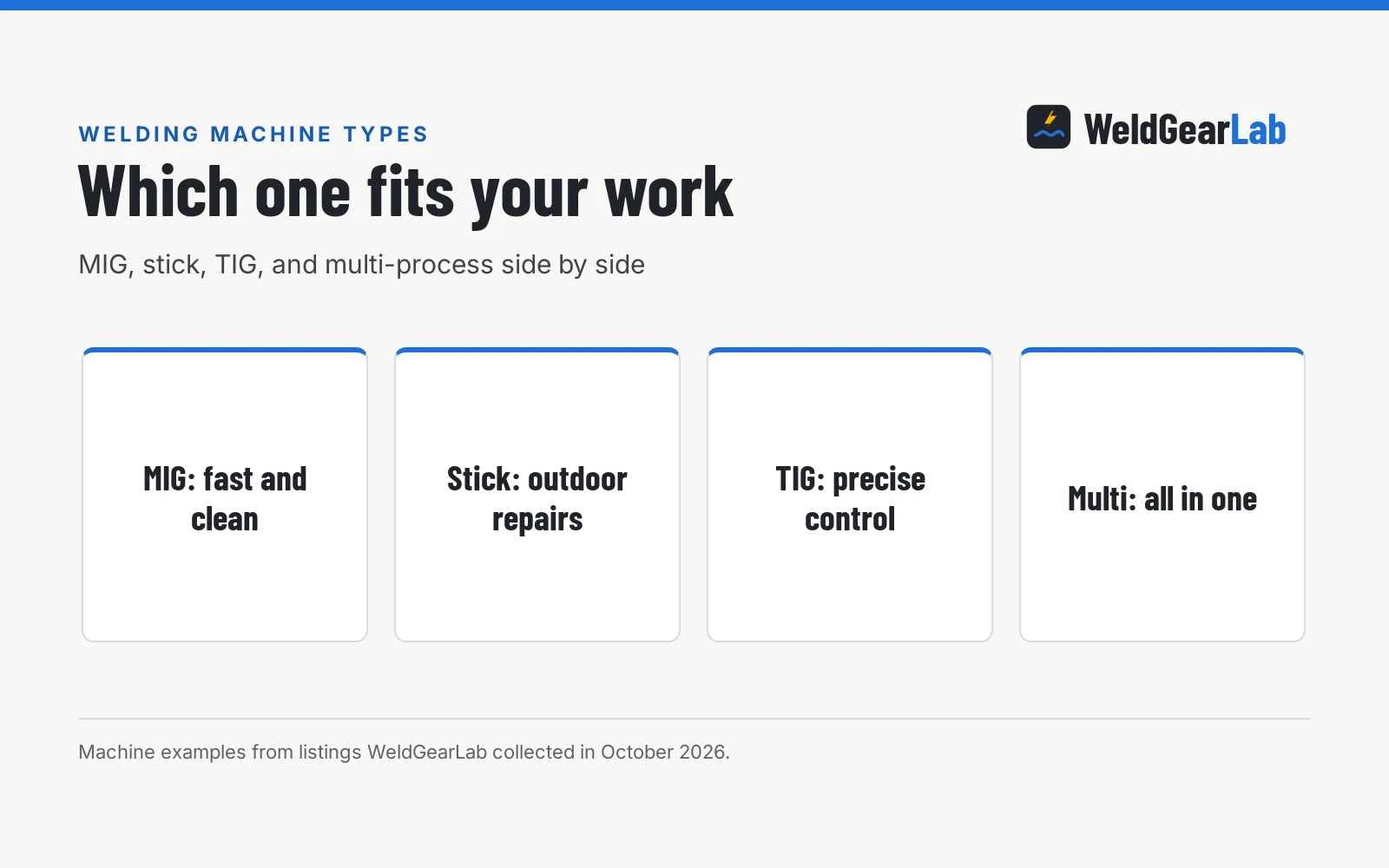
The main welding machine types are MIG, stick, TIG, and multi-process welders. MIG welders feed continuous wire for fast, clean welds on sheet metal and general shop projects. Stick welders use consumable flux-coated rods to join thick, rusty, or dirty steel outdoors in windy weather. TIG welders use a tungsten electrode and shielding gas for precise control on thin steel, stainless steel, and aluminum. Multi-process machines house multiple welding machine types in a single cabinet for home, farm, and repair versatility.
As an Amazon Associate I earn from qualifying purchases. This guide links to our product roundups, where WeldGearLab earns a commission when you buy through links, at no extra cost to you. Read our affiliate disclosure.
The difference in one paragraph
Every welding process joins metal by melting workpieces together with an electric arc, but they differ in how wire or filler is added and how the puddle is shielded from atmospheric contamination. MIG feeds solid or flux-cored wire automatically through a handheld gun. Stick welding uses an electrode holder to clamp a flux-covered rod that melts into the puddle as you work. TIG uses a non-consumable tungsten torch in a handheld grip while manually feeding a filler rod into the joint. Choosing among welding machine types comes down to metal cleanliness, material thickness, indoor versus outdoor location, and how much time you want to spend cleaning finished joints.
Welding machine types compared side by side
| MIG / Flux Core (Wire Feed) | Stick (SMAW) | TIG (GTAW) | Multi-Process | |
|---|---|---|---|---|
| Shielding method | External gas or flux inside wire | Flux coating on electrode rod | External inert gas cylinder | Depends on selected process |
| Gear beyond the welder | Gun, drive rolls, wire spool, gas cylinder for solid wire | Electrode holder, ground clamp, electrode rods | TIG torch, tungsten, filler rod, inert gas cylinder | Torch packages and leads for each supported process |
| Wind and outdoor work | Gas blows away, flux core handles breeze | Tolerates outdoor wind and weather | Gas blows away, indoor or sheltered only | Matches the individual process in use |
| Dirty or rusty metal | Needs clean steel for gas MIG, flux core tolerates light rust | Forgiving on mill scale, rust, and dirt | Requires meticulously clean metal | Matches the selected process |
| Thin sheet and auto body | Gas MIG suits thin sheet with low burn-through; flux core runs hotter | Difficult, high risk of burn-through | Superb heat control on thin stock | MIG and TIG modes handle thin stock |
| Spatter and cleanup | Low spatter with gas MIG, slag to chip with flux core | Slag coating to chip, moderate spatter | Virtually no spatter, zero slag to chip | Depends on whether wire, stick, or TIG is run |
| Skill curve to start | Easiest wire feed learning curve | Moderate, striking and holding an arc | Steepest, requires two-hand coordination | Varies by active process |
| Aluminum capability | With spool gun or U-groove rolls and argon | Specialized DC rods, uncommon for general use | AC/DC machine with argon, high weld quality | With spool gun or AC TIG if supported |
Polarity and shielding requirements depend on the process and filler in use. Always verify wire and rod recommendations in your machine’s manual and on consumable packaging. Multi-process power sources require changing torch connections and swapping lead polarities between processes.
When MIG is the better choice
- Sheet metal and auto body repair. Gas MIG with thin solid wire introduces less concentrated heat than stick, reducing the risk of blowing holes through thin body panels.
- Fast production and fabrication. The continuous wire spool eliminates the need to stop and swap rods, making long joint seams faster to complete.
- Minimal post-weld cleanup. Solid wire paired with shielding gas produces smooth weld beads with minimal spatter and no slag blanket to hammer off.
- Beginner friendliness. Trigger-activated wire feeding lets a newcomer focus on travel speed and gun angle without struggling to strike an arc.
Our how to choose a MIG welder guide walks through feeder mechanisms and torch options. For newcomers wanting automated parameter setup, see our best welder for beginners guide.
When stick welding is the better choice
- Field work and windy conditions. Stick electrodes carry their own solid flux coating, so a breeze cannot blow away your shielding.
- Rusty, dirty metal. The forceful arc burns through mill scale and surface oxidation that would cause porosity in solid-wire MIG welds.
- Equipment simplicity and portability. Stick welders require no gas cylinders, regulators, or delicate wire feed mechanisms, making them durable for field transport.
- Thick structural joints. Stick welding achieves deep penetration on heavy plate steel and farm implement repairs.
For outdoor repairs on gates, fencing, and machinery, see our best stick welder for farm use guide. If shop space or portability is your priority, explore our roundup of the best small inverter stick welders.
When TIG is the better choice
- Precise, aesthetic welds. TIG produces clean bead profiles with zero spatter and no slag, making it the standard for roll cages, bicycles, and architectural metalwork.
- Exotic metals and non-ferrous alloys. TIG offers exact puddle control on stainless steel, chromoly, and titanium.
- Aluminum fabrication. An AC-capable TIG power source cleans the oxide layer from aluminum while providing puddle control on thin tubing.
- Pinpoint heat control. Foot pedals or torch switches let you ramp amperage up or down dynamically to prevent burn-through on delicate parts.
Tackling aluminum projects with TIG requires an alternating current power source and pure argon gas; see our guide to the best TIG welder for aluminum.
How to tell what a machine supports
Welder listings can be confusing because makers frequently combine process terms in their product names. Look for these specific features in published specifications before purchasing:
- Dedicated gas solenoids and rear gas barbs. Gas-capable MIG welders include an internal gas solenoid and rear gas fitting to control gas flow when the trigger is pressed, whereas flux-core only machines omit the solenoid and gas inlet entirely. For TIG, dedicated units have solenoids, while entry-level lift TIG setups typically use a torch with a manual gas valve.
- Included torches and drive rolls. Wire feed machines typically include a MIG gun, but drive rolls vary by listing: smooth V-groove rolls fit solid wire, while knurled rolls fit flux-core wire. Lift TIG torches and spool guns are frequently sold separately.
- Supported electrode classifications and wire gauges. Review published electrode sizes to ensure the machine matches your work. ARCCAPTAIN lists compatibility with 6010, 6011, 6013, and 7018 stick rods for its 200A unit, while Protmex lists a handheld unit fitting 3/32″ to 1/8″ rods with a current range from 20 to 120 amps. On wire feed units, TASKZOOM lists capacity for .030″ and 0.040″ wire alongside 5/32″ stick electrodes.
- Rated duty cycle and maximum amperage. Duty cycle tells you how long a power source can weld before resting. For example, W Weldpro publishes a 60% duty cycle at 200A on its multi-process machine and rates its MIG capability for steel up to 10mm (3/8″) thick. For compact stick machines, Siasky lists a 250A maximum rating on 110V power at a weight of 3.3 pounds.
For wire welding comparisons between self-shielded wire and cylinder gas, read our breakdown of flux core vs MIG welding.
Multi-process welders and power supply
Multi-process power sources combine multiple processes into a single cabinet. Instead of buying separate boxes for shop fabrication and field maintenance, a single power unit can handle wire feed, stick, and scratch or lift TIG. For instance, W Weldpro lists a 7-in-1 multi-process platform weighing 30.2 pounds, while TORQBEAST lists a 145A 3-in-1 machine on 110V power weighing 7.16 lbs. For remote repairs where no outlet is available, battery-powered options exist; TLL lists a portable welder running on two 20V 8Ah batteries that delivers up to 120A for metal thickness from 0.06in to 0.2in.
Input voltage determines where you can weld. Many compact inverter welders plug into standard 110V household receptacles, making them accessible for home garages. Dual-voltage machines add 220V capability, delivering the higher amperage required to penetrate thicker plate. Browse our comprehensive best multi-process welder guide for versatile power units, or visit the main welders hub to explore every category.
Welding safety and ventilation. Every welding arc generates intense ultraviolet radiation, spatter, heat, and airborne fumes. Always wear an approved auto-darkening welding helmet, flame-resistant leather gloves, and heavy cotton or leather work clothing. Never weld near flammable materials, dry vegetation, or fuel containers. Galvanized and coated steels produce hazardous zinc plumes; weld outdoors or use mechanical fume extraction to keep your breathing zone clear of smoke. Secure compressed gas cylinders upright with a safety chain, and keep a dry-chemical fire extinguisher within reach of your welding station.
Frequently Asked Questions
Which welding machine type is easiest for a beginner?
Wire feed MIG welding is generally the easiest process for a beginner to learn. The gun automatically feeds consumable wire into the puddle when the trigger is pulled, allowing you to focus on travel speed and torch angle. Starting with clean steel and gas shielding produces smooth beads with minimal spatter.
Can a single welding machine run every process?
Multi-process machines can run MIG, stick, and TIG from a single power cabinet. While their DC TIG mode cannot weld aluminum (which requires AC TIG), many multi-process machines can weld aluminum in MIG mode using a spool gun or Teflon liner with pure argon gas. Dedicated AC/DC multi-process machines that can also TIG weld aluminum represent a much higher equipment investment.
What is the difference between MIG and flux-core welding?
Both processes use wire feed guns, but gas MIG uses solid wire and requires external shielding gas from a cylinder to protect the molten puddle. Flux-core uses hollow wire filled with flux compounds that generate shielding gas as they burn, making it practical for breezy outdoor repairs without a gas cylinder.
Why do stick welders perform better on dirty or outdoor steel?
Stick welding relies on a flux coating on the consumable electrode that creates a robust gas shield and slag blanket. The intense arc burns through surface rust, mill scale, and shop grime without requiring the meticulous cleaning that TIG or solid-wire MIG demands. The shielding also remains effective in windy weather.
Can I run a welding machine on a standard household circuit?
Many entry-level machines operate on standard household power circuits, though high-amperage settings can trip breakers. Machines with dual-voltage capability allow you to plug into standard household receptacles for light work and switch to higher shop voltage when tackling thicker steel.
Related: how to choose a MIG welder, flux core vs MIG welding, best welder for beginners, best multi-process welder, and the welders hub.
About the author
WeldGearLab Editorial is the editorial team behind WeldGearLab. We research product listings, specifications, safety listings and warranty terms, score every pick with the published Gear Score method, and correct errors when readers report them. We do not run our own shop trials; see How We Pick for exactly how picks are made.