How to Learn Welding at Home: A Safe 6-Week Plan for Beginners
A step by step plan to learn welding at home safely: the space, the gear, the process to start with, and six weeks of practice from flat beads to fillet welds.
 By WeldGearLab Editorial
Updated October 8, 2026
By WeldGearLab Editorial
Updated October 8, 2026
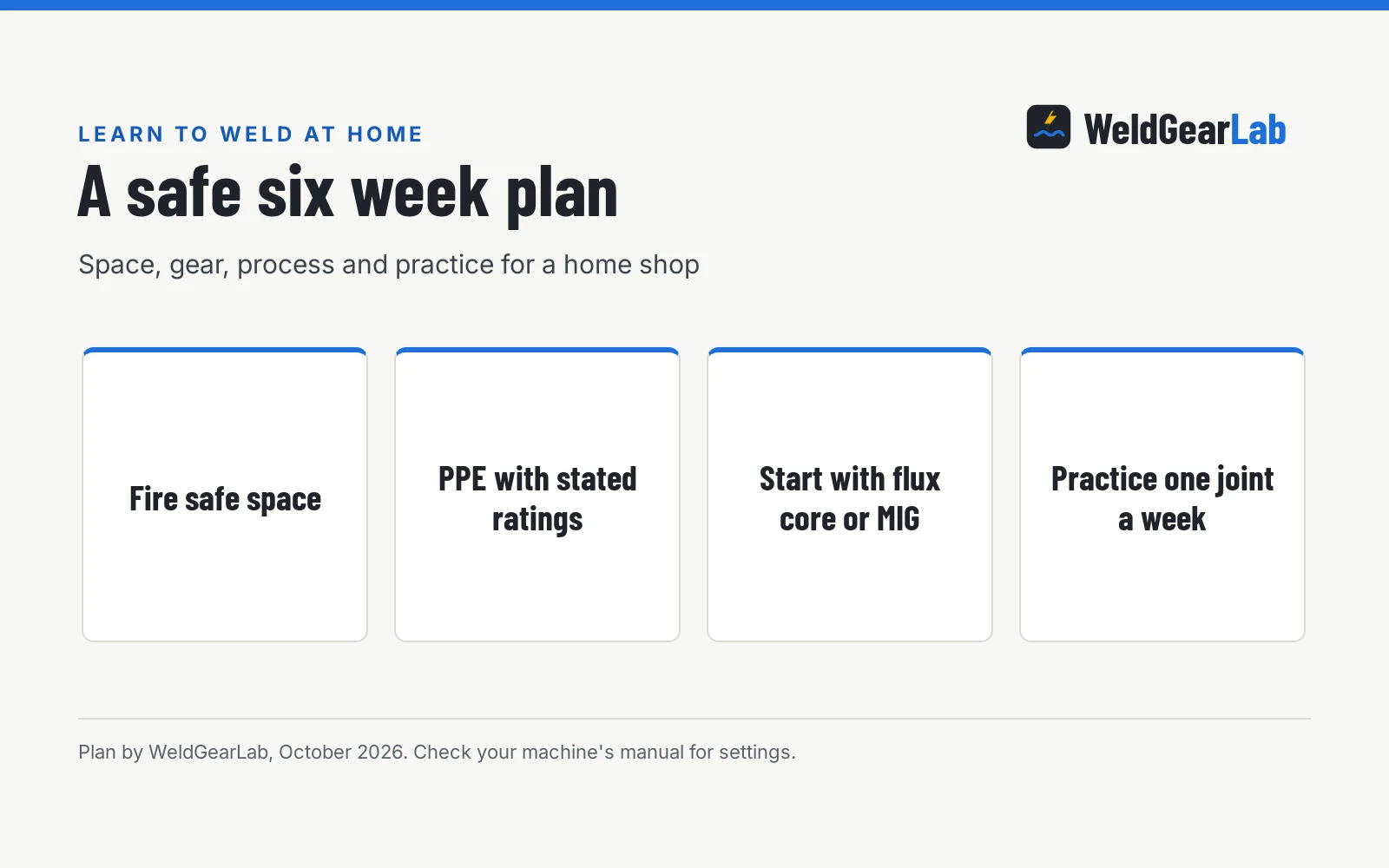
If you want to know how to learn welding at home, start with a fire safe space, proper protective gear and a beginner-friendly process such as flux core or MIG on a 120V machine. Then practice in a set order: straight beads, then pads, then butt joints and fillet welds, checking each weld before moving on. With a weekend session or two each week, a plan like the one below takes you from your first arc to sound fillet welds in about six weeks.
As an Amazon Associate I earn from qualifying purchases. WeldGearLab earns a commission when you buy through links on this page, at no extra cost to you. Read our affiliate disclosure.
Step 1: Set up a safe space
Welding throws sparks and spatter, makes fumes and runs on serious electrical current. Before you buy a machine, pick the spot. A garage or shed with a concrete floor works. Clear anything that burns: OSHA’s welding fire rule (29 CFR 1910.252) uses 35 feet as the distance within which combustibles should be moved or shielded. Sweep up sawdust, move fuel cans and rags, and keep a fire extinguisher within reach.
Ventilate. Open a door and use a fan to move fumes away from your face, not across it. Never weld galvanized, painted or oily steel without cleaning it first. Read the OSHA welding guidance and the NIOSH welding page once before your first session.
Check your power. A 120V machine should run on a dedicated circuit with the breaker the manual calls for. A 240V machine needs a properly installed outlet; hire an electrician if you do not have one. Our 120V vs 240V welder guide explains the trade-offs.
Step 2: Get the protective gear
- Helmet: an auto-darkening helmet that states ANSI Z87.1, with a shade range that covers your process. See our best auto-darkening welding helmet picks.
- Safety glasses under the helmet, for grinding and chipping slag.
- Gloves: leather welding gloves suited to your process. Our best welding gloves for MIG guide covers MIG and flux core.
- Clothing: a flame resistant jacket or heavy cotton, long sleeves, no synthetics, leather boots and no cuffs that catch sparks.
- Hearing protection for grinding and cutting.
Step 3: Choose the process to learn first
For learning at home, wire feed welding is the usual starting point. Flux core needs no gas bottle, works outdoors in a breeze and runs on 120V machines, which keeps the setup simple. Gas MIG gives cleaner welds with less spatter but needs a cylinder and regulator. Stick welding is cheap and good on dirty farm steel but harder to start an arc with. TIG gives the most control but takes the longest to learn. Our flux core vs MIG comparison goes deeper.
For the machine itself, look for a stated thickness range, a duty cycle with an amperage and a written warranty. Our best welder for beginners and best flux core welder lists stick to machines that state those details, and how to choose a MIG welder explains each spec.
Step 4: Gather practice steel and tools
Buy mild steel plate and flat bar around 1/8 to 3/16 in thick for the first weeks; thin sheet burns through too easily while you learn. Ask a local fabrication shop for clean drops, which are often cheap. You also need an angle grinder with grinding and flap discs, a wire brush, clamps, a chipping hammer for flux core slag, a welders pencil or soapstone, and a steel surface to work on. A steel table also gives the ground clamp a solid connection; see our best welding table for home shop picks.
How to learn welding at home: a six week practice plan
Change one thing at a time and write down your settings. Start from the chart inside your machine’s door or in the manual for your wire size and steel thickness, then adjust.
| Week | Goal | Practice | Check |
|---|---|---|---|
| 1 | Strike and hold an arc | Straight beads on flat 1/8 to 3/16 in plate | Even width, steady sound |
| 2 | Control heat and speed | Change one setting at a time, run beads side by side | Note settings that look best |
| 3 | Weld a pad | Overlap beads to cover a plate | No gaps or cold edges |
| 4 | Butt joint | Two plates edge to edge with a small gap | Penetration on the back side |
| 5 | Lap and T-joint fillets | Fillet welds in the flat position | Equal legs, no undercut |
| 6 | Test your welds | Cut or bend practice joints | Weld fuses into both plates |
Grind each practice plate clean and reuse it. Run the same joint until it looks the same three times in a row before moving to the next week. If a week takes two, that is fine.
Step 6: Learn to judge your own welds
A good bead has even width and ripples, blends smoothly into both pieces and has no holes, cracks or undercut along the edges. Cut a practice joint across the weld with a grinder or saw and look at how deep it fused. Clamp a fillet weld in a vise and bend it with a hammer; a sound weld bends the metal before it cracks at the joint. Our welding duty cycle explained guide also helps you understand why the machine may stop on long practice runs.
When to take a class
Home practice gets you a long way, but a few hours with an instructor can fix habits faster than months alone. Community colleges and trade schools run evening welding classes, and some offer open shop time. If you want welding as a job, a structured program leading to an AWS certification test is the path to look at.
Frequently Asked Questions
Can you really learn welding at home?
Yes, for hobby, farm and repair work. With a safe space, the right gear and steady practice you can learn to make sound welds on mild steel. For structural work or a welding job, you will need formal training and certification.
What is the easiest welding to learn at home?
Flux core and MIG are usually the easiest to start with, because the machine feeds wire for you and you only control the gun angle and speed. Flux core skips the gas bottle, which keeps the first setup simple.
How long does it take to learn to weld?
With regular weekly practice, many beginners can run decent beads in a few weeks and sound fillet welds in a couple of months. It depends on how often you practice and whether you check and correct your welds.
Is it safe to weld in a garage?
It can be, if you clear combustibles, ventilate, protect your eyes and skin, and use a properly rated circuit. Keep a fire extinguisher handy and check the area for smoldering sparks for a while after you finish.
What should I weld first as a beginner?
Straight beads on flat 1/8 to 3/16 in plate. Once those look even, try a small project from our welding projects for beginners list.
Related: all our welding guides, best welder for beginners and flux core vs MIG.
About the author
WeldGearLab Editorial is the editorial team behind WeldGearLab. We research product listings, specifications, safety listings and warranty terms, score every pick with the published Gear Score method, and correct errors when readers report them. We do not run our own shop trials; see How We Pick for exactly how picks are made.