1×1 vs 2×4 Auto Darkening Lens: Which One Should You Buy?
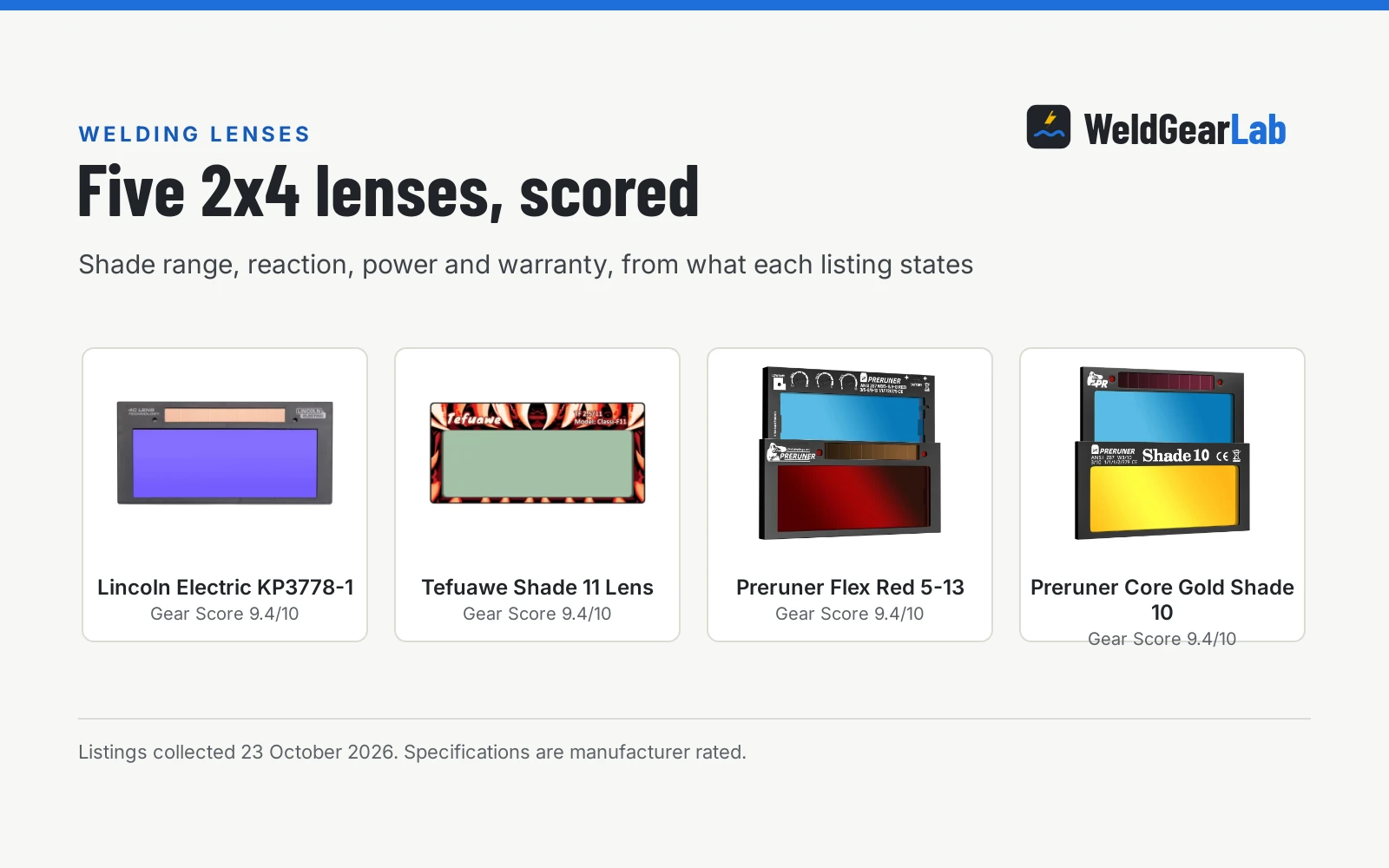
A 1x1 vs 2x4 auto darkening lens guide comparing window size, shade range, response and power across lenses stating 2 x 4 1/4 inches and 2 x 4.2 inches.

On this page
Top picks at a glance
As an Amazon Associate I earn from qualifying purchases.
- 1
 Lincoln Electric 2X4 C-Series Auto-Darkening Welding Lens9.4/10View on Amazon
- 2
 2x4 1/4 Auto Darkening Welding Lens9.4/10View on Amazon
- 3
 Flex Series Red Shade 5-13 Auto Darkening Welding Lens 2x4-1/49.4/10View on Amazon
- 4
 View on Amazon
- 5
 2×4.25 Auto Darkening Welding LensView on Amazon
- 6
 Auto Darkening Welding Lens 2x4 1/4View on Amazon
- 7
 Auto Darkening Welding LensView on Amazon
- 8
 Auto Darkening Welding Lens 2"x4-1/4"x0.33"View on Amazon
- 9
 SHINE 2x4 1/4 Auto Darkening Welding LensView on Amazon
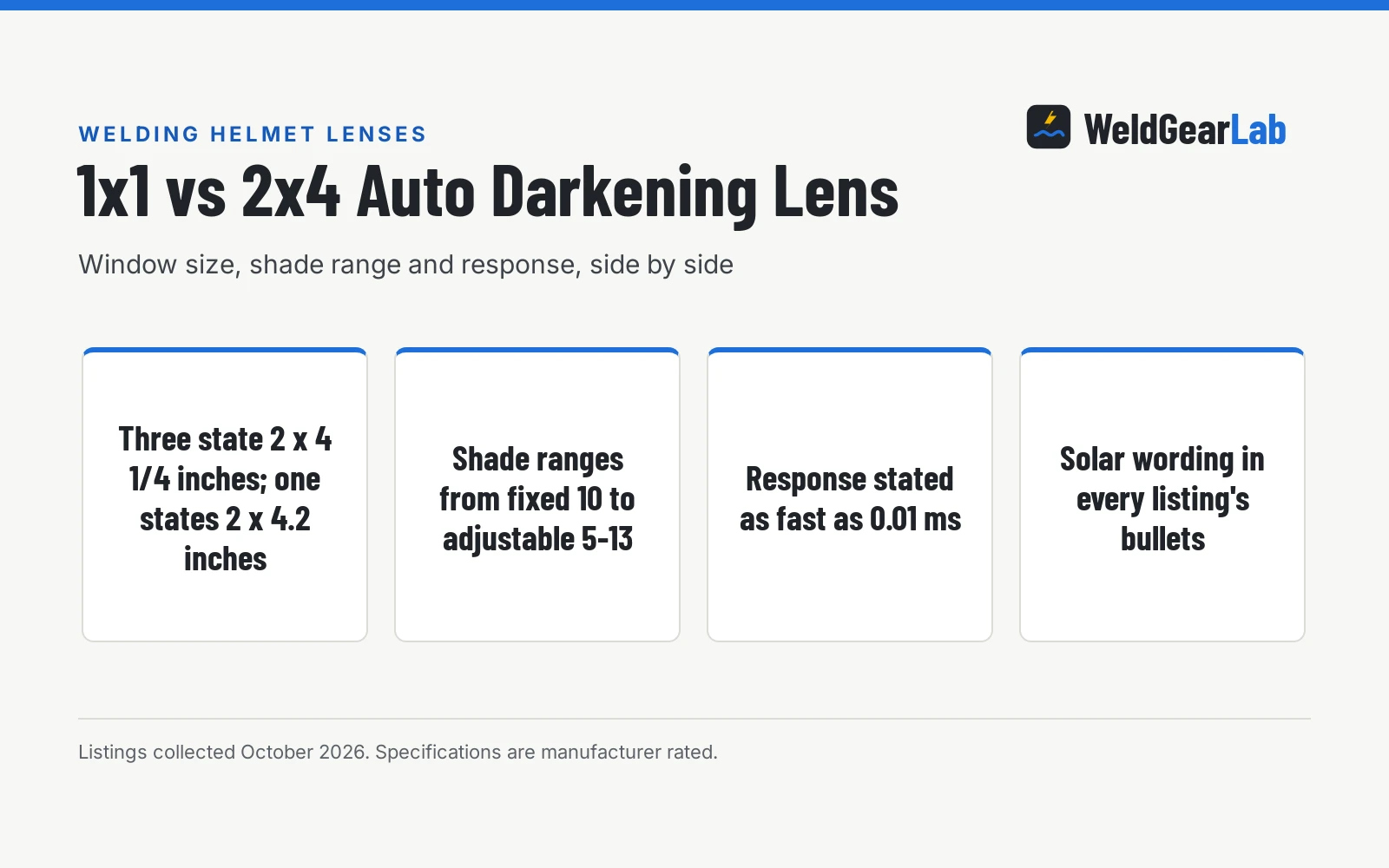
Setting up for a bead with a hood whose window does not match the work means either squinting through a narrow view or fighting a lens that does not sit right, and the 1×1 vs 2×4 auto darkening lens question starts with that fit. The direct answer is this: window size is a stated figure on the listing, and three of the four lenses featured in this guide state 2 x 4 1/4 inches and the fourth states 2 x 4.2 inches, so the real comparison here is shade range, response, sensors and power, checked against the hood before buying.
Other welders and gear to compare
 2×4.25 Auto Darkening Welding LensCheck price on Amazon
 Auto Darkening Welding Lens 2x4 1/4Check price on Amazon
 Auto Darkening Welding LensCheck price on Amazon
 Auto Darkening Welding Lens 2"x4-1/4"x0.33"Check price on Amazon
 SHINE 2x4 1/4 Auto Darkening Welding LensCheck price on Amazon
This guide links to our product roundups, where WeldGearLab gets a commission on purchases made through links on this page, and your price stays the same. Read our affiliate disclosure.
The 1×1 vs 2×4 auto darkening lens difference in one paragraph
The two sizes in the keyword name two window sizes, and the listing for the lens being bought should state which size it is. Check the stated size against the hood window before buying: the size on the listing must match the window the hood takes. Shade range, response speed, sensor count and power source then decide how the lens behaves once it is fitted, and those figures differ across the four lenses featured below.
Side by side
| Lens | Size stated | Shade stated | Response stated | Power stated |
|---|---|---|---|---|
| Preruner Flex Gold | 2 x 4 1/4 inches | 5-13 adjustable | 0.01 ms | Solar assist, replaceable battery |
| Ridge Prince 1.0 | 2 x 4 1/4 inches | 5-13 adjustable | Not stated | Solar, CR1025 batteries |
| Phosyder 2-Pack | 2 x 4.2 inches | 3/11 | Less than 1/10000 s | Solar powered batteries |
| Ridge Gold Shade 10 | 2 x 4 1/4 inches | 10 fixed | Not stated | Solar, CR1025 batteries |
Figures are as stated in each listing. Where a listing states no figure, the table says so rather than borrowing a figure from another lens.
The gear in this guide
Ranked by how much the listing states, from the fullest detail to the least, the gear runs as follows.
Preruner Flex Gold
The Preruner listing states the fullest detail in this guide: a 2 x 4 1/4 inch lens with shade 5-13 adjustable control, sensitivity and delay control, dual arc sensors and a fast 0.01 ms auto-darkening response. The listing describes a gold coating with a cool blue puddle view and solar assist plus a replaceable battery. That combination of adjustable shade, stated response and dual sensors is why it leads this ranking.
Ridge Prince 1.0
The Ridge Prince 1.0 listing states a 2 x 4 1/4 inch lens with shade 5-13 adjustable in the title, a mirror front with a light blue weld puddle view, and solar panels that recharge from the weld arc with CR1025 batteries. One contradiction to note: the bullets describe single shade lenses in shade 9 – 13 for the Royal Series 1.0 line, while the title states an adjustable 5-13 lens, so the title figure is used here. The listing warns against TIG welding below 90A with this lens and offers a free replacement for up to a year. One contradiction to note: the spec table lists the power source as hand_powered while the bullets describe solar panels recharged by the weld arc.
Phosyder 2-Pack
The Phosyder listing states a 2-pack of true-color lenses at 2 x 4.2 inches, with light state 3 and dark state 11 and a response time of less than 1/10000 s. The listing states 2 advanced sensors, solar powered batteries with full automatic on and off, and fit for most 2 x 4 1/4 inch welding helmets. Shade 11 is the only dark shade stated, so this lens suits work where that shade fits and leaves adjustable shade work to the listings above.
Ridge Gold Shade 10
The Ridge Gold listing states a fixed shade 10 lens at 2 x 4 1/4 inches with a cool blue view, described for a sugar scoop welding hood or a pancake welding hood. The listing repeats the same clarity, build and solar wording as the Prince listing, including the warning against TIG welding below 90A and a free replacement for up to a year. As with the Prince listing, the spec table lists the power source as hand_powered while the bullets describe solar panels recharged by the weld arc. A fixed shade keeps the choice simple, but it cannot cover the shade 5-13 range the adjustable listings state.
How to choose 1×1 vs 2×4 auto darkening lens
Match the stated size to the hood
Size is the first check, because a lens that does not fit the hood window cannot be used at all. Three lenses featured here state 2 x 4 1/4 inches; the Phosyder states 2 x 4.2 inches and is described as fitting most 2 x 4 1/4 inch helmets. Check the stated size on the listing for the lens being bought and compare it with the hood window it must fit, rather than assuming any auto darkening lens fits any hood. See the wide view vs standard welding lens comparison for more on window choice.
Compare shade range, not just shade
Shade range decides how many jobs one lens covers. The Preruner and the Ridge Prince listings state shade 5-13 adjustable, the Phosyder states light state 3 and dark state 11, and the Ridge Gold states a fixed shade 10. An adjustable range suits a shop that moves between processes and light conditions, while a fixed shade suits a single repeated job at that shade. The variable shade vs fixed shade welding lens guide covers that trade in more detail.
Check response and sensors
Response and sensor figures are stated for two of the four listings and missing for the other two, which is itself useful information. The Preruner states a 0.01 ms response with dual arc sensors, and the Phosyder states less than 1/10000 s with 2 advanced sensors, while the Ridge listings state no response figure. A stated response figure lets the buyer compare directly; a missing figure means the listing cannot be ranked on response. Do not borrow a response figure from one listing for another lens.
Check power and TIG notes
Solar wording appears in the bullets of all four listings, but the Ridge spec tables list the power source as hand_powered, so check both fields on those listings. The Preruner states solar assist with a replaceable battery, the Phosyder states solar powered batteries with automatic on and off, and the Ridge bullets describe solar panels recharged by the weld arc with CR1025 batteries. The Ridge listings also warn against TIG welding below 90A, a process note that matters for low amperage TIG work. Check the power wording and any process warning on the listing before buying, and see our auto darkening welding lens 2×4 picks for more lenses in this size.
FAQ for welders
What size are the lenses in this guide?
Three featured lenses state 2 x 4 1/4 inches; the Phosyder states 2 x 4.2 inches and is described as fitting most 2 x 4 1/4 inch helmets. Check the stated size on any lens being bought against the hood window it must fit.
Which lens here has adjustable shade?
The Preruner Flex Gold and the Ridge Prince 1.0 listings state shade 5-13 adjustable. The Phosyder states light state 3 and dark state 11, and the Ridge Gold states a fixed shade 10.
What response speeds are stated?
The Preruner states a 0.01 ms response with dual arc sensors, and the Phosyder states less than 1/10000 s with 2 advanced sensors. The Ridge listings state no response figure in the listing data.
Are these lenses solar powered?
Solar wording appears in the bullets of all four listings, but the Ridge spec tables list the power source as hand_powered. The Preruner states solar assist plus a replaceable battery, the Phosyder states solar powered batteries with automatic on and off, and the Ridge bullets describe solar panels recharged by the weld arc with CR1025 batteries.
Can the Ridge lenses be used for low amperage TIG?
The Ridge listings warn against TIG welding below 90A with those lenses and point low amperage TIG buyers to a different lens in the same line. Check the process warning on the listing for the lens being bought before relying on it for low amperage TIG work.
Related: variable shade vs fixed shade welding lens, best auto darkening welding lens 2×4, best variable shade welding lens, and the welding helmets hub.