Tig Torch Sizes Explained: Numbers, Cooling, and Amps
How TIG torch numbers like 9, 17, 20, and 26 indicate physical size, amperage capacity, air or water cooling, and consumable fit for your welder.
 By WeldGearLab Editorial
Updated October 9, 2026
By WeldGearLab Editorial
Updated October 9, 2026
Tig torch sizes explained clearly: torch size numbers like 9, 17, 20, and 26 tell you the physical size of the torch head, whether it uses air cooling or water cooling, and which consumables fit the front end. A lower number does not always indicate a lighter-duty torch, because water-cooled designs pack higher heat capacity into compact bodies. Choosing the correct size keeps your hand comfortable, matches your welder output, and prevents melted torch heads during long welding runs. This guide walks through what every number means, how air and water models compare, and how to verify connector compatibility before you buy.
As an Amazon Associate I earn from qualifying purchases. This guide links to our product roundups, where WeldGearLab earns a commission when you buy through links, at no extra cost to you. Read our affiliate disclosure.
TIG torch sizes explained in one paragraph
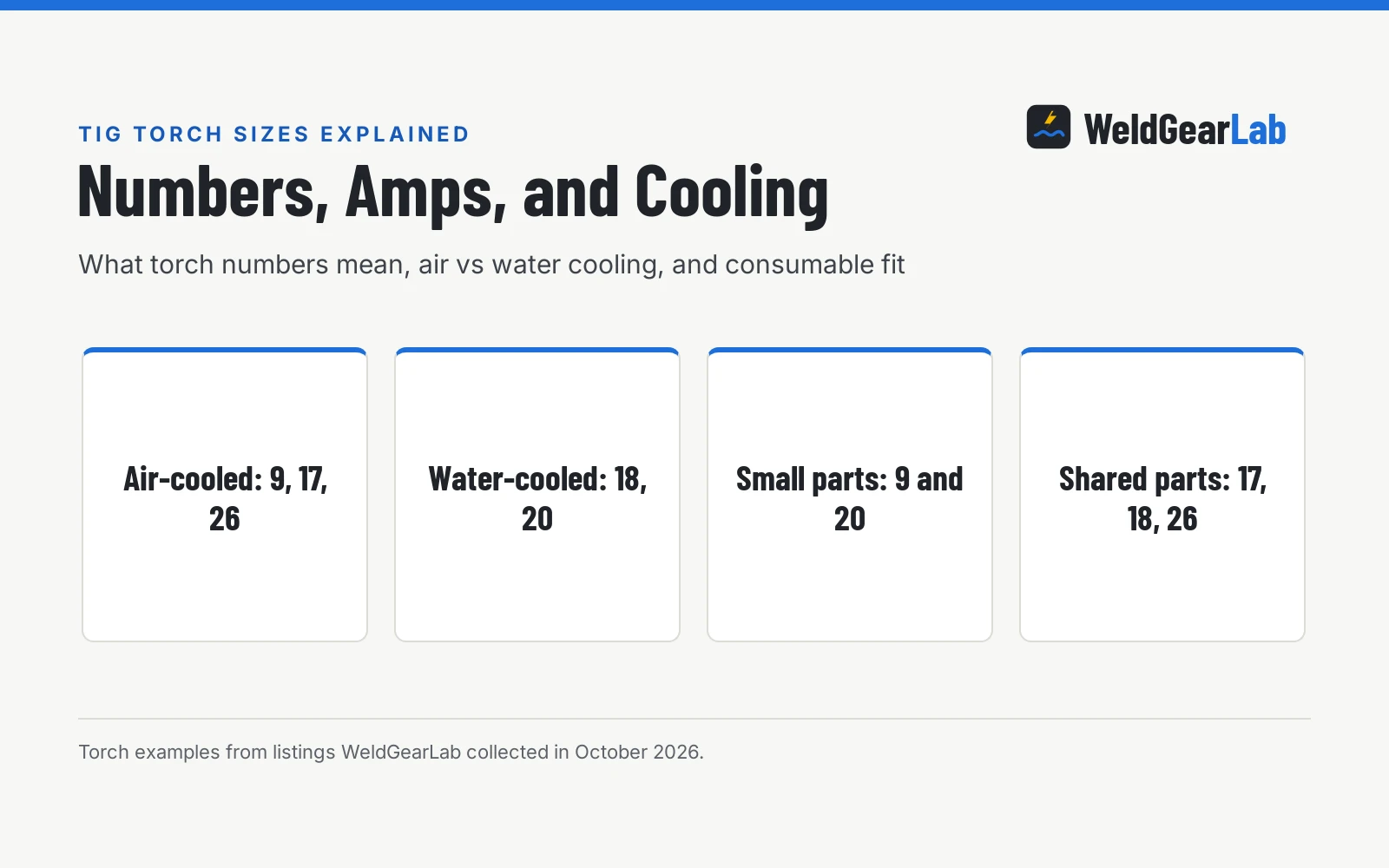
Standard TIG torches follow an industry numbering system where each number identifies a specific body style, cooling method, and consumable group. Air-cooled models include the compact 9 series, the midsize 17 series, and the larger 26 series. Retail listings commonly rate 17 series torches around 150A and 26 series torches around 200A for DC welding. Water-cooled models include the compact 20 series and the heavy-duty 18 series, which circulate coolant from an external cooler to handle continuous welding without overheating. Torches in the 17, 18, and 26 series share the exact same collets, collet bodies, and ceramic cups, while the 9 and 20 series share a smaller consumable format. Letters attached to the model number indicate extra hardware: V means a manual gas valve on the handle, F or FX indicates a flexible neck, and R denotes a swivel head.
Side by side
| Torch series | Cooling type | Stated amperage | Consumable family | Common applications |
|---|---|---|---|---|
| 9 series (PTA-9, NR-9) | Air-cooled | Not stated | 2 series parts | Thin sheet, roll cages, tight automotive spaces |
| 17 series (WP-17, WP-17V, WP-17FV) | Air-cooled | 150A | 17, 18, 26 family | General fabrication, home shop, light repair |
| 26 series (WP-26, WP-26FV) | Air-cooled | 200A | 17, 18, 26 family | Thick steel plate, heavy shop welds without water |
| 20 series (CK20-25SF) | Water-cooled | Not stated | 2 series parts | High-amperage production, aluminum, detailed work |
| 18 series (WP-18) | Water-cooled | Not stated | 17, 18, 26 family | Heavy structural steel, automated or prolonged welding |
Amperage ratings listed above reflect stated manufacturer figures from retail listings; when a brand does not publish an exact rating, the table marks it as not stated. Duty cycle and thermal limits depend directly on whether you use air cooling or a dedicated water cooler. Check your machine manual and torch packaging to confirm exact continuous limits before running high heat.
When an air-cooled torch is the better choice
- Simpler setup without plumbing. An air-cooled torch connects straight to the welder terminal and argon cylinder without requiring a water cooler, radiator, pump, or coolant lines.
- Lower overall equipment cost. You avoid buying or maintaining an auxiliary water circulator, antifreeze mixture, or extra fluid hoses around your welding table.
- Job site portability. Carrying a welder out to a trailer, fence line, or farm gate is much simpler when you only haul a power source and gas cylinder.
- Sufficient power for general fabrication and repair. Air-cooled models handle typical hobby joints and repair tasks on plate and brackets without the complexity of a water cooler. Retail listings commonly state ratings like 150A for a 17 series or 200A for a 26 series.
Our best TIG torch roundup compares air-cooled and water-cooled picks scored for shop and garage fabrication.
When a water-cooled torch is the better choice
- Comfortable compact handle at high current. A water-cooled 20 series torch body stays small in the hand, weighing only 3 oz (85gm) on CK Worldwide models, while carrying heavy continuous current without heating up.
- Extended arc time and thick aluminum. Welding aluminum requires high heat that quickly overheats air-cooled torches; water cooling draws heat away continuously through dedicated water channels.
- Reduced wrist fatigue during intricate welds. Small torch necks maneuver smoothly around roll cages, motorcycle manifolds, and tight tubular joints where a bulky 26 series torch cannot reach.
- Longer consumable life. Cooler operating temperatures keep collets, collet bodies, and gas lens screens from warping or annealing under sustained arc heat.
If you weld heavy aluminum plate frequently, pair a water-cooled torch with a machine from our best TIG welder for aluminum guide.
How to tell which torch fits your welder
Not every TIG torch plugs directly into every welding power supply. Look for these details in your welder manual and listing specifications:
- Dinse connector size. Torch listings show two common power pin formats: small 10-25 dinse pins (10-25mm²) and larger 35-50 dinse plugs or LC-40 connections. Check your welder faceplate to match the pin diameter your machine accepts.
- Gas connection location. Welders with an internal gas solenoid route shielding gas through a front panel port or through-dinse connector. Machines without an internal solenoid require a separate gas hose connected directly to the regulator with 5/8″-18 RH threads, using a torch with an integrated manual valve (marked V) to control gas flow.
- Arc start method. High-frequency machines start the arc without touching the work, while lift TIG and scratch start power sources start by contacting the metal. Torches equipped with manual valves provide simple gas control for lift TIG machines that lack an automated gas solenoid.
- Cable length for shop mobility. Listings show common cable lengths of 12 ft, 12.5 ft, 13 ft, 15-ft, and 25′, allowing you to choose between lightweight bench setups and wide shop reach.
Checking your machine front panel before ordering prevents the hassle of buying aftermarket dinse adapters or thread reducers. If you plan to buy a dedicated machine, see our best welder for beginners guide for models with standard connections.
Which consumables fit each torch size
TIG torch front-end parts are grouped into interchangeable consumable families. The most widespread family covers 17, 18, and 26 series torches. A collet, collet body, or gas lens that fits a WP-17 also screws straight into a WP-18 or WP-26 body, as shown in the 123-piece consumable set from WelderElite. TimelyDu listings show 57Y02 long, 57Y03 medium, and 57Y04 short back caps fitting all three torch bodies. YESWELDER listings include standard alumina cups like #4 (1/4″ orifice), #5 (5/16″ orifice), and #6 (3/8″ orifice).
Smaller torches like the 9 and 20 series use a more compact consumable family, often cataloged as 2 series hardware. Their collets, collet bodies, and nozzles have smaller outside threads and shorter profiles to preserve maximum joint visibility. Electrodes across all torch bodies typically span diameters from 0.5-2.4MM or 1/16″ (1.6mm), 3/32″ (2.4mm), and 1/8″ (3.2mm). Always match your collet and collet body inner diameter to the exact tungsten diameter you clamp inside.
Can you swap torch sizes on the same welder?
Yes, you can swap different torch sizes onto the same welding machine whenever a project demands it. Many welders keep a compact 9 series torch for automotive sheet metal and bench work, then swap to a 17 or 26 series torch when welding heavier structural brackets. As long as your power pin matches the dinse socket, such as a 10-25 or 35-50 connection, the machine will supply current to any torch size you mount.
Keep duty limits in mind when pairing small torches with powerful machines. Running high amperage through a compact 9 series torch will quickly melt the rubber handle and burn the power cable. Conversely, running a large 26 series torch on a small hobby welder adds unnecessary bulk to your wrist without providing extra welding output. For a broader comparison of welding equipment and power supplies, explore our welders overview and our guide on AC vs DC TIG welding.
TIG torch safety and electrical supply. TIG welding produces intense ultraviolet radiation and electrical arc hazards. Inspect torch cables regularly for cracked insulation or exposed copper wiring, especially around flexible necks. Never touch the tungsten electrode while depressing a foot pedal or torch trigger. Ensure argon cylinders are chained upright against a sturdy wall or dedicated cart, and keep gas fittings secured at 5/8″-18 connections. Weld in well-ventilated spaces, wear proper shaded eye protection, and browse our welding safety gear resources before striking an arc.
Frequently Asked Questions
What is the most common TIG torch size for beginners?
The 17 series air-cooled torch is the most common model supplied with entry-level and intermediate TIG welders. With listings commonly rating it at 150A, it provides adequate heat capacity for general steel projects while keeping the handle manageable. Its wide compatibility with standard 17, 18, and 26 consumable kits also makes replacement parts easy to locate.
What is the difference between a 17 and a 26 TIG torch?
Both are air-cooled torches that share the exact same collets, collet bodies, and ceramic cups. The primary difference is physical size and conductor capacity: listings typically rate 17 series models at 150A and 26 series models at 200A. The heavier copper cable in a 26 series handles sustained current on thicker plate, but the added bulk and weight can increase hand fatigue during long runs.
Can a 9 series torch use the same cups as a 17 series?
No, a 9 series torch cannot use standard 17 series cups, collets, or collet bodies directly. The 9 series uses a smaller front-end format shared with 20 series torches. Instead of trying to adapt bulky cups onto a compact 9 torch, welders who want a compact cup profile on a 17 series torch typically install stubby gas lens setups.
What do the letters V and F mean on a TIG torch?
The letter V indicates an integrated manual gas valve built into the torch body, which is required for lift TIG machines that lack an internal argon solenoid valve. The letter F or FX signifies a flexible head neck that allows you to bend the torch angle for awkward welding positions. A torch marked WP-17FV includes both a flexible head and a manual gas control valve.
Do I need water cooling for hobby TIG welding?
Most hobby and garage welders work comfortably with air-cooled 17 or 26 series torches on steel and stainless steel. Water cooling becomes necessary primarily if you weld thick aluminum or run continuous production passes where air-cooled torches get too hot to hold. If your projects stay within typical sheet and tubing gauges, an air-cooled setup avoids the added cost and plumbing of a radiator cooler.
Related: best TIG torch, best welder for beginners, best TIG welder for aluminum, and our TIG welders hub. Also see our welders guide.
About the author
WeldGearLab Editorial is the editorial team behind WeldGearLab. We research product listings, specifications, safety listings and warranty terms, score every pick with the published Gear Score method, and correct errors when readers report them. We do not run our own shop trials; see How We Pick for exactly how picks are made.