How to Choose Flux Core Wire
How to choose flux core wire by matching wire diameter, spool weight, AWS classification, and drive roll setup to your machine and metal thickness.
 By WeldGearLab Editorial
Updated October 9, 2026
By WeldGearLab Editorial
Updated October 9, 2026
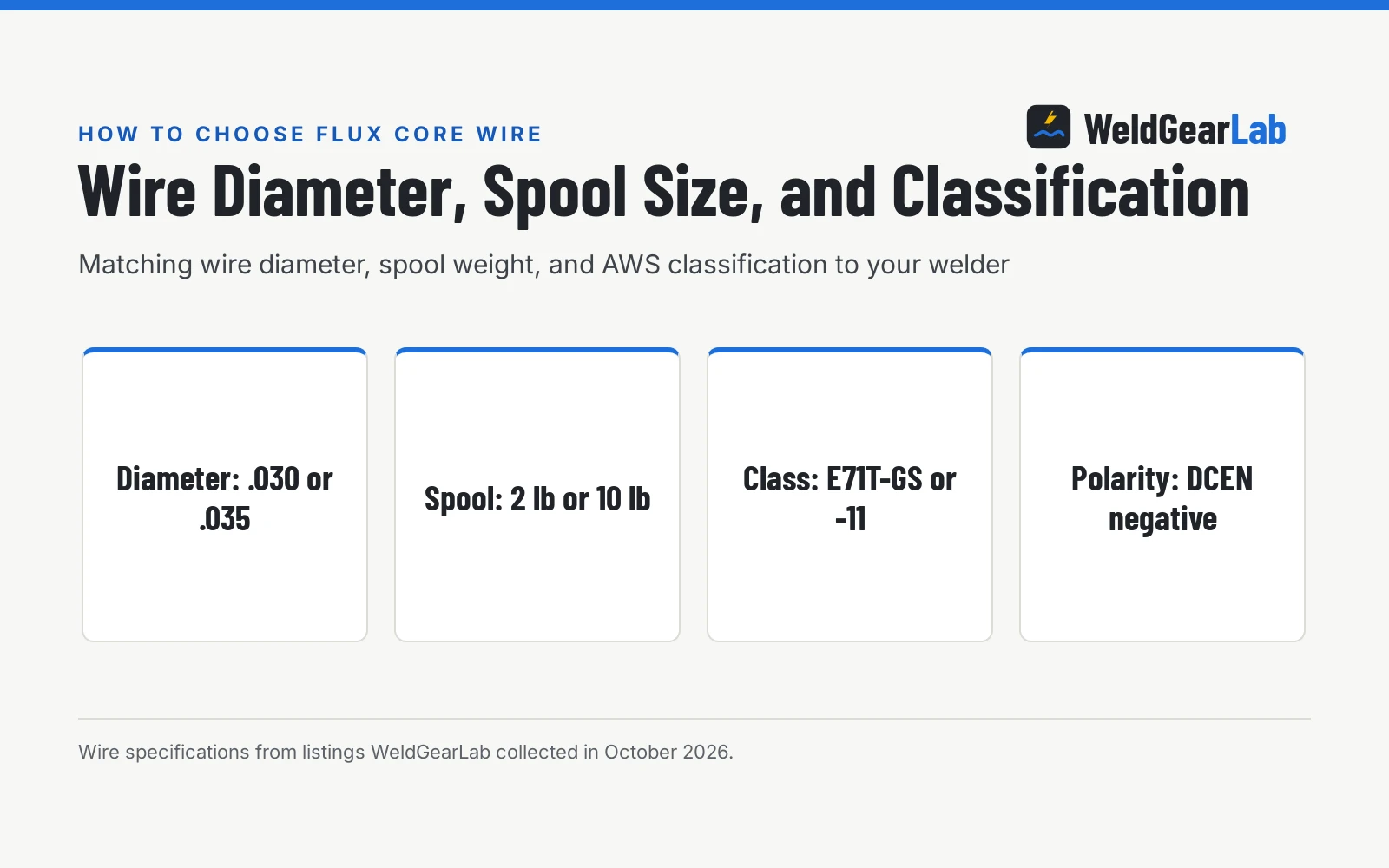
Learning how to choose flux core wire begins with matching wire diameter to base metal thickness, selecting a spool weight that fits your machine, and choosing the proper AWS classification. For home and farm repairs, deciding between .030 inch and .035 inch gasless wire determines penetration depth, arc behavior, and puddle control. This guide explains each factor step by step to help you select the right spool without wasting money on wire that jams or burns through thin metal.
As an Amazon Associate I earn from qualifying purchases. This guide links to our product roundups, where WeldGearLab earns a commission when you buy through links, at no extra cost to you. Read our affiliate disclosure.
How to choose flux core wire step by step
Self-shielded flux core wire carries flux inside a hollow steel sheath, eliminating gas cylinders, regulators, and hoses. When the arc strikes, core materials vaporize into a protective gas cloud while depositing slag over the puddle. Choosing wire comes down to several factors:
- Base metal thickness: Thin sheet metal uses .030 inch wire to prevent burn through, while thicker steel needs .035 inch wire for deeper fusion.
- Spool compartment: Portable welders take compact 16 ounces or 2 lb spools; shop welders take 10 lb spools.
- Pass requirements: Single-pass repairs match AWS E71T-GS wire; multi-pass joints call for AWS E71T-11 wire.
- Drive rolls and polarity: Gasless wire performs best with knurled drive rolls and DCEN (electrode negative) polarity.
Our welding consumables hub covers filler metals across processes, while our guide to flux core vs MIG welding compares gasless and solid wire setups.
Side by side
| E71T-GS (.030″) | E71T-GS (.035″) | E71T-11 (.030″) | |
|---|---|---|---|
| Pass capability | Single-pass (general use) | Single-pass (general use) | Single-pass and multi-pass |
| Primary metal thickness | Thinner sheet metal and light tubing | Thicker steel plate and structural repairs | Joints and layered repairs |
| Heat input to base metal | Lower heat input, less burn through | Higher heat input, deeper penetration | Moderate heat input, controlled buildup |
| Deposition rate | Moderate filler deposit per pass | Higher filler metal deposition rate | Moderate filler deposit per pass |
| Standard contact tip size | 0.8 mm contact tip (.030 inch) | 0.9 mm contact tip (.035 inch) | 0.8 mm contact tip (.030 inch) |
| Drive roll groove size | 0.8 mm knurled drive roll | 0.9 mm knurled drive roll | 0.8 mm knurled drive roll |
| Common spool capacities | 2 lb and 10 lb spools | 2 lb and 10 lb spools | 2 lb spool |
| Typical joint types | T-joints, butt welds, and lap welds | T-joints, butt welds, and lap welds | T-joints, butt welds, and lap welds |
| Required welding polarity | DCEN (electrode negative) | DCEN (electrode negative) | DCEN (electrode negative) |
Wire diameter and classification dictate operating range and joint capability. Setting your welder to DCEN (electrode negative) polarity is standard for gasless wire to ensure arc stability and low spatter. Always verify polarity on your spool label and door chart before welding.
Choosing wire diameter: .030 vs .035 inch
Wire diameter controls current draw and puddle penetration. Flux core wire is tubular, penetrating deeper at comparable amperage settings than solid wire.
When to choose .030 inch wire: Wire measuring .030 inch (0.8 mm) draws lower current to maintain a stable arc, producing a smaller puddle with less heat input. This suits thin sheet steel and auto body panels where excess heat causes burn through. For example, PGN Bearings supplies .030 inch wire on a 2 lb spool, Rumvita lists .030 inch (0.8 mm) wire in a 2 lb spool sold in a 5-pack, and BIG RED provides .030 inch wire on a 10 lb spool. On household outlets, .030 inch wire runs without pushing duty cycle limits.
When to choose .035 inch wire: Stepping up to .035 inch (0.9 mm) increases deposition rates, laying down more filler metal per pass for deeper penetration into plate and farm equipment. For instance, YESWELDER lists .035 inch (0.9 mm) wire on a 10 lb spool, ARCCAPTAIN offers 0.035 inch wire on a 10 lb spool, YixangDD lists 0.035 inch wire on a 2 lb spool in a 4-pack, and Lincoln Electric packages its NR-211-MP wire in .035 inch diameter. This size reduces passes on heavy joints.
Listing variations: Listings format figures differently. VEVOR lists wire as 0.03-inch in a 2 lb spool, which is standard .030 inch wire, while RUBIK lists 0.039 inch wire on a 2-pound spool in a 2-pack. See our guide to the best MIG wire for mild steel.
Selecting spool size: small spools vs 10 lb spools
Spools come in compact sizes for portable machines and 10 lb spools for shop welders. Choice depends on cabinet size and welding frequency.
Compact 16 ounces and 2 lb spools: Portable welders use compact internal bays to keep machine weight light for mobile repairs. For example, Lincoln Electric offers its NR-211-MP mild steel spool in a 16 ounces size, PGN Bearings lists a 2 lb spool of E71T-11 wire with an item weight of 2.23 pounds, and VEVOR supplies 2 lb rolls in a 3-pack weighing 6.66 pounds. YixangDD packages 2 lb spools in a 4-pack with an 8.69 pounds package weight. Smaller spools suit occasional welders because opened wire exposed to humidity can oxidize.
Larger 10 lb spools: Shop welders feature larger bays and spindles supporting 10 lb spools, lowering wire cost per pound and reducing spool swaps. For instance, YESWELDER provides a 10 lb spool of .035 inch wire on an ABS plastic spool, ARCCAPTAIN lists a 10 lb spool with an item weight of 4921 g, and BIG RED supplies a 10 lb spool of .030 inch wire. For regular shop fabrication, 10 lb spools offer better economy. See our guide to the best flux core welder to find machines that take 10 lb spools.
Understanding AWS classification: E71T-GS vs E71T-11
AWS classifications on spool labels define formulation, positional ratings, and pass limitations:
- E: Designates an arc welding electrode.
- 7: Indicates tensile strength class. Listings publish specific ratings; ARCCAPTAIN lists tensile strength of 80496 psi, while VEVOR lists minimum tensile strength of ≥490 MPa.
- 1: Indicates all-position welding. YESWELDER, ARCCAPTAIN, and VEVOR list all-position performance on flat, vertical, and overhead joints.
- T: Signifies tubular flux-cored construction.
- GS: Stands for general single-pass use with deoxidizers that tolerate light rust. While listings from YixangDD, RUBIK, and Rumvita claim single and multi-pass welding, AWS standards designate GS for single-pass welds because multi-pass layers can embrittle. YESWELDER, ARCCAPTAIN, and BIG RED also list E71T-GS wire.
- 11: Designates multi-pass capability. AWS E71T-11 allows layered passes on heavy steel. PGN Bearings lists E71T-11 wire rated for single-pass and multi-pass welding on T-joints, butt joints, and lap joints.
- Proprietary designations: Lincoln Electric uses NR-211-MP Innershield as its model identifier.
Select E71T-11 for structural joints needing layered passes. Choose E71T-GS for single-pass home repairs on light steel.
Drive rolls, contact tips, and polarity setup
Feeding flux core requires distinct feeder adjustments compared to solid wire:
- Knurled drive rolls: Solid wire uses smooth V-grooves. Hollow flux wire performs best with knurled rolls that grip with light tension without crushing the casing. Use an 0.8 mm knurled groove for .030 inch wire, or an 0.9 mm groove for .035 inch wire.
- Contact tip sizing: Match tips to wire diameter. Rumvita lists .030 inch (0.8 mm) wire for an 0.8 mm tip; YESWELDER lists .035 inch (0.9 mm) wire for an 0.9 mm tip.
- Polarity setup: Gas MIG runs DCEP. Self-shielded flux core runs DCEN (straight polarity), with gun negative and work clamp positive. Running DCEP causes violent spatter and poor penetration. Listings such as RUBIK specify negative polarity. See our guide on why a MIG welder spatters for troubleshooting.
Spool packaging, storage, and safety
Flux core wire contains minerals that absorb atmospheric moisture, introducing hydrogen that causes porosity and cracking.
Packaging standards: ARCCAPTAIN, YixangDD, Rumvita, and BIG RED package spools in vacuum-sealed bags to block humidity. RUBIK packages spools in a sealed mylar bag with anti-corrosion paper. When buying multi-packs like the VEVOR 3-pack, YixangDD 4-pack, or Rumvita 5-pack, keep spare spools sealed until needed.
Workshop storage: Store opened spools in dry containers with desiccant packs when idle. If outer wraps develop surface rust, discard the oxidized length before feeding wire through the gun liner.
Safety precautions: Gasless flux core generates heavy smoke and hot slag. Weld in ventilated areas with your head out of the plume. Wear safety glasses beneath your helmet when chipping slag, and clear dry grass and flammables from work areas. For gear recommendations, see our guide to the best welding helmet for flux core, and review the flux core welding vs stick welding comparison for outdoor work.
Frequently Asked Questions
Can I run .030 and .035 flux core wire with the same contact tip?
No, contact tips must match wire size. An 0.8 mm tip sized for .030 inch wire will jam when fed with .035 inch wire. Feeding .030 inch wire through an 0.9 mm tip creates erratic electrical contact and arc stutter.
What is the difference between E71T-GS and E71T-11 flux core wire?
AWS E71T-GS is formulated for single-pass welds on sheet metal and light repairs. AWS E71T-11 has balanced chemistry for single-pass and multi-pass welds on heavier joints. Multiple passes with E71T-GS can embrittle the deposit.
Why does flux core wire require DCEN polarity?
Self-shielded wire relies on straight polarity (DCEN) for stable arc transfer and flux vaporization. Running on electrode positive (DCEP) destabilizes the arc, producing violent spatter and a porous bead.
How long does an opened spool of flux core wire remain usable?
An opened spool lasts weeks or months in a dry shop. Exposed to damp air, moisture enters the core, causing porosity and spatter. Store spools in airtight containers with desiccant.
Can flux core wire weld stainless steel or aluminum?
Mild steel wires like E71T-GS and E71T-11 are for carbon steel only. They cannot weld aluminum, which needs gas MIG with argon or AC TIG. While listings like YixangDD mention stainless surfaces, carbon steel wire rusts and contaminates stainless joints.
Related: best MIG wire for mild steel, best flux core welder, best welding helmet for flux core, flux core vs MIG welding, flux core welding vs stick welding, and the welding consumables hub.
About the author
WeldGearLab Editorial is the editorial team behind WeldGearLab. We research product listings, specifications, safety listings and warranty terms, score every pick with the published Gear Score method, and correct errors when readers report them. We do not run our own shop trials; see How We Pick for exactly how picks are made.